















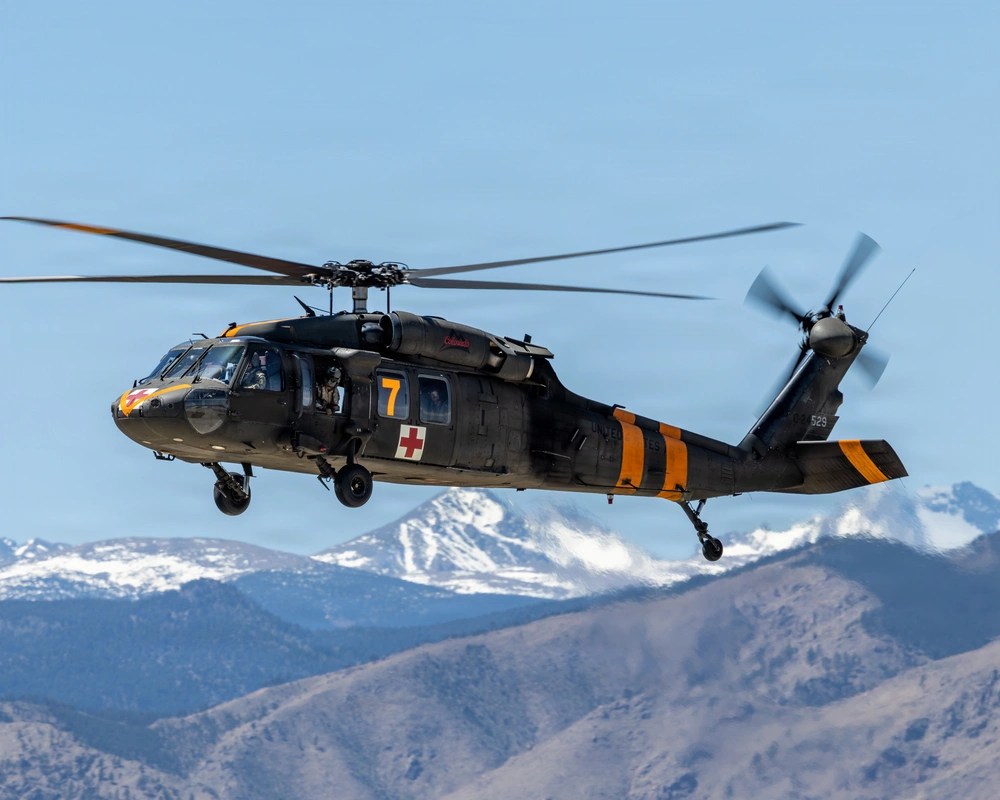

A Colorado National Guard Black Hawk helicopter experienced a rotor blade strike Saturday night while attempting to rescue an injured hiker in the mountains west of Nederland, Colorado.
The Boulder County Sheriff’s Office said the helicopter made a precautionary landing during the operation near Diamond Lake. According to the Colorado National Guard, the strike occurred around 10:15 p.m. while the crew was attempting to hoist the hiker. The crew landed safely, and no injuries were reported.
Nighttime Rescue Interrupted
Rescue operations began at around 4:18 p.m. on Saturday in response to an injured 38-year-old man who fell while hiking alone. The sheriff’s office said steep terrain complicated ground access, prompting rescuers to request helicopter assistance.
The Black Hawk experienced the blade strike near the scene, although officials have not disclosed what the rotor struck. Authorities closed the Fourth of July Trailhead and surrounding area while personnel worked to recover the Black Hawk. The Colorado National Guard said the helicopter would remain at its landing site until the investigation was complete.
“I am incredibly grateful that everyone returned home from this mission,” Colorado Adjutant General Maj. Gen. Robert Davis said in a statement provided to CBS Colorado.
Davis also credited the crew’s emergency training and emphasized the importance of aviation safety.
Second Helicopter Completes Rescue
Following the Black Hawk’s landing, the Colorado National Guard dispatched a UH-72B Lakota helicopter from Buckley Space Force Base near Denver. The second crew reached the injured hiker and successfully hoisted him from the mountainside around 12:21 a.m. Sunday. He was flown to a landing zone at Nederland High School before being transported by ambulance to a Boulder hospital.
The rescue required more than eight hours of coordination among ground teams, aviation crews and emergency responders.


Ouch!
Elsewhere, a Canadian Navy helo’s blades severed tail rotor driveshaft on tail boom, I presume a slam down for some reason including ship heave due rogue wave, occupants fine, major repairs needed to helo.
(Canada does use a ‘bear trap’ hauldown device, a probe extends from bottom of helo to engage a socket on deck, under guidance of a deck person.
USN uses the system on some ships.)
The Lakota has much smaller main rotor diameter than Blackhawk.