
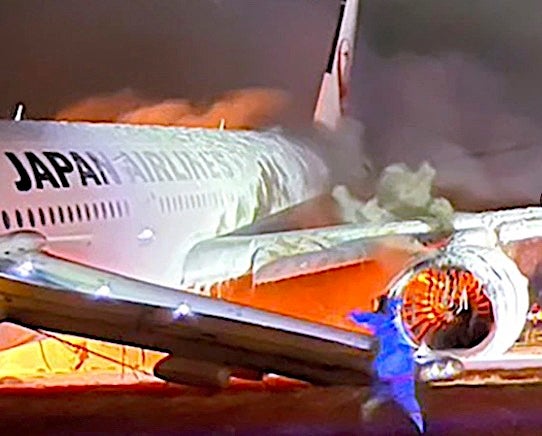

The Financial Times reports from London that the composite structure of the Airbus A350 likely played a role in the survival of all 379 on board Japan Airlines Flight 516. The incident marks the first hull loss involving the 53% composite airframe A350-900 and preliminary evidence suggests the material performed to expectations, providing fire protection similar to that of aluminum.
Certification standards require that airliner manufacturers demonstrate their designs are capable of evacuating all passengers within 90 seconds using half the available exits. Bjorn Fehrm, an aeronautical engineer, told the Financial Times, “The most important part, whether the plane is aluminum or carbon fiber, is that you have protection for many, many minutes from external heat. In this case, the carbon fiber is giving that heat-shield protection.”
Even though carbon fiber will burn at lower temperatures than the 600 degrees Celsius of aluminum, Emile Greenhalgh, a professor of composite materials at London’s Imperial College, said the composite material reacts differently to fire. “As the material burns,” he said, “all the flammable material forms a char layer, so you end up with a barrier against the progression of fire.”
While Airbus and Boeing, with its largely-composite 787 Dreamliner, have tested their aircraft to satisfy certification requirements, the JAL accident provides real-world evidence of the performance of carbon fiber in a catastrophic fire.