















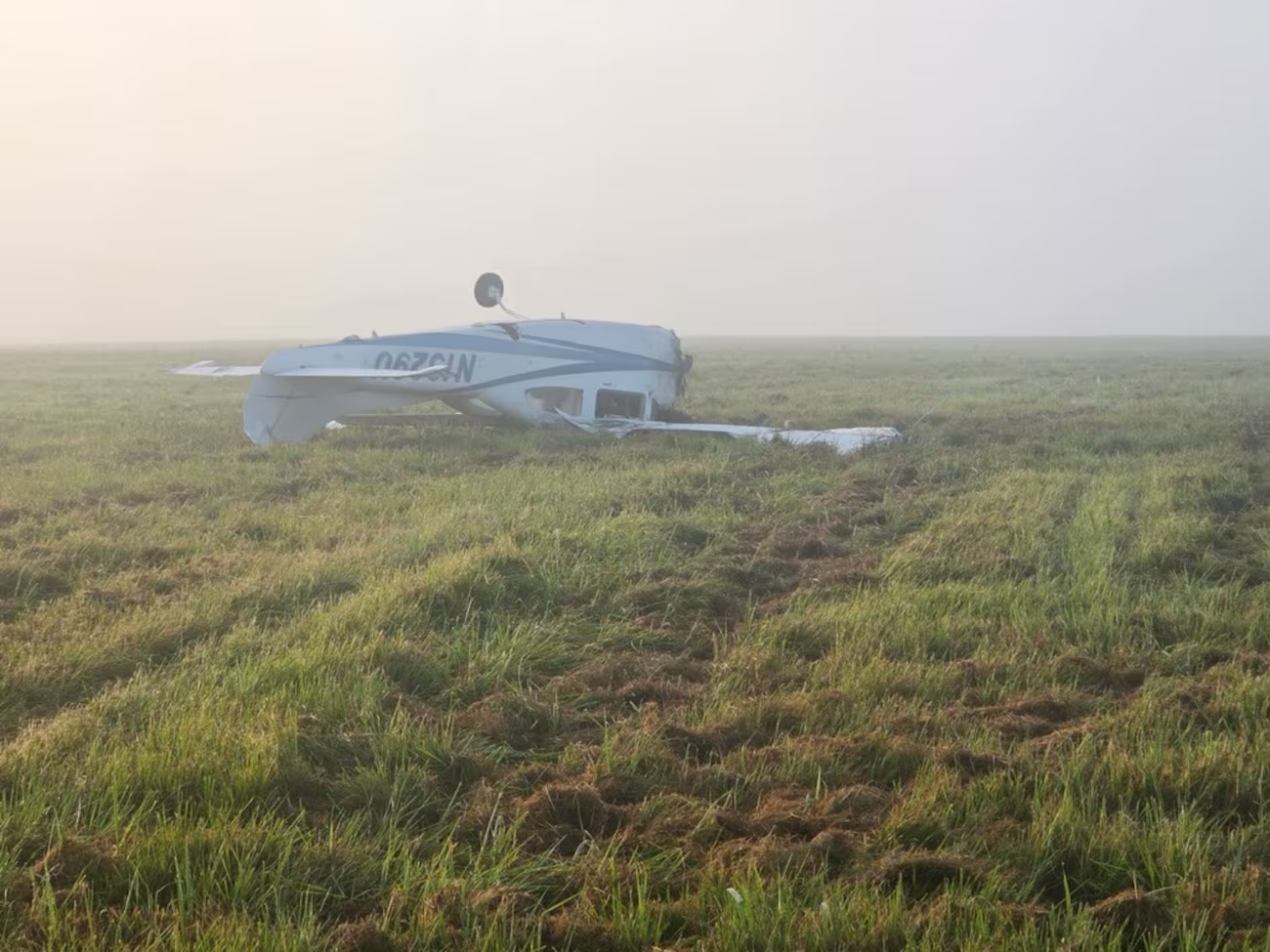

A Cessna 210 went down shortly after takeoff from Louisiana Regional Airport in Gonzales, Louisiana, Tuesday morning after its engine separated completely from the aircraft.
According to local WAFB, Ascension Parish Sheriff Bobby Webre confirmed that the engine detached before the airplane went down into a nearby field. The 74-year-old pilot survived with minor injuries.
Engine Found Away From Wreckage
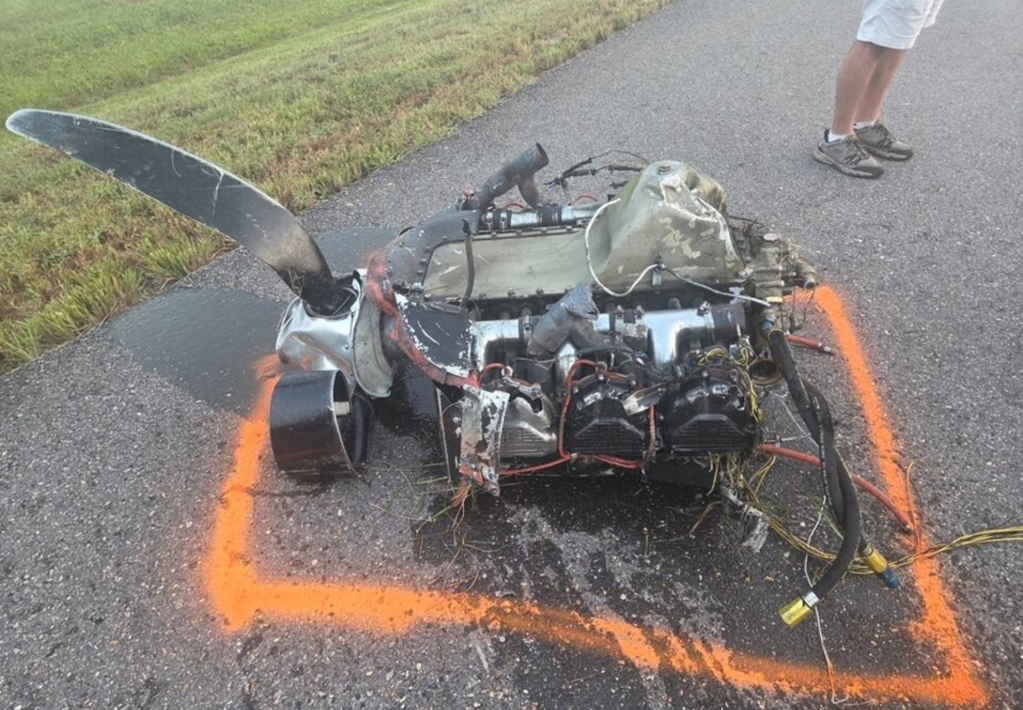
Gonzales Fire Chief Preston Landry told WBRZ that emergency crews discovered the aircraft upside down approximately half a mile from the runway. The engine was located roughly 100 yards from the main wreckage, on a nearby road. Responders arrived around 6 a.m. and found the pilot walking around the crash site.
FlightAware tracking data indicated that the aircraft departed shortly before 5 a.m. and that the recorded flight lasted less than a minute.
Cause Under Investigation
Authorities have not yet established what caused the engine to separate. Likewise, potential problems involving the engine mounting structure or attachment hardware have not been confirmed. The pilot suffered a minor cut to his head, according to the Ascension Parish Sheriff’s Office.


That one blade is curled up like the tips of Salvador Domingo Felipe Jacinto Dalí i Domènech, Marquess of Dalí de Púbol’s mustache. Tighter than the lid on a tin of kippers. So much for “the cables will keep it from completely falling out of the airplane” theory. Any higher AGL and better get ready to kick out the windscreen and tell your copilot to hang over the firewall to maintain a gliding CG…
During my NTSB accident investigator course I learned that a reciprocating prop bends forward when under power and aft when not.
Any good pilot would have gone thru the emergency restart procedure!
I’m impressed this wasn’t fatal. I can’t imagine it’d be possible to maintain control after losing that much weight off the nose— must be waaayyy out the aft CG limit at that point. Possibly the dramatic reduction in weight left enough control authority somehow?
300 feet from the plane means the engine failed and separated later. Perhaps seconds later, but long enough to get close to landing. It may have been dislodged and separated at first contact. The oil sump took quite a hit.
It will be interesting to see the details.
Looks like a three-blade prop with one blade missing. That would explain the engine separating. probably could not shut it down fast enough to prevent engine separation.
Not going to go 300’ after first contact with the ground.
In the late 1950’s dad was diving back toward a cotton field he was spraying when the two bladed prop threw a blade. (R985 radial engine mounted on a Navy N3N biplane.) Out of all his accidents this was the most unique.
(There was no cowling forward of the firewall.) The two mount bolts at the top sheared off…the engine & mount tilted forward, hanging onto the fuselage by the bottom two mounts and a few control rods and cables.
Mounted in the top center of the firewall was the oil tank which ripped apart from the violent action going on. The tank ripped apart and threw oil down the top of the fuselage winding up in dad’s face (he didn’t like wind screens…too many crushed bugs blocking his vision). He flew the plane #1…wiped his goggles… shut stuff down…wiped the goggles…flew under some power-lines…and landed in the cotton field.
Three days later he flew the plane out of the cotton field.
He and one mechanic had changed the engine in 3 days. He was mostly upset about losing 3 days income during a great bug year in Arizona.
A year later a farmer plowed the prop blade up, nearly a mile away.
I’m suggesting the plane went 300’ past the engine dropping off at first contact. Whatever, I’m not having an argument on AvWeb.
With some airplanes propeller would gash wing skin.
Happened to at least one Hercules/C-130, its engines hang down from wing so gash would be on the skin taking flight load - lower skin. (I forget the details, I vaguely recall that in one case the engine with propeller damaged fuselage which may have then broken in the air).
I thought all GA airplanes were designed to contain an engine separation.
This is definitely a story that needs to be followed up with an interview with the pilot. I think every one of us has imagined this scenario and asked ourselves “Is it even possible to push the nose down without the weight of the engine”? I always assumed that losing the engine (off the plane) was a guaranteed death sentence. If it did happen to me, I am going to guess that flaps might(?) help (causes a nose down pitching moment with normal CG, but if the NEW CG is behind the main wing, an increase in lift ANYWHERE on the wing would be a pitch up moment), sufficient speed likely would help (get as much lift as possible from the elevator), and REALLY quick thinking helps (get the nose down while you still have authority). Someone needs to do the wind tunnel math and explain it to us!