















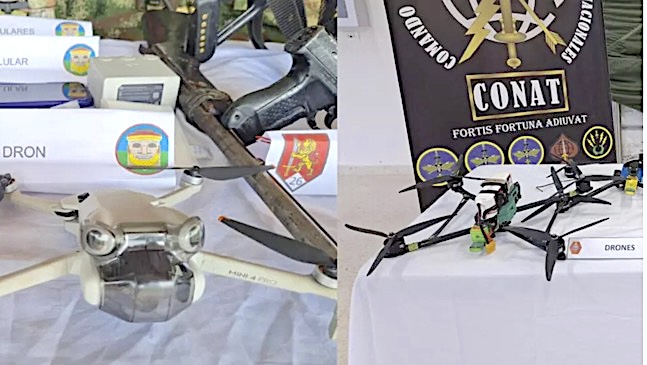

Colombia is turning in-country-manufactured armed drones on drug cartels. In a report by National Public Radio, Colombian air force Colonel Andrés Talavera said the new drones are capable of carrying up to 18 pounds of explosives. “It’s a tactical drone that’s easy for troops to carry but one that also has a lot of firepower,” he said.
It’s a case of fighting fire with fire. According to Colombian Army General Juan Carlos Correa, drug gangs use drones of their own to monitor crops and cocaine laboratories, as well as combatting rival smugglers. They have also used the unmanned aircraft to ambush Colombian soldiers. “Over the past two years, these groups have successfully attacked security forces about 200 times with explosive-laden drones,” according to NPR. “In one single day they launched 17 attacks,” Correa told the news agency.
But government forces are playing catch-up, and the gangs have the advantage when it comes to drone technology and tactics. Laura Bonilla, deputy director of the Colombian think tank Peace and Reconciliation Foundation, maintains that overly restrictive government policy on drones is impeding the military’s ability to counter the threat. “There is too much bureaucracy,” she said, “So, it’s really difficult for the armed forces to reach the same capacity. The criminals don’t need any permits.”


The advances that small drones have made here and in the Ukraine as offensive tactical weapons has me concerned. How long until bad actors, gangs & terrorists, utilize them here in the US?
Terrorists don’t need permits !
And a government that can declare anyone it wants an “enemy combatant” is totally going to use this only for good. Maybe red tape isn’t so bad–you know “transparency” and “accountability”?
Drones have become airborne IED’s. Ukraine has clearly demonstrated the ability of drones to wreak havoc on a much larger and more powerful military neighbor. The US military needs to wake up and see the future. What good is a fleet of stealth fighters or bombers if a few terrorists can roll up to the base fence line and take them out with a few drones? If Ukraine can transport a fleet of drones through a highly restrictive country and destroy aircraft over 2,000 miles away, how easy would it be to do even more damage in this country? Instead of wasting billions of dollars on a new F47 seventh generation fighter, we need to spend a whole lot less on systems and tactics to use drones as weapons as well as devising effective defenses against them.