















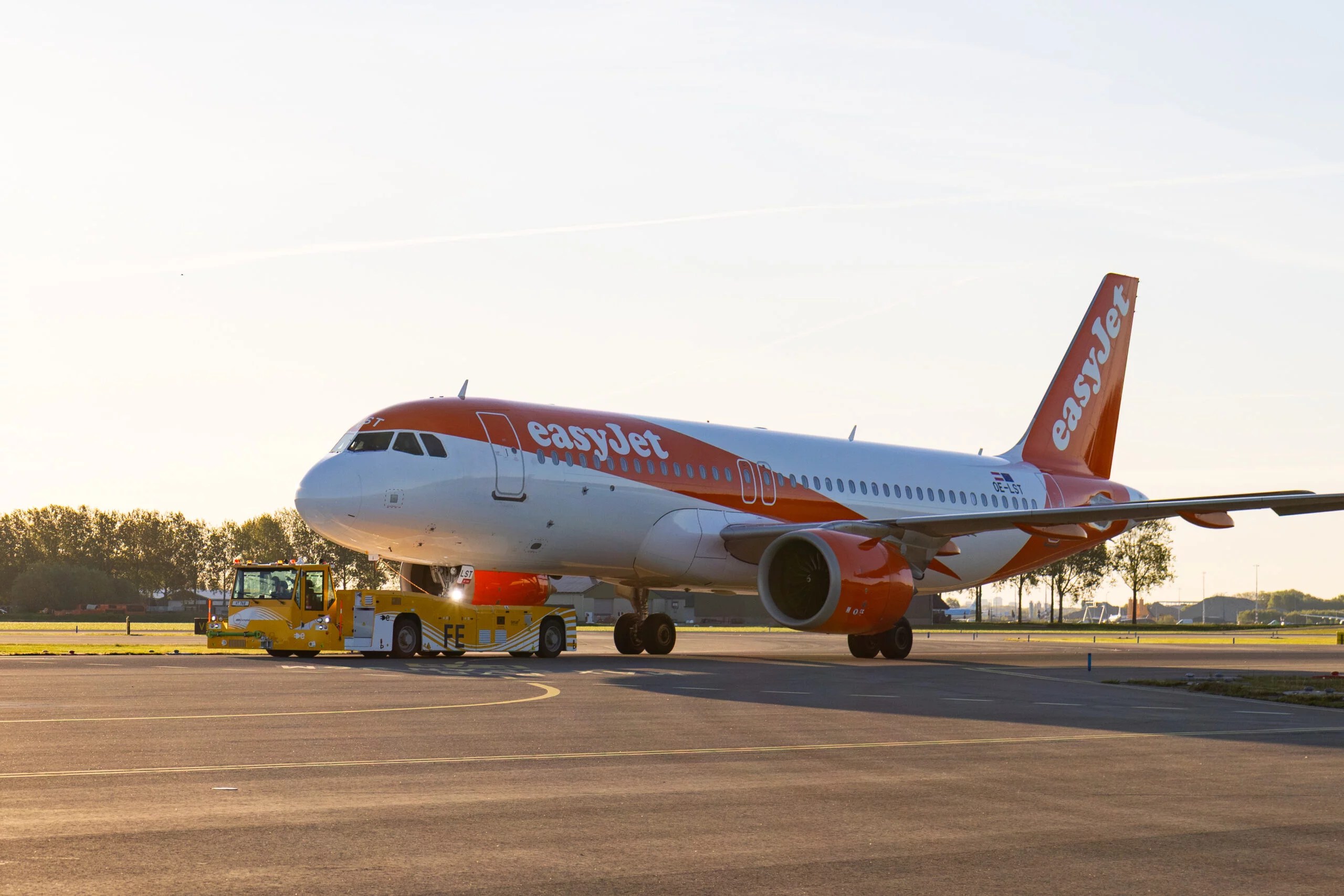

After a successful trial run earlier this year, European airline easyJet and Amsterdam Schiphol Airport (AMS) announced on Tuesday the roll out of their new electric taxiing system for Airbus operations at the airport.
TaxiBot, a semi-robotic aircraft tractor, allows aircraft to taxi between the gate and runway using only an Auxiliary Power Unit (APU), rather than main engines. easyJet said they project that each use of TaxiBot will on average save 95 kg, or around 209 pounds, of fuel per flight.
The first passenger flight utilizing TaxiBot took place on April 30. As part of the rollout, three more Airbus A320neo are being readied for TaxiBot compatibility.
“TaxiBot is another important step in our mission to operate as efficiently as possible. This technology delivers immediate reductions in fuel consumption, carbon emissions and noise, while supporting more efficient ground operations at one of Europe’s busiest airports,” David Morgan, chief operating officer at easyJet, said.
AMS is the first airport in Europe to integrate TaxiBot technology, specifically for Airbus aircraft. According to the airport, widespread adoption of the technology could result in a 65 percent decrease in fuel consumption while taxiing, while also decreasing the output of CO2 and other emissions.
Last June, StandardAero, in partnership with Green Taxi Solutions (GTS), received a $5.6 million grant from the FAA to develop a similar technology.

Does the calculation include the cost to produce, transmit, and store the electricity in the batteries of the tug? If a grant is required to promote this Green New Scam nonsense, then you know it will fail when subsidies and government coercion are forced onto airlines, the costs of which will simply be passed on to passengers.
Something in the back of my mind tells me that something similar was tried at London Heathrow a few years ago. I recall that it was abandoned because it turned out that the noseleg wasn’t really designed for long distance towing and the extra maintenance costs (and aircraft downtime) involved more than offset the fuel savings. But maybe something has changed…
This can’t be a cost effective solution nor is it carbon neutral. I always thought an electric motor in the hub of a nose wheel would be a better solution. I don’t think any modern airlines have nose wheel brakes. The last plane I saw with nose brakes was a 727 for short runway Caribbean operations.
Carrying the weight of a heavy electric motor for the duration of the flight is not cost effective. Also, the nose-wheel doesn’t have adequate traction with the pavement due to weight distribution to propel the airplane efficiently or reliably.
What constitutes a successful trial run? Was there proper validation of the cost savings? (Not just fuel savings; overall cost savings).
What is required to make an A320NEO “compatible” with this tug? What powers this tug? How does it navigate? Is a human involved? What control does the pilot have/not have? Another useless media release that says nothing.