















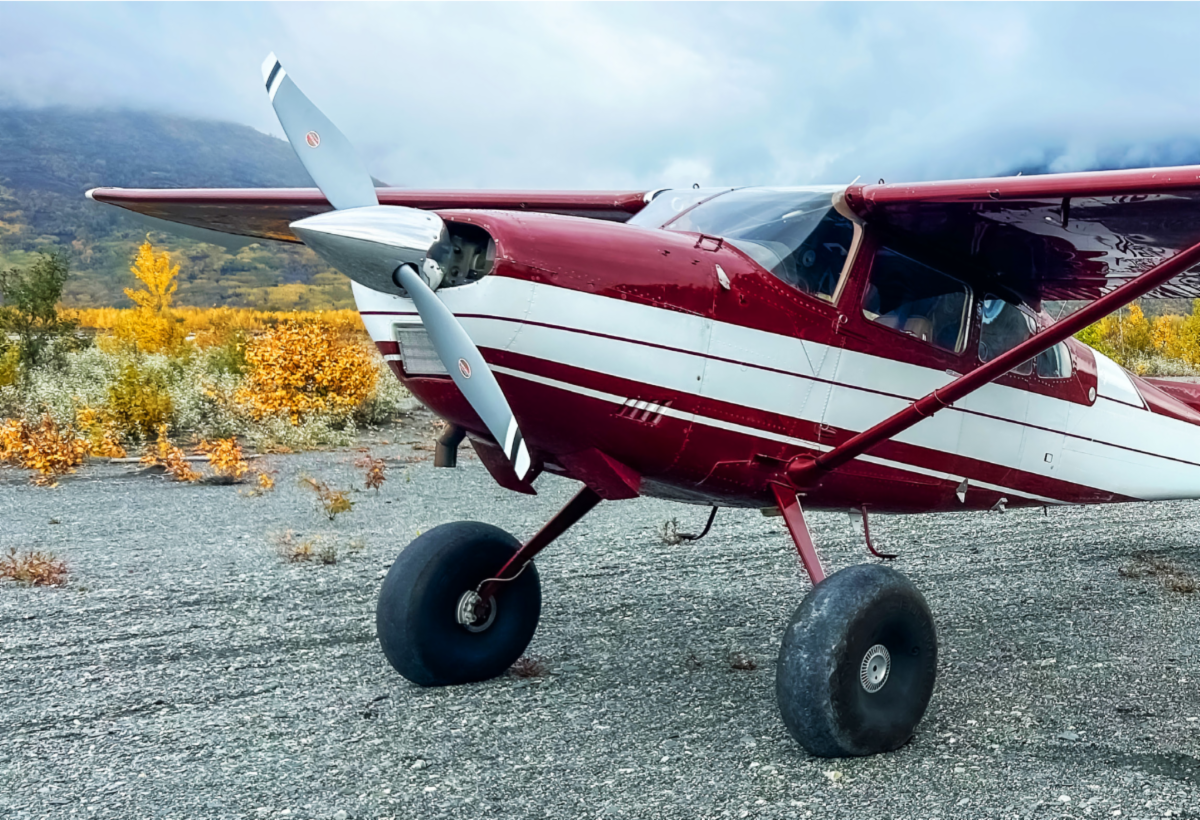

Hartzell Propeller said Monday that it has received FAA supplemental type certificate approval for its Frontier aluminum propeller for Cessna 180 Skywagon A-J models powered by Continental O-470 engines.
Propeller Details
The 88-inch, two-blade propeller uses an aluminum hub and scimitar-style aluminum blades. Hartzell said the installed assembly weighs 55.4 pounds and is approved for Continental O-470 A, J, K, L, R and S engine variants. The company said the propeller has no RPM restrictions.
“The Skywagon community has been looking for a way to get more performance from these trusted aircraft without the downtime and expense of an engine upgrade,” JJ Frigge, president of Hartzell Propeller, said. “The Frontier is our answer—an affordable, two-blade aluminum Hartzell propeller designed to help pilots get off the ground faster, climb out of tight strips better, and give the Skywagon a presence you can hear as well as feel. It is an especially compelling solution for floatplane operators and pilots flying in demanding environments, such as Alaska.”
STC Kit And Support
The STC kit includes a polished spinner and FAA-approved documentation. Hartzell said the propeller is covered by its Top Prop warranty through first overhaul. According to the company, the Frontier can provide up to a 5% improvement in ground roll, total takeoff distance and climb performance.
The Frontier adds another option to Hartzell’s Top Prop line for Cessna Skywagon operators. The company has also received Voyager propeller STCs for several Cessna models, including the Cessna 180, 182, 185, 206 and T206 fleets.


An old story, frequently quoted in earlier courses of mechanical engineering, is about a funny case of bicycle tires, which allegedly happened in Germany. It is known, during WWI Germany suffered from a severe shortage of rubber. Among many other things bicycles too had a problem of replacement tires. But German engineers have always been famous about their ingenuity! Actually, one of them came up with an invention to solve the bicycle replacement-tire problem. He created a wheel having a tire made of - beech wood. Patenting was quickly done, commercial leaflets were distributed, and - prototypes were offered too for public testing.
The story ends with the inventor doing the public test himself. Unfortunately, after passing a short stretch of cobbled road, he suddenly needed medical care.
Today (in 2026), fine hi-tech company Hartzell is advertising “scimitar-style aluminum blades” – in fact blocks of solid metal, as one of top products. The Hartzell Frontier propellers mostly work as constant speed propellers. They have variable pitch, which puts them in the sophisticated category. Still, when looking at them in a “virtual wind tunnel test” analysis (geometrical checking of the blade sections and speed vectors of the airflow, at variable speed), they resemble the above bicycle case.
Except a single value of the airspeed (or, at least, a narrow range of the speed values) parts of the blades stall, always. Angle of attack (AOA) assumes awkward values along the propeller radius, sometimes even negative ones, causing reverse thrust. That means energy losses, a less than optimal thrust, more noise, and vibration.
Of course, owners and pilots will not reach the extremes as speed limits have been established - and also wired in the system - so the aircraft remain well behaved all the time. That is why e.g. the Cessna 180 top speed is limited to below 0.22 Mach.
Important detail is that this .22 Mach is a PROPELLER LIMIT !
That means the same aircraft (engine + body) can fly significantly faster – up to even .8 Mach - when a better prop is fitted. The matter is that Hartzell knows those “better” props have been available for years now. At least in concept. The concept of the ADAPTIVE rotors and propellers has been published as early as September 2020. First in Europe, then in the US. Description contains special mathematical part to prove the AOA is maintained optimal at any speed. A real insurance policy for the company potentially venturing to produce a prototype.
It is known traditional propellers have a limited market. Steadily spreading jet propulsion keeps endangering even that limited one, worldwide. Also, it is sad seeing Hartzell quietly distancing themselves from the traditional propeller business and trying to invest in other industries. At the same time it is quite obvious no company is better fitted to prototype a revolutionarily new propeller, than Hartzell. Also, that path of strategy leads to both greatly improved profits, and to a safe, long term survival of the company staying in its own traditional market.
The adaptive propeller concept carries a guarantee to stop the aggressive spreading of the jet propulsion in the subsonic aviation market. Adaptive rotors and propellers are quieter, and a lot more efficient than jets in this sector. Environmentalists will just jubilate over such a decision.
Pilots and plane owners will be happy too. They are going to find new, increased power in their old machinery. Also, the nature of the proposed adaptive technology allows a method of upgrading of existing rotors and propellers with minimal intervention and losses. Governor and actuation systems of variable pitch propellers remain mostly unchanged. Improved alignment of the blades is ensured by the “mechanical computer” of the skeleton-grid of the adaptive blades.
As a visionary I can see a coming ad for the Cessna owners from Hartzell stating: “Double the speed and power of your aircraft - the Adaptive Frontier is our answer…”
Lots of words, no citations, and a 0.8 Mach Cessna 180. Sometimes AI gets it wrong.