














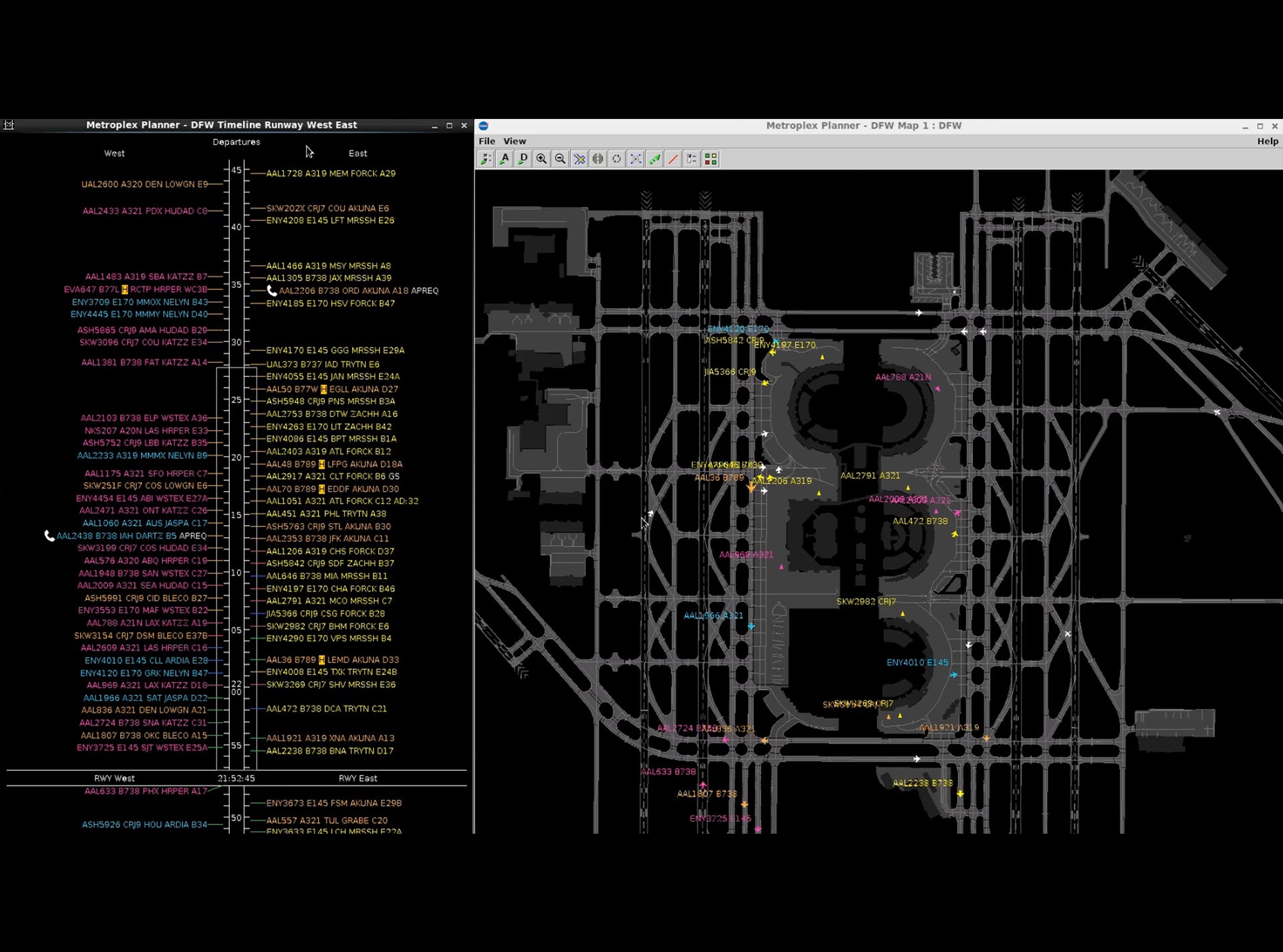

The FAA and NASA have wrapped up research and testing on software designed to minimize taxi delays and ease ramp congestion along with saving fuel and reducing carbon emissions. The new NASA-developed software capability, which is designed to calculate gate pushbacks to allow aircraft to “roll directly to the runway and to take off,” will be part of the FAA’s Terminal Flight Data Manager (TFDM) program. The agency initially plans to roll the TFDM program out to 27 hub airports beginning with Phoenix Sky Harbor (PHX) next year.
“This air traffic scheduling technology enhances aircraft efficiency and improves dependability for passengers every day,” said NASA Administrator Bill Nelson. “I’m excited that the software NASA developed for air traffic controllers and airlines will be soon rolled out at airports across the country and know the results will continue to be extraordinary.”
The TFDM program has undergone almost four years of testing by the FAA’s NextGen group; airlines’ airport operations; FAA radar facilities in Charlotte, North Carolina, and Dallas, Texas; and the Atlanta, Georgia and Washington, D.C. centers. According to the FAA and NASA, testing at Charlotte Douglas International Airport (CLT) resulted in reduced taxi times, savings of more than 275,000 gallons of fuel annually and a daily reduction in greenhouse gas emissions of 8 tons of carbon dioxide. The FAA says it expects that, when the program is complete, it will save more than 7 million gallons of fuel and eliminate more than 75,000 tons of CO2 emissions annually.
