



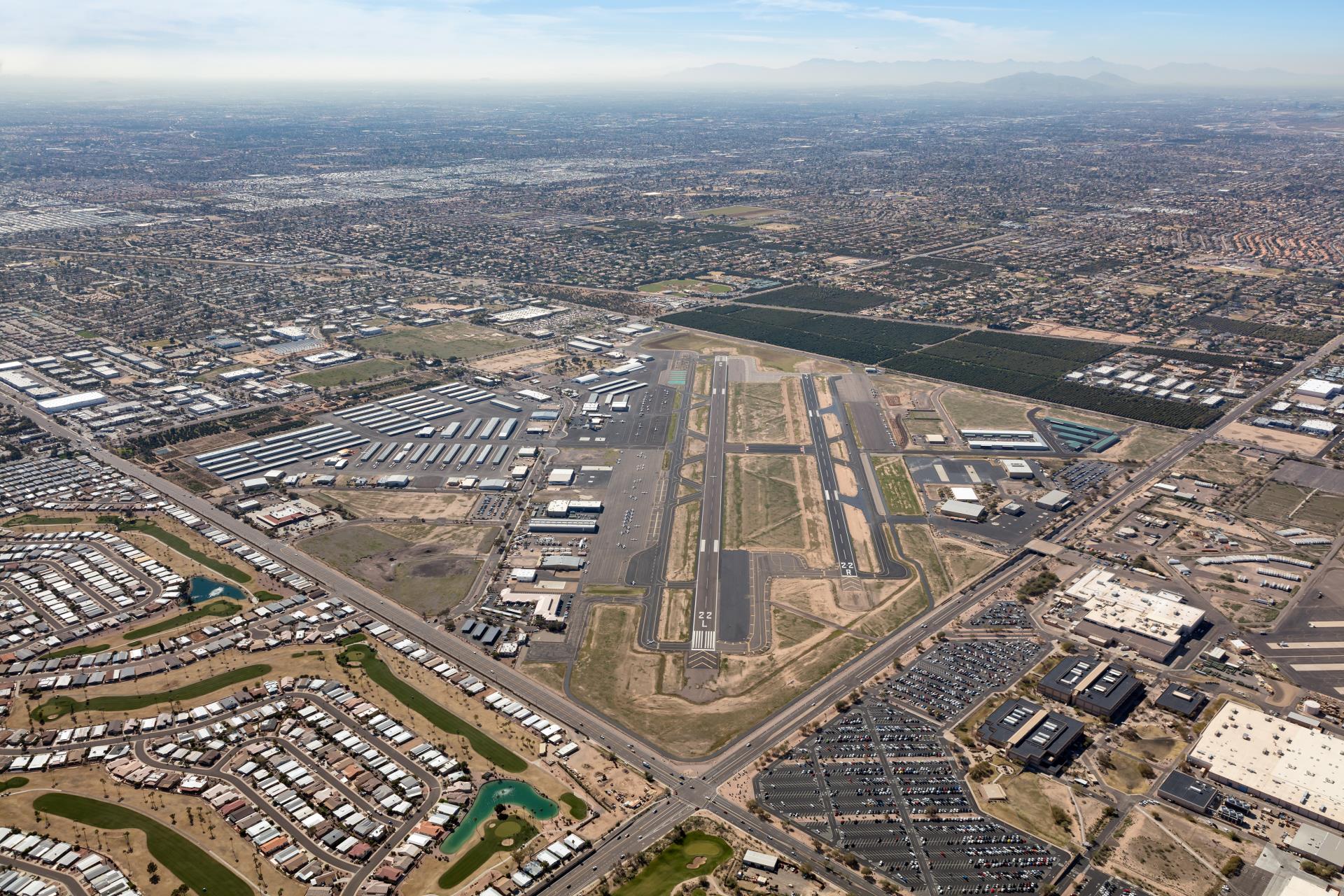

Mesa, Arizona’s Falcon Field (FFZ) is preparing to move forward with a landing fee proposal that would impact all flights to the airport. The fee proposal is scheduled for consideration by the city council on February 9.
Potential landing fees at the airport are driven in part by long-term budget forecasts and rising training activity, and have prompted a broad response from pilots and aviation groups.
Falcon Field Airport management sent tenants an email on Wednesday outlining the proposed fee structure. The proposal includes landing fees for all aircraft, with based aircraft under 6,000 pounds receiving five free landings per month before a $29.95 charge applies. Itinerant aircraft under 6,000 pounds would be charged $33.95 per landing, and heavier aircraft would see a per-1,000-pound rate. Hangar rents, tie-downs, storage rooms and related security deposits would also increase, along with a fuel flowage fee rising from $0.14 to $0.15 per gallon.
Budget Concerns and Proposed Falcon Field Fees
Airport Director Corinne Nystrom told representatives from the Arizona Pilots Association (APA) during a Nov. 10 meeting that while the airport is currently self-sustaining, future projections show a budget deficit tied to maintenance obligations that are not eligible for FAA grant funding.
The airport was awarded more than $655,000 of FAA Airport Infrastructure Grants in September. The grants were supplemented by an Arizona Department of Transportation match and include funds for taxiway and runway upgrades, along with service road improvements.
The proposal follows a rise in neighborhood noise complaints and community concerns related to lead emissions. A stakeholder group was formed by the city earlier this year to evaluate training operations, emissions and potential mitigation measures.
Cary Grant, president of the Arizona Aviation Safety Advisory Group and an assistant professor at Embry-Riddle Aeronautical University in Prescott, told AVweb that training operators at Falcon Field would face the most direct effects.
“The real target of this are the flight schools, and there are 15 different flight schools at Falcon Field,” Grant said, noting that many lessons involve repeated takeoffs and landings. “With five free landings per month, that would probably placate the local general aviation pilots that aren’t out doing a bunch of touch-and-go’s.”
Business aviation operators, by contrast, typically record far fewer movements and may be less sensitive to landing fees, he said.
“There are major Gulfstream owners … complaining that they’re wasting way too much time being able to get access on and off the runway because of the plug-up of all the [training] flights.”
Grant said he is concerned that, if passed, the landing fees could drive away the airport’s flight schools. Given the volume of flight training at the airport, Grant said this would impact aviation’s broader training pipeline in the region.
“The flight schools are our seed corn,” Grant said. “If we don’t have the flight schools, where do we go?”
Grant also noted that, if schools were forced to relocate to other airports in the Phoenix area, this could overwhelm some of the area’s practice area airspace, creating what he said could be a genuine flight safety issue.
A Change.org petition opposing the fees has gathered more than 2,000 signatures at time of publication. The petition cites Falcon Field’s historic mission and economic contributions to the larger community. At the same time, another petition in favor of the landing fees has also been circulated. That petition has accumulated more than 1,500 signatures so far.
A pilot based at Falcon Field shared an email with AVweb Friday from the City of Mesa stating that proposed adjustments to the airport’s fee schedule will be considered by the city council on Feb. 9, 2026. The city is expected to post a formal notice of intent on Friday.
According to the email, seven virtual informational meetings are scheduled in December and January for tenants to ask questions and receive additional details. APA encouraged operators to participate in these sessions and upcoming council meetings.


I’m a pilot at Falcon Field, the airport has wasted money on projects that provide little to no real benefit like Taxiway G, which I rarely see used and which has done nothing to reduce congestion or improve ground flow. they’ve installed new stickers along the tower and on the sides of hangars that reportedly cost around $80,000. EIGHTY THOUSAND DOLLARS FOR STICKERS?… that offer no safety improvement and serve only as decoration.
Now, the airport wants tenants and pilots to absorb the cost through new landing fees and hangar rent increases. They’re even using community concerns as a weapon to justify these fees. This comes after the airport management and the city worked hard to bring flight schools in and now that those schools aren’t as profitable for them, they’re turning their backs.
On top of all this, hangar rent has been increasing by roughly 8% every 3–6 months for the past two years, yet we’ve seen no real improvements or benefits from these rising costs.
The skies over Fountain Hills used to be mostly peaceful when we moved here in 2016. It used to be enjoyable to open doors and windows this time of year. It used to be enjoyable to sit on the patio. Now, with all the flight schools that started business there over the past several years, we have flights buzzing over our home 10-12 hours a day, not to mention all the helicopters that come from multiple places. Flightradar24.com tells the story. In addition to flights coming and going from other places, we now have 15 flight schools out of Falcon Field going back and forth all day long. What used to be a peaceful environment has been utterly spoiled by the noise of these multiple training flights that go back and forth all day long. It’s more than annoying. Its become nerve-wracking. I, for one, plan to rally our community to speak up about this disturbance of our peace and quiet. I shouldn’t have to want to move away based on all these annoying flights. I hope FF forces these flight schools to move to a less populated area.
Every flight that i plan, if the airport i intend to land at has those fees, i pick another airport without those fees. Even getting fuel. If i cannot get self service, I’ll try to find an airport where i can. If no choice, so be it. But i will at least try.
“Arizona law mandates that sellers disclose if a property is located in territory in the vicinity of a military airport or ancillary military facility. To assist with this legally required disclosure, the Residential Seller’s Property Disclosure Statement and Vacant Land/Lot Seller’s Property Disclosure Statement ask whether the seller is aware if the property is located in the vicinity of an airport.”
You moved there in 2016. The airport was opened in 1941.
Why a $29.95 fee? If you are hell bent on a fee make it an even number, like $30, $40, or $50. I would bet the carpet baggers are pushing this to run every body off. Eventually the city will want to close the airport for land development.
When someone buys a home near an airport/airfield it is incumbent upon the buyer to educate themselves about the potential traffic/noise. Just like buying a home near a factory. You bought it, you own it…quit crying. I feel absolutely no sympathy for you.
You buy a home near an airport, there are gonna be aircraft. Don’t buy a home near an airport, then complain about the noise from the airplanes and helicopters. You should have done your research before purchasing.
This seems to be a problem at other general aviation airports, too. We have it at Naples, FL. Noise complaints, noise studies. Even a study to close the airport and build a new airport out in the boonies.
When we purchased our home here in 2016, we most certainly did our research. There weren’t 15 flight schools operating out of Falcon Field at that time.
I found this information posted by another concerned resident:
A few data points:
Basically, the level of traffic and resulting noise that residents are experiencing is unprecedented compared to the previous 83 years of the airport’s operations (during which residents largely lived peacefully nearby).
It’s also a much higher level of traffic relative to the other general aviation airports nearby. Is it fair that the effects of this (very needed) flight training are shouldered by just one tax-paying community?
Some residents have begun measuring decibel levels and report sound levels between 65-85 decibels. This is consistent with online estimates for low-flying aircraft and is similar to a gas-powered lawn mower in a neighbor’s yard.
If we take 424,000 flights per year and assume most flights happen roughly between 7am and 8pm (13 hours a day), that works out to 1 flight every 40 seconds. When each flight takes 20 seconds to pass overhead, that means residents are actively hearing the aircraft noise 6+ hours each day.
If your neighbor ran a lawnmower for 6 hours each day, would you have concerns? Would you file a noise complaint to the city?
Falcon Field was built in 1941 and deeded to Mesa in 1948. Unfortunately, there are not many pre-1940s Mesa residents who are still around to claim longer tenure as a way to validate their position on this issue. Similarly, it’s unlikely many of the current FF pilots were around when the airport was first built — and given the transient nature of Phoenix, some may only be recent newcomers to the area themselves.
The point is, “xyz was here first” doesn’t give anyone a license to do whatever they want regardless of the impact on others. Change happens. As much as northeast Mesa has developed since the airport was built, so have the airport’s operations. Again, refer to the data points above to see how rapidly this is happening. Neither residents nor pilots should get precedence over the other’s needs, but balance.
Again, many residents have lived near the airport for decades without any issues — until the last year or two (and the data shows why).
For the vast majority of people, that is blatantly false. In fact, many love the airport. Personally, I actually enjoy watching planes overhead — it reminds me of camping in the desert as a kid and watching pilots practice cool maneuvers.
But the level we’re seeing (again, 6+ hours of active flight noise each day), is what some might consider unreasonable. And if people don’t say something now, in 5 years of growth at the rate we’re going it will be much, much worse. This traffic should be spread across airports, not concentrated at one.
Well said quiet skies. I moved near falcon field nine years ago and yes, of course I knew the airfield existed at the time. But who would expect the amount of traffic around the airfield to explode the way it has. The noise level is becoming a real nuisance to me and I’ve been around aviation my whole life. I love playing golf here and looking up to see a 4 ship Stearmans flying over or perhaps the B-17. But the flight schools are ridiculous.
“Change happens”
In 1940 , the population of Mesa was approximately 7,000. Today, it’s over 500,000.
The airport did not encroach upon the population, the population encroached upon the airport.
Any new roads or highways built since 1960? Any new shopping centers? New schools? Any increase in automobile traffic?
I’d wager, Mesa has seen an increase in all of the above, including airport traffic-change happens.
And by moving there, you’ve help make that change happen. You performed your due diligence, and realizing that change happens- and well aware of the airport, purchased property.
“Unfortunately, there are not many pre-1940s Mesa residents who are still around to claim longer tenure as a way to validate their position on this issue.”
I’d wager, there are not many pre-1941 residents still around either. Regardless, we don’t require their testimony to know that the airport was there long before you knowingly purchased property.
No worries “767”.
Once the airport closes (that is almost always the goal) and they fill the property with high density housing, they’ll be no need to keep the golf course as a buffer. It’ll be next to go.
If you’re at Fountain Hills, that’s a distance of about 10 miles from Falcon Field that isn’t even within its airspace boundaries. No aircraft can fly within 1000 feet of FH residences as per the universal FAA rule that applies throughout the United States. You’re not affected. Yet here you are.
It seems to me that what you really want is to live in our giant and thriving Phoenix metropolis but magically have a noise free environment where no one else can exist. You may as well be arguing for the closure of Phoenix Sky Harbor too.
Neilends, you make my point. We didn’t think we’d be so greatly affected by Falcon Field being this distance away, yet we have all these flight school aircraft flying over our house all the day long for the past couple of years, not to mention training flights out of Scottsdale, Glendale, and Buckeye. We’re not asking for no aircraft over our house, just less of these constant training flights. What we’ve experienced over the past couple of years is nowhere near reasonable.
Then don’t live in a booming metropolis. Go buy a ranch in Gila County. You don’t even live near an airport and are demanding to live noise-free from any aircraft. Ridiculous. This is a perfect example showing why the airport noise complaints are meritless and should be roundly rejected.
LOL Fountain Hills is not a booming metropolis. That’s why we moved here. Check out flightradar and you’ll see the steady stream of small planes over our community, most of them from the flight schools. I do expect a change and I think it’s coming.
I would like to say thank you to the flight school pilots who are flying on the other side of Red Mountain, farther away from Fountain Hills, even if it’s just one way. It makes a difference.
Fountain Hills is in Maricopa County and very much within our metro area, which means that airplanes above, cars driving by, and all the rest that come with the pleasures you have of being so close to Phoenix are part of the package. FH is not a ranch in the wilderness.
By the way, I don’t know what “changes” you’re thinking of but the FAA regulations that apply nationwide are not in fact about to change—so there is zero chance of FH seeing less air traffic. You are outside the Falcon Field Class Delta airspace, which means that FAR § 91.119 is the only restriction that protects your area. That provision only requires that planes remain 1,000 feet above your home. I think you know as well as I do that all those planes you’re complaining of are already flying significantly higher than that. You have zero legal basis for challenging that rule, which has been in place for decades. So no, nothing’s going to change.
I suspect the coming higher fees will drive out the flight schools. We’ll see…
I live 1.6 miles from an airport built in 1929. There were 5 houses in the town then. Now, as everywhere else, homes have been planted and bought all up to the airfield boundaries.
Today with flight training, there are about 60,000 flights per year.
People complain about the noise…BUT, do not complain about the 24 hour per day noise from a state highway that runs through the town.
It is incumbent upon buyers to exercise due diligence.
It is incumbent upon realtors to point out an airport is nearby.
People believe the airport can do something about the noise — they will not accept that once a craft’s wheels have left the ground, it is the FAA who has control and authority over the plane, not the airport.
I think it was Forrest Gump who said: “Stupid is as stupid does.”