















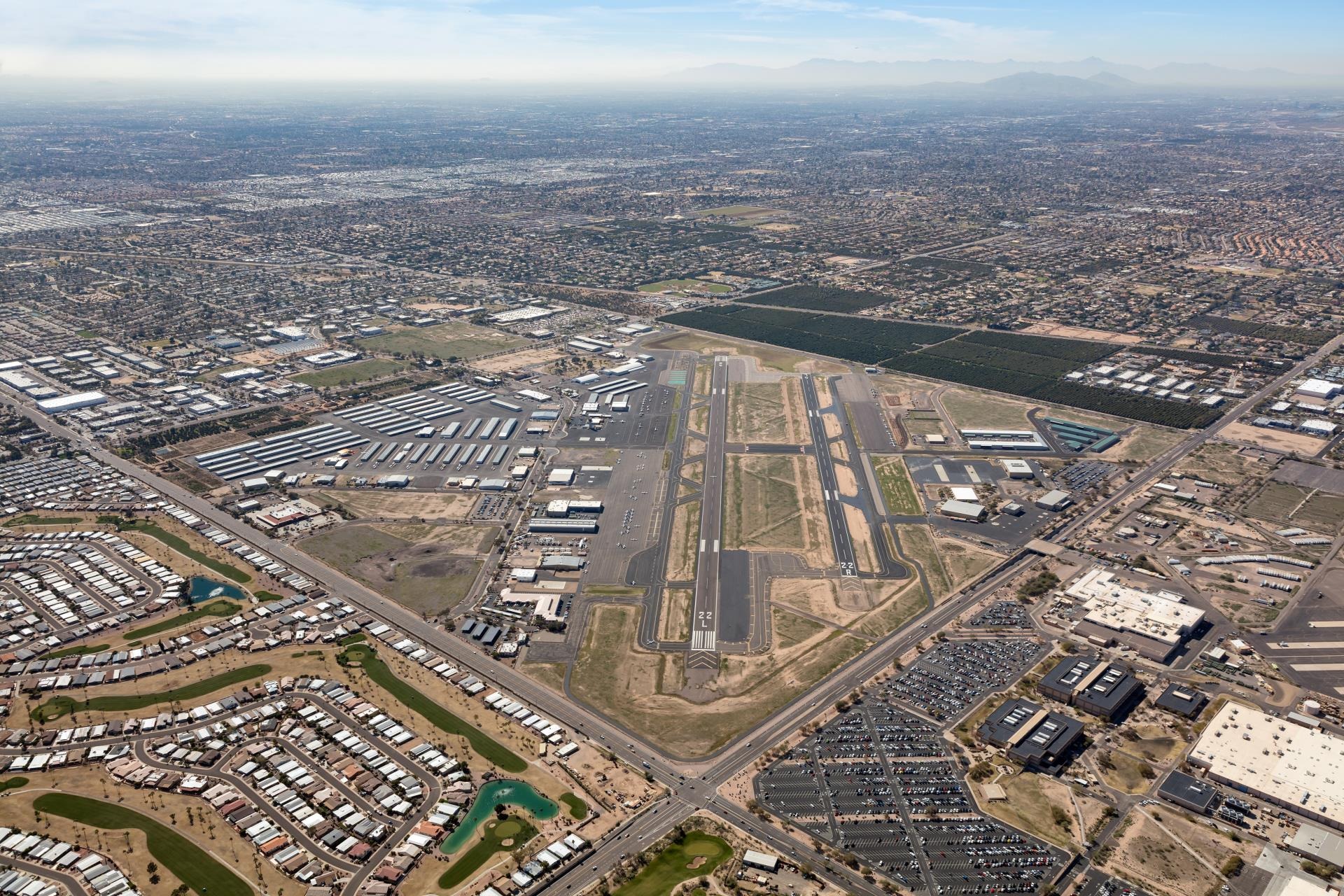

Two flight schools based at Falcon Field Airport in Mesa, Arizona, have filed a joint FAA Part 13 complaint challenging the city’s planned landing fee program, scheduled to begin collecting landing data for billing purposes Aug. 1. The complaint was filed by CAE Aviation Academy and Thrust Flight and asks the FAA to review whether the fee structure complies with federal airport obligations, grant assurances and safety requirements.
Schools Raise Training Concerns
Thrust Flight CEO Patrick Arnzen said that, in addition to the federal action, the schools are also pursuing a separate local lawsuit.
“We filed the FAA Part 13 complaint because this issue goes way beyond one airport or one fee,” Arnzen said. “Increased costs could eventually fall on the students and that matters. But an equal and potentially even bigger concern is what happens to training quality and long-term safety when airports start discouraging the repetition pilots need to become truly proficient.”
Arnzen said the Part 13 complaint alleges Mesa violated its federal grant assurances. He said the schools believe the fee program is tied to noise complaints from nearby residents, and that landing fees are being used as a vehicle to address those concerns. Arnzen said the Part 13 complaint could ultimately become a Part 16 complaint, the FAA’s formal process for certain complaints involving federally assisted airports.
Thrust believes the Falcon Field fees could cost the school more than $500,000 in the first year, and likely more in the future as the operation grows. Arnzen said Thrust has invested about $5.5 million in its Falcon Field location, which opened last year, and said the school would not have made that investment had it known landing fees were being considered.
Mesa Defends Fees
Mesa has rejected the schools’ claims and said it intends to move forward with the program after completing work on the landing fee system. The city said the fees are intended to support Falcon Field’s operating costs and long-term financial sustainability.
“The City believes the lawsuit lacks legal merit and does not justify delaying the landing fee program,” the city said in a statement. “The City will continue to defend the legality and necessity of the landing fees, which are intended to help cover the costs of operating, maintaining, and improving Falcon Field Airport and to support the Airport’s long-term financial sustainability.”
Mesa said it plans to activate the landing fee collection system on July 30 and begin collecting landing data for billing purposes Aug. 1. Falcon Field had previously delayed the program from its original May 1 rollout while work continued on the tracking and billing system.
Mesa Gateway Airport, which previously announced a separate landing fee for itinerant fixed-wing aircraft under 12,500 pounds, has also delayed implementation and has said its program is tied to whether Falcon Field begins collecting its fee.


So, if MESA has taken Federal Funds for the airport, landing fees are unlawful. If not, then landing fees are an open question. No pilot wants to see landing fees. I presume the FAA has paved the runways at MESA; but do not know for certain. If the FAA has funded repaving, the airport landing fees are out of the question. If the FAA has not funded MESA Airport repaving or any other improvements, then their proposed fees may stand. I hope not! One would think asking the FAA to repave runways is a routine task; done nearly at every US Airport. Suggesting to me the MESA Airport has no basis for collecting landing fees. Who will tell the MESA Airport to ask the FAA to repave their runways? Like most other US Airports!
Hayward Executive Airport (KHWD) in the SF Bay Area has an almost identical runway configuration and composition of T-hangars, flight schools, two full service FBOs and some aircraft repair stations. They get their money from rents charged to tenants, as well as federal grants for movement area maintenance. KHWD hosted a large number of business jets for last February’s Superbowl weekend (they even closed 28R-10L for additional parking!). I have yet to hear any discussion or proposal about landing fees. It sounds to me like the Mesa City Council is made up of anti-airport “Karens” looking for a new revenue stream by treating the airport as a cash cow. When Hayward needed to address operating costs, they raised the rents. As hangar tenants, we certainly protested. But they were raised incrementally so that it would be less painful. That said, at no time were landing fees on the table for discussion.
This is just one more sad consequence of the Phoenix area’s explosive growth over the past 60 years. We based our airplane at Falcon Field years ago. It was uncontrolled, well away from any residential areas, surrounded by orange groves. McDonnell-Douglas had a facility on the northwest side, and conducted much of the flight test program of the Apache helicopter there. There was one busy flight school, and the Champlin Fighter Museum.
Of course the orange groves, inevitably, gave way to dense subdivisions, Champlin’s collection went to Boeing Field in Seattle, FAA put in a tower, and now the neighbors are complaining about the airplane noise, which was there long before their homes were built.
Luke AFB on the west side of town is getting the same complaints. It was built during WWII, 40 miles out in the empty desert. The original residents of Sun City, after the war, were veterans, so they loved the jets overhead. But 70 years later, the (vastly expanded) Sun City residents are calling their congressman to complain about someone letting those noisy jets fly over their homes.
It is unfortunate that suburbs grow up around existing airports, populated by people who did not do their due diligent to determine whether an airport was in the vicinity. Then, they complain about the noise, file lawsuits, demand landing fees to deter airmen, and the like.