















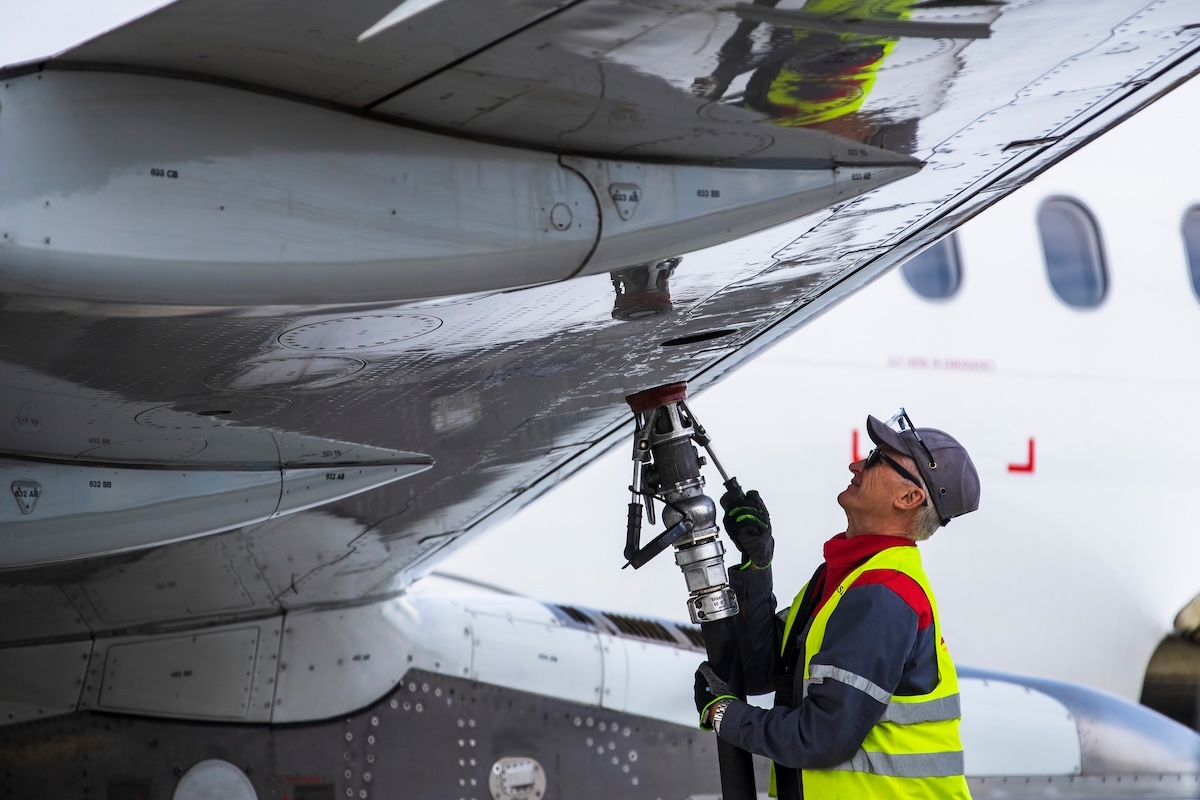

FedEx announced this week that it has begun using sustainable aviation fuel (SAF) at Chicago O’Hare and Miami International airports, marking its second and third U.S. deployments in six months. The announcement follows the company’s initial rollout at Los Angeles International Airport in May.
Increased SAF Use
At Chicago, FedEx will initially receive one million gallons of blended fuel from Air bp, while Miami will see deliveries of about three million gallons from AEG.
“Each executed agreement signals to fuel producers that airlines are willing and eager collaborators to help scale the SAF market,” said Karen Blanks Ellis, FedEx chief sustainability officer, in a company statement.
Broader U.S. Adoption
The development follows Neste’s recent expansion of its partnership with United Airlines to supply SAF to Houston, Newark, and Washington Dulles airports. The partnership builds on previous deliveries in Chicago and San Francisco.
“Introducing sustainable aviation fuel for the first time at our hubs in Houston, Newark, and Dulles is another significant milestone,” said United Chief Sustainability Officer Lauren Riley.
U.S. producers including Valero and Montana Renewables have recently increased capacity, while distributor Avfuel has expanded its SAF supply networks to eight locations nationwide. State programs in California, Oregon, Washington, and others provide ongoing incentives as federal grant funding incentivizing the fuel decreases.
SAF adoption faces major hurdles where cost gaps between it and traditional fuels exist. Although funds and legislative measures look to address this issue, it is still a major roadblock, particularly where legislation does not play a strong role in local markets. Shell, for instance, cited the cost gap in its decision to halt work on a major European plant in September.
SAF Funds and Global Legislation
Internationally, several recently formed funds and legislative measures look to accelerate adoption.
A partnership between Breakthrough Energy Ventures, oneworld alliance, and several individual member airlines launched an investment fund initially worth $150 million in September that aims to expedite SAF commercialization.
The Civil Aviation Authority of Singapore, meanwhile, announced the formation of a central Sustainable Aviation Fuel Company that will purchase and distribute SAF departing its major airports. Singapore’s parliament approved a measure in October that will fund the fuel purchases through collections of a fixed levy on passenger and cargo flights using its airports.
According to DataM Intelligence, the global SAF market reached $586 million in 2024 and is projected to exceed $4.8 billion by 2031, supported by decarbonization requirements and airline fuel commitments. In Europe, ReFuelEU regulations are expected to raise blending requirements from 2 percent in 2025 to 6 percent by 2030.


This SAF fuel has got to be the biggest Green Washing scandal since the Bush administration mandated corn ethanol use, saying the it would reduce CO2 which it will not do. Through the use of science not politics it was discovered that there was no reduction in CO2 as compared to just using the petroleum alternative. Science also found that corn ethanol production does contribute significantly to other environmental damage in many ways.
And what proportion is this blend? A whole 2%. Until fossil oil derived kerosene is taxed like petrol (gas) in Europe, there is absolutely no incentive to use bio-fuel alternatives.
Although the tourist traffic will be more reluctant to fly to the seaside, when that sea side is more likely to be subjects to storms or recovering from storms – as the anguished wails from tourists in Jamaica during the hurricane showed.
Here in California, there is a proposal to further drain the Colorado River reservoirs to produce SAF fuel. The government subsidies from taxpayers have made this possible. How is this good for the environment?
I do not have enough real information about SAF to know how sustainable it is. I think that corn ethanol is more of a subsidy for farmers than an environmental solution but I would add that it is a better and much safer octane booster than tetraeythllead. I think that FedEx would be better off converting all of their delivery and short to medium haul trucks to battery electric. In addition to be bigger win for the environment, this would probably even save them money in the long run. A win-win.
Don’t these people ever leave their bubble and see where things are headed? EVs are as dead as the New Green Scam Deal. The US is once again setting record production numbers for oil and gas, which will lead to lower Jet-A costs. Ethanol, Bio-Diesel, SAF, etc. fuel turn what should be food for humans and feed for livestock into expensive fuels, a net loss for the economy and the environment. Shell finally woke up and did the inevitable when it turned its focus back toward our glorious fossil fuels, a gift from God.