
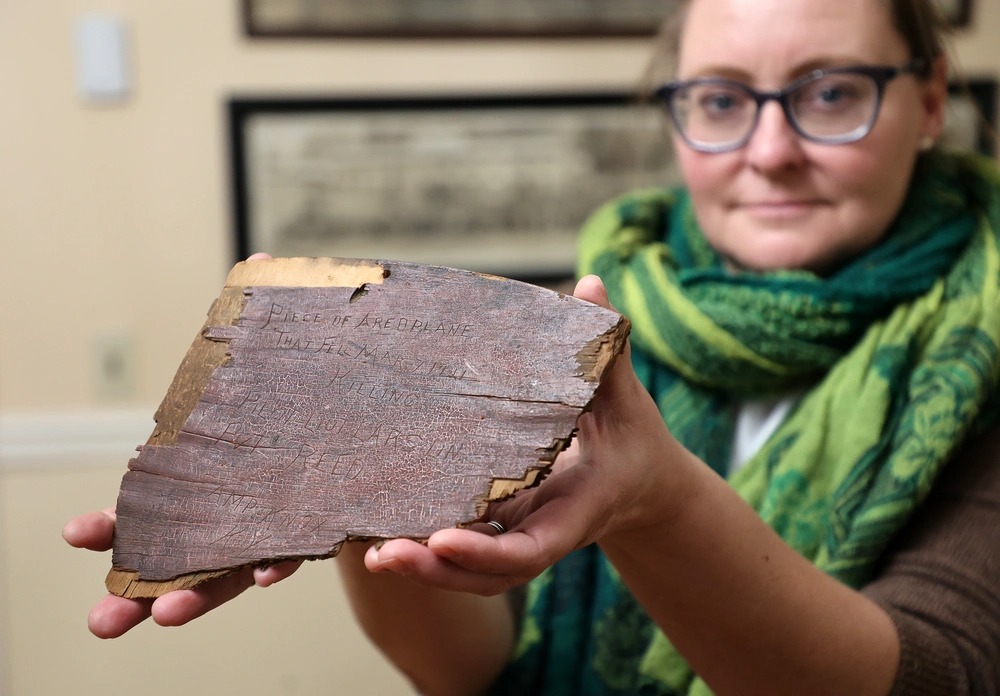

A fragment of laminated wood believed to be from a 1921 Curtiss JN-6H “Jenny” crash has returned to Fort Knox more than a century after the accident that killed 2nd Lt. J.T. Lawson and Pvt. Joseph Reade. The piece, roughly the size of a hand, bears an inscription noting the date of the crash—March 7, 1921—and the two service members who died when the aircraft went down during a training flight over what was then Camp Knox. According to historical accounts, investigators suspected mechanical issues or strong winds may have prevented Lawson from recovering from a spin.
The artifact surfaced decades later in the attic of a Pennsylvania home, where Susie McGinley discovered it while sorting through her grandfather’s belongings. Unsure of its significance at the time, she kept it until sharing the piece with neighbor Dan Ergler earlier this year. Ergler began researching the engraved details, which, despite some misspellings, aligned with records of the Jenny crash. A museum educator familiar with Curtiss aircraft later suggested the wood may have supported rudder pedal mounts or other cockpit components.
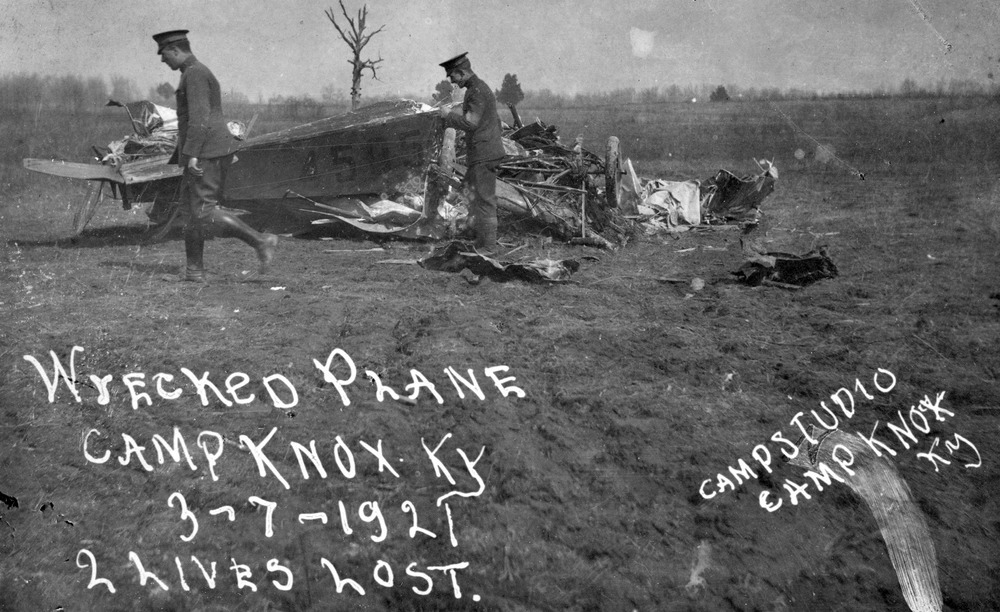
“Could it be that the loss of control of the airplane on that day in 1921 was due to a failure of the rudder controls at the point where the peddles were mounted to this piece of the floorboard?” Ergler said. “Could it be that this piece holds the evidence of the actual root cause of the accident?”
The fragment is now housed at Fort Knox’s Cultural Heritage Center, where staff say it offers a tangible connection to an era when Army aviation was still young.
“This piece symbolizes how far back our aviation history goes at Fort Knox,” said Niki Mills, Cultural Resources manager.
While how the fragment traveled from Kentucky to Pennsylvania remains unknown, its return highlights a story long tucked away in archives—and now back where it began.