
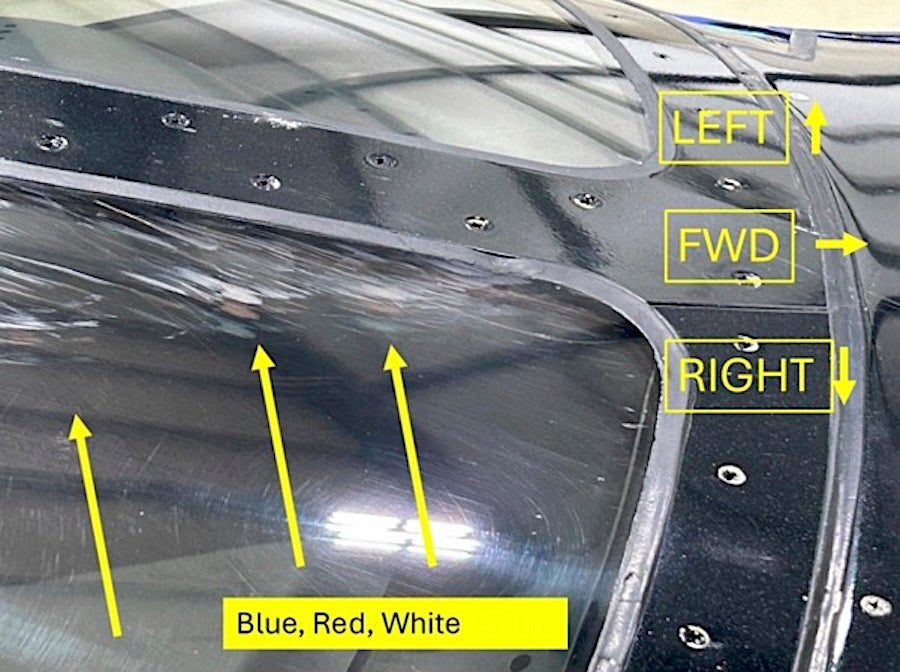

A Cirrus SF50 Vision Jet pilot had an interesting experience on approach to Austin-Bergstrom International Airport (KAUS) in Texas last month. According to the National Transportation Safety Board (NTSB) Preliminary Report (attached below), the pilot initially thought he had experienced a bird strike, followed by an uncommanded activation of the Emergency Autoland sequence—not once, but twice.
On Sept. 14 the Cirrus single-engine jet was approaching KAUS when something struck the right windshield panel. Later investigation revealed blue, red and white scrapings and an “oily residue” that the pilot, who landed safely and was uninjured, wiped off without retaining samples.
The aircraft central maintenance computer showed that, shortly following the impact, the SF50’s Emergency Autoland (EA) system activated and issued a warning message lasting 10 seconds. The system then began its sequence but was deactivated. Some five seconds later, the warning message reappeared for 10 seconds but was again deactivated and did not reactivate.
According to the NTSB report: “Once activated, the system enters a 10 second waiting period and provides visual and aural warnings of the impending EA sequence. The system can be deactivated at any time (during the waiting period or after) with the red autopilot disconnect button, located on the pilot side stick.”
The manufacturer and the NTSB are examining data files from Cirrus’s onboard Recoverable Data Module.