















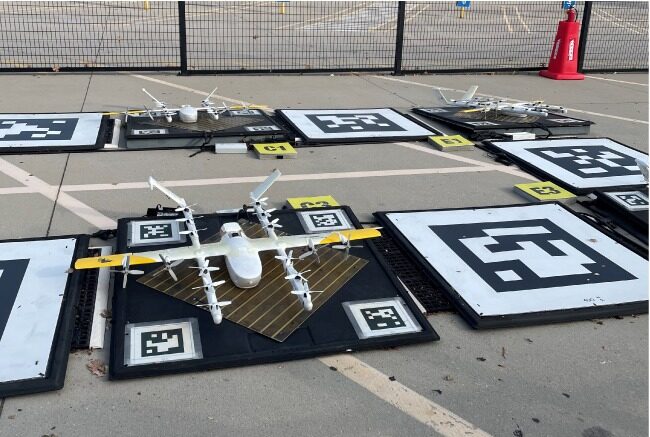

A broad cross-section of aviation and drone industry organizations submitted comments following the FAA’s reopening of the comment period on its proposal to normalize beyond visual line of sight (BVLOS) unmanned aircraft operations. Responses to the proposed Part 108 rulemaking focused largely on electronic conspicuity, right-of-way and detect-and-avoid responsibilities, with commenters generally supporting drone integration while outlining different approaches to implementation.
Many stakeholders pointed to portable electronic conspicuity devices as a potential near-term tool for improving air-to-air awareness, frequently referencing existing and emerging products and concepts. Several filings emphasized that these devices should remain distinct from certified ADS-B Out equipment used for air traffic surveillance. Commenters also said timelines for bringing such systems to the U.S. market would depend on FAA technical standards, with some estimating availability within months after a framework is finalized.
Manned aviation groups emphasize layered safety
General aviation and crewed-aircraft organizations generally supported integration, but stressed compatibility with existing operations and layered safety measures. AOPA said in its comments that BVLOS integration “must be done in a manner that is safe and that accommodates manned aircraft operations,” adding that drones must be able to detect and avoid “ALL manned aircraft, including those not equipped with EC devices.”
EAA wrote that “the safety of manned aircraft must take precedence,” while other groups, including the National Agricultural Aviation Association (NAAA), Vertical Aviation International (VAI) and the NBAA described electronic conspicuity as a supplemental awareness tool rather than a replacement for ADS-B Out.
Several filings also supported performance-based standards to support BVLOS operations and referenced RTCA DO-282C as a possible interoperability baseline. RTCA DO-282C referrs to a technical standard that defines how aircraft broadcast position data over the 978 MHz Universal Access Transceiver system used for ADS-B traffic awareness.
Uncrewed and commercial operators highlight scalability
Drone industry groups and commercial operators also supported electronic conspicuity as part of a broader safety framework, often focusing on interoperability and scalability.
The Association for Uncrewed Vehicle Systems International described ADS-B-derived conspicuity as “the most mature, interoperable, and immediately deployable baseline,” while the Commercial Drone Alliance said expanded use of EC could help enable BVLOS operations.
Amazon Prime Air cited operational experience in which its systems detected and maneuvered to avoid crewed aircraft, stating that layered safety measures are needed because “equipment failure and human error will cause EC systems to fail even when properly installed.”
Wing Aviation, however, cautioned against broad mandates for noncooperative detect-and-avoid-systems that allow BVLOS drones to sense and avoid aircraft that are not electronically broadcasting their position, such as those without ADS-B or electronic conspicuity equipment. In its filing, the company said requirements to deploy those systems in Class B, Class C and certain high-density operating areas “are not supported by evidence,” and argued they could add weight, cost and technical complexity for small unmanned aircraft while limiting BVLOS operations in urban environments.
Across submissions, many organizations agreed electronic conspicuity devices should enhance situational awareness rather than replace ADS-B Out, and several supported performance-based standards grounded in existing infrastructure.
Crewed-aviation groups often emphasized protections for current operations and layered safeguards, while uncrewed stakeholders tended to focus on interoperability, adoption speed and scalable compliance paths.
The FAA will review the comments as it continues development of the Part 108 rule.


Wing Aviation states the obvious: broad mandates for non-cooperative detect and avoid systems add weight, cost and complexity. Wing wishes to avoid the absolute necessity of detect and avoid aircraft however they are equipped. These see and avoid rules and rights of way have been in existence practically since the time the first two boats collided on water and have continued to be the prime rule of the seas and now of the air. Wing and others like it wish to mandate EC systems to replace their see and avoid responsibility and obedience to standard navigation rights of way. They can pay the cost of installing, inspecting and maintaining every single one in every single aircraft including NORDO aircraft without electrical systems who fly the airspace outside of Class ABCD. It seems they are perfectly willing to add cost, complexity and risk to every single aircraft but their own. Broad mandates for non-cooperating manned aircraft are essential to safety and have been supported by over a thousand years of admiralty law. Airspace merely adds a third dimension. Once the BVLOS is fully permitted, how long to you think companies like this will take to completely saturate the package delivery BVLOS airspaces surface to 800’ AGL, in urban or rural or sparsely populated areas? The reason we have Class B/C/D/E airspace in the first place is because there is higher traffic density in those areas and that traffic needs coordination, whether from ATC or rights of way rules or pilot cooperation. To add aircraft exempt from cooperation is simply irresponsible.
The simple truth is that a manned aircraft pilot cannot see and avoid a small drone. I’ve flown several forest fires where I was told there were drones flying. It’s impossible to see them while circling a fire in a bank at 90 knots. The burden of avoidance has to be on the drone operator no matter whether the manned aircraft is squawking ADS-B.