















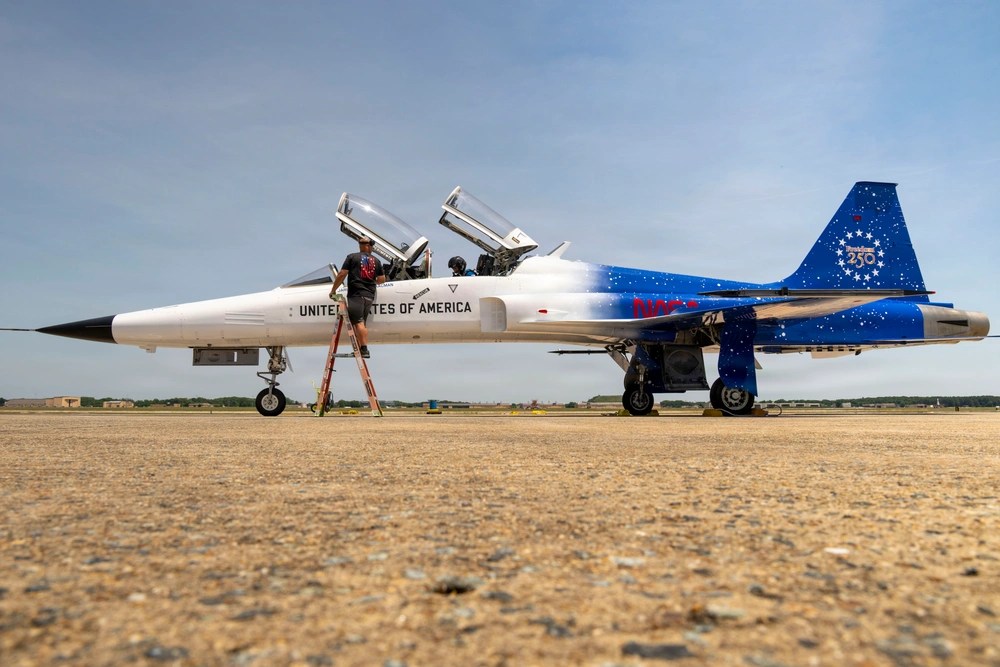

NASA Administrator Jared Isaacman flew a Northrop F-5 Tiger II during the Fourth of July flyover over Washington, D.C., after the FAA had denied a request to include four of the aircraft in the event, according to a new report from The Wall Street Journal. The flyover later proceeded after Isaacman said the aircraft had been placed under NASA control, moving the operation outside the civil exemption request.
FAA Cited Safety Concerns
The Journal reported that a representative for Isaacman asked the FAA in late June to allow four 1970s-era F-5s to take part in the air show over the National Mall. The FAA denied the request June 30, citing concerns about the aircraft, ejection systems, prior accidents and potential risk to people and property on the ground. The denial was signed by Hugh Thomas, a senior FAA official in the agency’s flight standards division, according to the report.
Isaacman Cited Government Aircraft Rules
Isaacman told The Wall Street Journal there was no question that the flyover could be conducted safely. He cited the F-5’s history of use and the number of aircraft still operating worldwide, and said the issue stemmed from a misunderstanding over how the aircraft should have been classified for the event. According to Isaacman, the aircraft should have been classified as government aircraft instead of civilian aircraft, which prompted the FAA review.
Isaacman told the Journal that he had placed the aircraft under NASA control before the flyover, though the aircraft titles had not been transferred. The FAA said it had conducted a standard review of privately owned experimental aircraft before they came under government ownership. FAA records showed Isaacman’s company, JDI Holdings, listed as owner of three of the F-5s, while a separate entity owned the fourth.
Passengers Were Planned, Report Says
“It never should have been a civil operation from the get go,” Isaacman told The Wall Street Journal.
The Journal also reported that Isaacman had initially planned to carry passengers during the flight, including Treasury Secretary Scott Bessent and White House officials, but those rides were canceled. Isaacman’s F-5 was part of a larger flyover that included a range of U.S. military aircraft during the Fourth of July event.


Another government asshole who does not believe he has to follow the rules… like his boss
Don’t worry, Duffy will use the cronyism act of January 20th, 2025 to ensure no certificate action will be taken against the monovalent malcontent.
Excellent! It’s good to see the FAA get pushed back when it oversteps and makes stupid decisions. This is the same FAA who refused to even contact the private jet pilot who came in for landing opposite of traffic at a uncontrolled airport even though there were four of us in the pattern and he could clearly see that I was on short final. If I hadn’t been warned of him by the plane that landed ahead of me - and sidestep the runway as he touchdowned and rolled past me - we all probably would have died on the runway. But the FAA representative refused to even contact that pilot to advise him of the risk that he caused.
It’s a shame that your debilitating TDS is not a terminal illness. As you continue to post irrelevant BS.
Another internet warrior who does not understand who the people put in charge of the rules.
Sure was a pretty paint job and I’m glad I got to see it fly on the 4th.
The FAA denial was a paper shuffle in absentia. The official could have got off his ass and inspected the airplane and its maintenance records if there was serious doubt as to its operational safety for the simplest and least stressful of operations, a straight and level flyover at 250 kts or less.
If a Public Aircraft Operation, was the Attorney General of the United States a participant in this apparent violation of USC (https://www.washingtonpost.com/politics/2026/07/07/trump-encouraged-todd-blanche-fly-nasa-administrators-jet/)? It would appear any of the F-5s carrying passengers would have made the flights “civil,” ergo, subject to FAA jurisdiction, therefore in violation of 14 CFR §91.9 & §91.319?
It appears, Isaacman’s claim that the aircraft were not civil, but public aircraft, is a ploy to avoid culpability. Assuming circumstances are such that the aircraft met the definition of civil aircraft (had FAA N-number registration painted on the aircraft and/or were still on the FAA civil aircraft registry, at the time of the flyover), it would appear JDI Holdings and each airman who piloted the F-5s, operated them in violation of 14 CFR Part 91.9(a) and 14 CFR Part 91.319(c). This, due to their petition for exemption from the respective regulations having been denied.
§ 91.9 Civil aircraft flight manual, marking, and placard requirements.
(a) Except as provided in paragraph (d) of this section, no person may operate a civil aircraft without complying with the operating limitations specified in the approved Airplane or Rotorcraft Flight Manual, markings, and placards, or as otherwise prescribed by the certificating authority of the country of registry.
(d) Any person taking off or landing a helicopter certificated under part 29 of this chapter at a heliport constructed over water may make such momentary flight as is necessary for takeoff or landing through the prohibited range of the limiting height-speed envelope established for the helicopter if that flight through the prohibited range takes place over water on which a safe ditching can be accomplished and if the helicopter is amphibious or is equipped with floats or other emergency flotation gear adequate to accomplish a safe emergency ditching on open water.
14 C.F.R. § 91.319
(c) Unless otherwise authorized by the Administrator in special operating limitations, no person may operate an aircraft that has an experimental certificate over a densely populated area or in a congested airway. The Administrator may issue special operating limitations for particular aircraft to permit takeoffs and landings to be conducted over a densely populated area or in a congested airway, in accordance with terms and conditions specified in the authorization in the interest of safety in air commerce.
Assuming JDI Holdings and the F-5 pilots are proven to have violated the respective CFRs, FAA Order 2150.3C, FAA Compliance and Enforcement Program, stipulates,
"Engaged in an activity that requires a certificate, rating, approval, authorization, license, or permit without holding one” (Order 2150.3C, pdf Pg. 232)-Severity Level 3
“Failure to comply with operating limitation” (Order 2150.3C, pdf Pg. 233)- Severity Level 2
Severity Level 2 violation, if reckless or intentional, calls for a high sanction (# of days of suspension of airman certificate) (Order 2150.3C, pdf Pg. 215)
Severity Level 3 violation, if reckless or intentional, calls for a maximum sanction (# of days of suspension of airman certificate) (Order 2150.3C, Pg. 215)
Respective suggested monetary sanctions against JDI Holdings are also shown on pdf Pg. 215 of Order 2150.3C
Order 2150.3C, pdf Pg. 214, provides the following definitions:
Careless- A violation is careless when the violator’s conduct falls below the standard of care expected of a reasonable person or certificate holder in the same or similar circumstances, but is not reckless or intentional. The statutes and regulations enforced by the FAA set the minimum acceptable level of conduct. Accordingly, all violations are at least careless.
Reckless-A violation is reckless when the violator’s conduct demonstrates a gross disregard for or deliberate indifference to safety or a safety standard.
Intentional- A violation is intentional when the violator’s conduct is deliberate and the violator knows that the conduct is contrary to statute or regulation, or is otherwise prohibited.
At this hour, to my knowledge, the FAA has not in any way suggested it may have erred, or that at the end of the day, the JDI Holding F-5 flyover and pilots operating the F-5s, were in compliance with 14 CFR, or the aircraft could indeed be considered public aircraft, not subject to FAA safety oversight. That is telling.
Just another example of the callous disregard of established rules, regulations, and morales of the nation by this administration.
Yet another case of TDS rears its zombie head? Is it too much to ask to leave politics out of aviation forums?
Maybe it is time to move the FAA into the NATIONAL AERONAUTICS & Space Administration? It sure seems like a bureaucratic government (doesn’t matter which political party) cancer has infected the FAA: “We’re from the government and we’re here to help!”
If you do a simple search for how many aircraft are classified as very high risk by the FAA, you get no results. Curious.
They are second in bureaucratic idiocy to the Veterans Administration. This is what the commies see as progress. Jobs programs for dummies.