














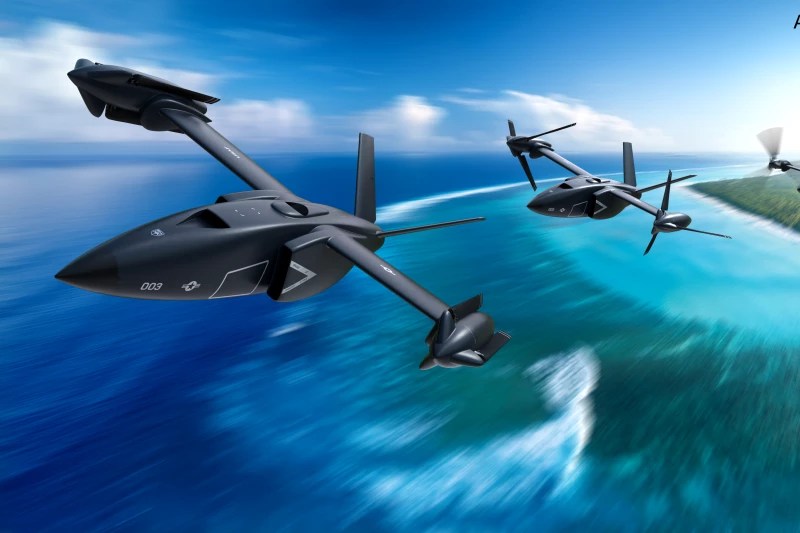

Bell Helicopter has been asked to build a flying prototype of a jet-powered VTOL that can hit speeds of up to 450 knots by DARPA as part of its Speed and Runway Independent Technologies (SPRINT) program. The new aircraft has tilting wings with engines and large propellers at the tips that allow for vertical takeoffs and landings. But once airborne with enough speed for the wings to lift the aircraft, those props can fold into the nacelle and the jet engines take over for much faster flight than any other VTOL aircraft. The project is a joint project with the U.S. Special Operations Command.
The aircraft has been under development at Holloman Air Force Base in New Mexico and at the wind tunnel at Wichita State University. The aircraft is designed to be scalable up to 100,000 pounds in gross weight and even be a little stealthy thanks to advanced digital flight controls. The aircraft is expected to operate on land without runways and to be able to land and take off from ships at sea. There is no timeline on its development.

Hard to fathom that this design would be able to have much of a payload.
Depending on it’s mission, it may not need much of a payload.
Wouldn’t a newer, larger Harrier be a better and simpler (safer) solution?
I guess that would depend on scale. The prototype may not have much carrying capacity, but the article says it’s designed to be scalable to 100,000 lbs.
The Osprey’s rotors fold. Granted, not in flight, and plausibly, not on the same axis.
E props might make the design spec more attainable.