














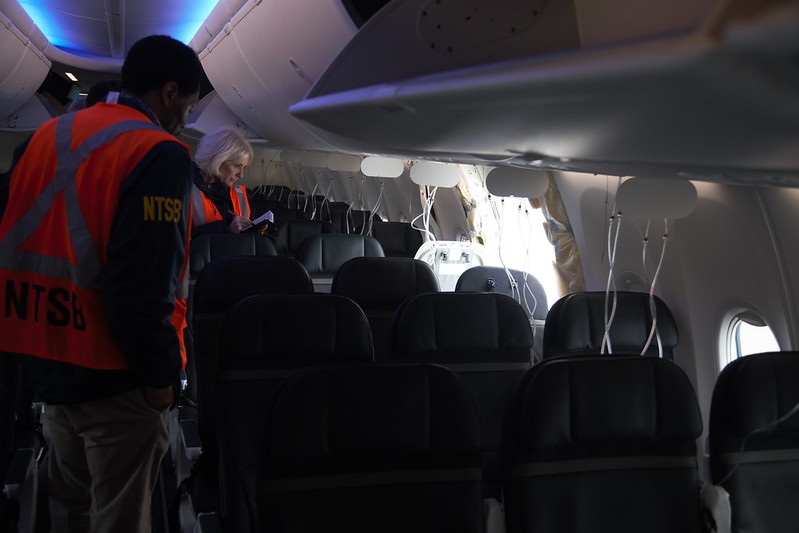

Investigators released the final report on the January 2024 Alaska Airlines door plug incident Thursday, concluding that the in-flight separation of the left mid-exit door plug was the result of Boeing’s failure to follow proper manufacturing procedures. The FAA’s inadequate oversight and audit processes were also cited as contributing factors.
The accident, involving Alaska Airlines Flight 1282, a Boeing 737-9, led to rapid depressurization while climbing out of Portland, Oregon. Eight people suffered minor injuries, and the aircraft sustained significant damage, but the flight landed safely.
Investigators discovered that four critical bolts meant to secure the left MED plug vertically were missing before delivery to Alaska Airlines. This allowed the plug to gradually shift upward during previous flights until it ultimately disengaged and separated during the accident flight.
In response to the event, the National Transportation Safety Board (NTSB) issued several safety recommendations to the FAA and Boeing. Key recommendations include requiring retrofits of all in-service 737s with a certified MED plug design enhancement, revising FAA oversight processes, enhancing Boeing’s training and manufacturing quality controls and reviewing Boeing’s overall safety culture.
The report also called for broader actions, such as requiring extended-duration cockpit voice recorders (CVRs), improving flight crew oxygen system training and increasing the use of child restraint systems on commercial flights.

Crew did well, as we all expect
Also, I have had a few incidents when I flew the F-14 essentially due to maintenance issues that were never completed correctly - I have ALWAYS suggested that were necessary in critical areas and even areas where things can ‘loosen’ over time - that a CLEAR unbreakable glass be alllowed to check items - and this is ONE case where a clear glass SHOULD be applied. Enough said. I am now an AME - so pilot / doctor and I have been in the aviation field for 40 years, and I have done numerous accident investigations in the miltary.
A hundred and forty pages that could have been answered with one short question. Who didn’t install the damn bolts and why wasn’t it inspected? Well two questions. It’s easy to point the finger at “Boeing”. That narrows it down to a few hundred thousand people in the supply chain but hides the personal actually involved. Who did the final work improperly, who didn’t inspect it and why? It sure wasn’t the CEO. This was not a training issue as thousands of these doors have been installed, removed and replaced over the years. Paper trails seldom if ever keep things like this from happening. Whoever forgot the bolts could just as easily forget the paperwork. Or even pencil whip it. Perhaps the NTSB and FAA should be more proactive instead of reactive. But of course, they are “short staffed”.
The fuselage tubes (including the door plugs already installed, I believe) are provided by a sub-contractor. I think the failure chain (or the holes lining up in the Swiss cheese (if you prefer that accident model)) started with that sub-contractor, then Boeing workers failed to do a better Acceptance Inspection, then failed to do an In-Process Inspection before the cabin interior was installed. I spent a full Naval career working on Naval aircraft following the Naval Aviation Maintenance Program policies. That program is something Boeing should adopt. It saves lives.
The facility that makes the fuselage tubes was originally a Boeing factory. They built B-29’s in world war II. Boeing sold it off to Spirit Aerospace maybe twenty years ago, and it wasn’t the brightest idea. After this event, Boeing has bought it back (at a huge loss) and it is once again an in-house factory but still not located where the “airplane” is built.
A better question is WHO did the maintenance checks all these years…
On a two month old plane?