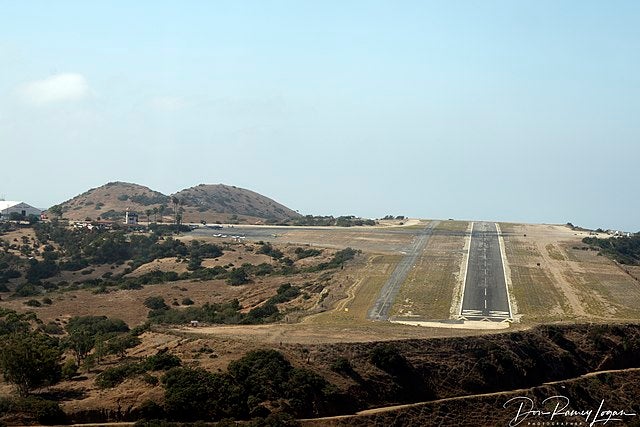

Investigators released new details surrounding the fatal crash of a Beech 95-B55 at Catalina Airport on Oct. 8, revealing that the pilot ignored warnings not to take off after dark.
The National Transportation Safety Board’s (NTSB) preliminary report states that the incident unfolded after a flight instructor and two student pilots became stranded at Catalina due to a magneto malfunction in their rental aircraft. They contacted the flight school, and another aircraft was dispatched from Santa Monica Municipal Airport (SMO) to pick them up.
Catalina Airport, which operates from 0800 to 1700, has a single runway (4/22) but no runway lighting, and night operations are prohibited. The airport manager gave the pilot permission to land after closing hours emphasizing that they needed to depart before sundown at 1831.
According to the report, the pilots encountered additional trouble when the right engine failed to restart due to insufficient battery power. They attempted to recharge the battery, but the airport manager warned that departing after sunset would be unapproved, though he could not stop them.
The aircraft took off at around 2004 from Runway 22, in dark conditions. Security video footage showed the plane descending shortly after takeoff, and ADS-B data suggested the airplane may have become airborne around the runway’s midpoint, maintaining a low altitude until reaching the departure end. The plane continued a slight descent, followed by a right turn, before the data ended about 0.6 miles west of the runway, at an elevation of approximately 1,230 feet. The wreckage was found about 450 feet further down a ravine, with the landing gear extended.
According to the NTSB, the cause of the crash remains under investigation.