















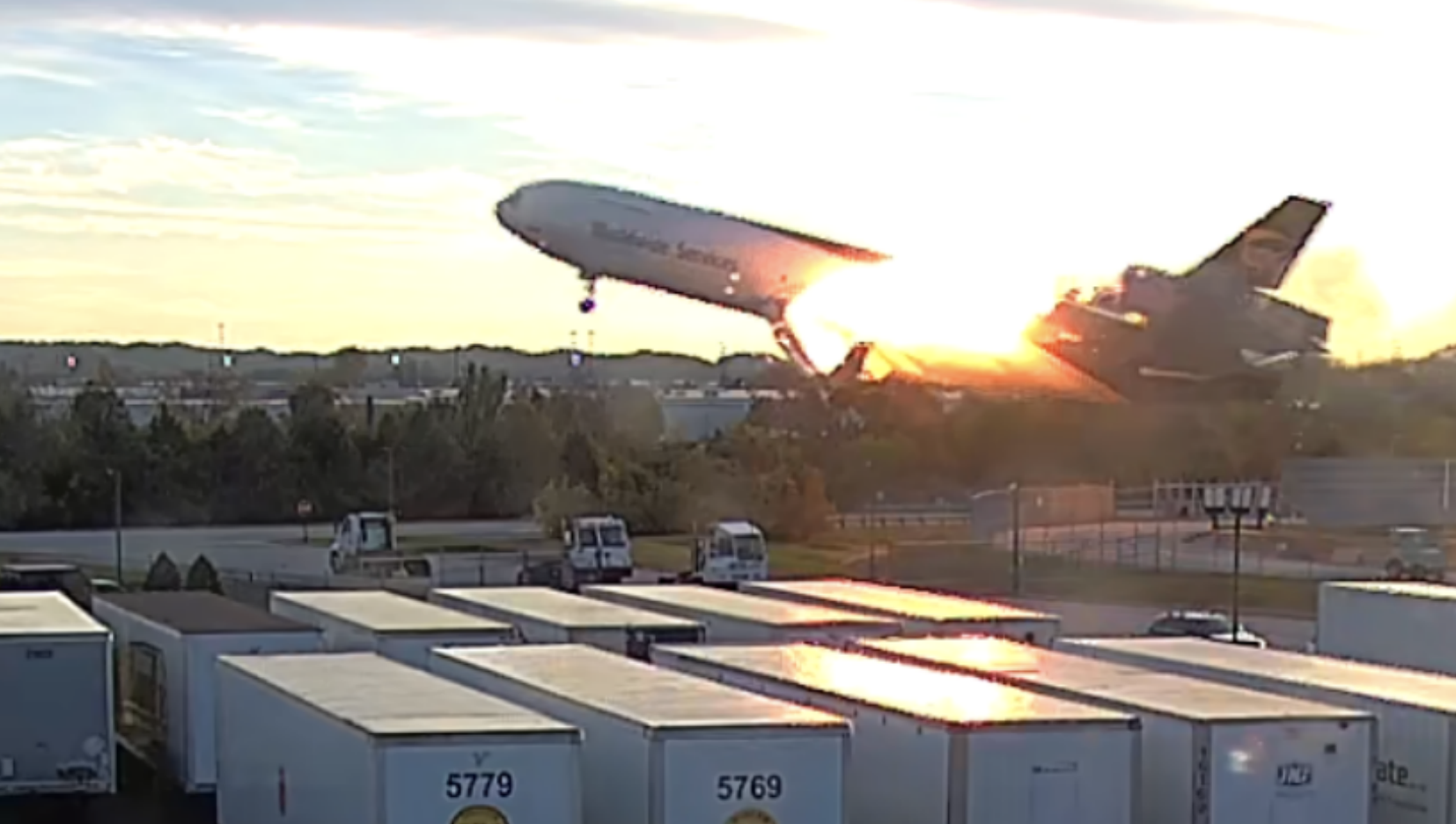

The wife of a pilot killed in last November’s UPS Flight 2976 crash near Louisville, Kentucky, has filed a lawsuit against Boeing, General Electric and maintenance provider VT San Antonio Aerospace, alleging their roles in the aircraft’s design, manufacturing and upkeep contributed to the accident. The complaint, filed Feb. 25 in Jefferson County Circuit Court, is the first on behalf of a flight crew member’s surviving family.
The Boeing MD-11F cargo aircraft was departing for Honolulu when its left engine and pylon separated shortly after takeoff, followed by a fire and crash in an industrial area south of the airport.
The accident resulted in the deaths of three crew members, including pilot Dana Justin Diamond, and 12 individuals on the ground. Diamond, a Caldwell, Texas, resident, had worked for UPS for more than 37 years and held the top seniority position on the MD-11, according to the release. The aircraft had been operating in cargo service since 2006 and was powered by General Electric CF6 engines, which had undergone recent maintenance in the weeks leading up to the crash.
The lawsuit alleges wrongful death, negligence, loss of consortium and related damages tied to the engine separation and subsequent crash, and seeks punitive damages and a jury trial.
“When an engine separates from a wing seconds after takeoff, that’s not an accident,” lead attorney Mark Lanier said. “That’s a failure by the companies responsible for building and maintaining that aircraft.”
The case names Boeing Co., General Electric Co. and VT San Antonio Aerospace as defendants.


Isn’t it premature given that the final report on the accident is not in yet?
I understand that AD 98-25-15 requires a visual inspection every 1,500 landings. Eddy Current Inspection:AD 95-23-07, which references McDonnell Douglas Alert Service Bulletin MD11-54A049 (Revision 03), requires eddy current inspections of the left and right upper spar angles on the No. 1 and No. 3 wing pylons. It seems that the inspection was accomplished within the mandatory 72 month period since October 2021 but that might not be adequate for an older aircraft. The separation occurred around a bearing on the left engine pylon that showed fatigue and cracking. I’m not sure if the AD or SB addressed that area of the pylon.
While it is unfortunate that a lawsuit must be initiated to fully adress the compensation of individuals that were wronged in an incident like this it is most often needed as corporations tend to bury evidence of malfeasance in a regular basis. Have said that yes now is the time to start the very long process of a civil case. The final report will come in time .
The problem here is that the first order evidence points to a fatigue to fracture failure of a critical component. While there is a recommendation of the supplier as to indications those are alway subject to the specific circumstances of use.
Harkening back to tha infamous aloha flight where a catastrophic structural failure occurred on a medium life aircraft when cycles were counted it actually was the highest cycle count.
Now freighters live a different life than passenger aircraft and the load factors are nit the same nor operational protocols. This will I predict be the focus of the court effort.
Again he good part of the terrible accident was that it could have been much worse if that failure was a few min later w the aircraft landing on a population center.
Mcpocci, this is VERY well said. You nailed the issues.