















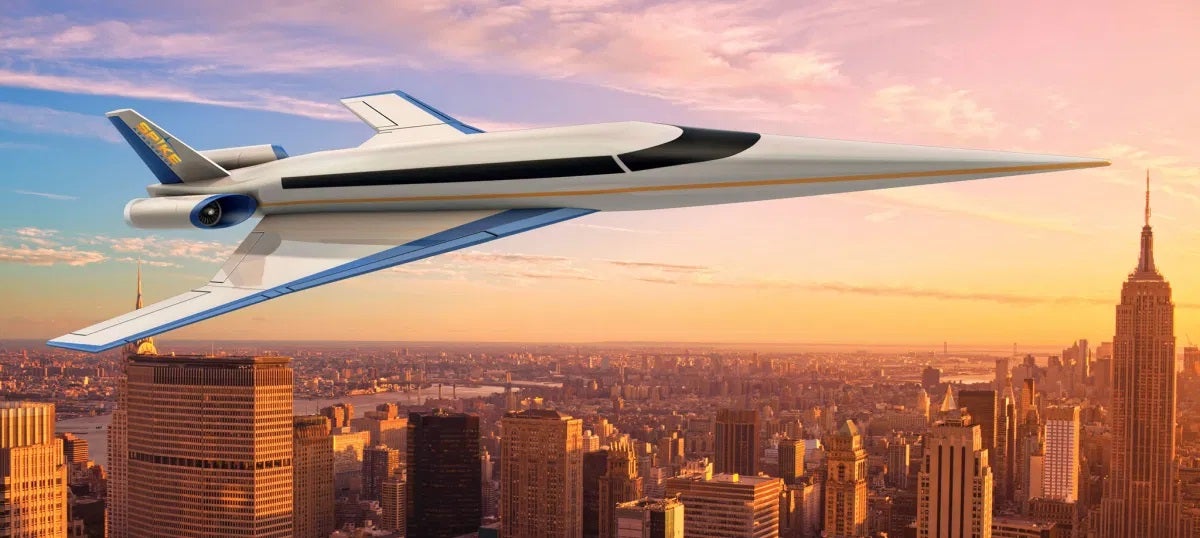

Spike Aerospace says it is moving ahead with development of its S-512 Diplomat, a supersonic business jet in design for international routes. The company reported last week that engineers are conducting new studies to shape the jet’s aerodynamics, cabin layout and noise profile. The aim is to meet strict limits for supersonic flight over land, a hurdle that has limited previous high-speed designs.
The S-512 project has gone through multiple design iterations since its introduction and is now centered on reducing noise while maintaining long-range performance. Spike officials say the jet is being engineered to fly from New York to Paris in less than four hours.
“Our goal is to redefine long-distance travel for business and government leaders, offering the speed of supersonic with the comfort and discretion of a private jet,” company president, Vik Kachoria, said.
The company said it is also recruiting engineers from a variety of established aerospace firms while also initiating partnerships with universities to support certification planning. Alongside the technical work, Spike launched a new website as part of a broader brand update. Spike Aerospace said it is positioning the S-512 as a faster option for business aviation while addressing concerns over noise and environmental effects that have challenged supersonic aircraft in the past.


Have they done wind tunnel tests?
Have they built and flown a demonstrator, as Boom Supersonic has?
How deep are their pockets?
Serious questions, especially given the failure of an earlier venture to do more than make a mockup. So could not attract investors.
An earlier article said it is partnered with ‘Tech Mahindra’ which seems to be a design consulting company, perhaps part of Mahindra of India.
There is experience making parts for aircraft in India, such as Tata which is an Indian manufacturing conglomerate.
Predicting 1.6M speed, I forget what Boom wimped down to from its initial goal of 2.2M.
Key for an airliner is round trip time in the face of curfews for all airplanes with some allowance for delays, to get utilization of capital investment, I suggest a business jet is somewhat sensitive to that as well, to get pax back home.