
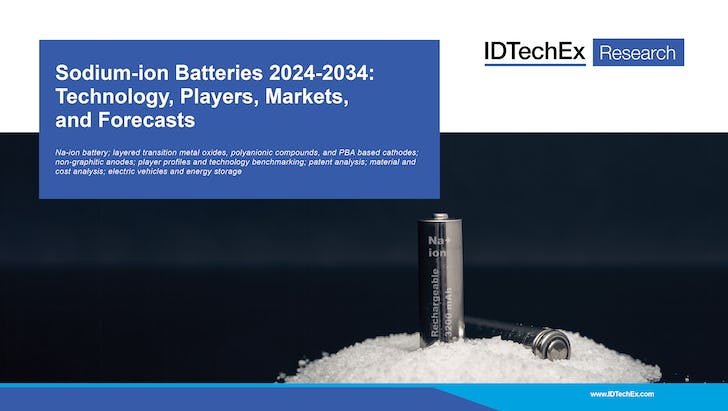

Cambridge, U.K.-based market research firm IDTechEx released a statement yesterday (Jan. 10) on how it believes sodium-ion batteries are safer, more practical, less expensive, more sustainable and potentially higher performing than “traditional” lithium-ion batteries. The company announced it has scheduled a free webinar, Decoding Sodium-ion: Market Insights and Outlook, on the topic, scheduled for Jan. 25. In addition, the company’s website has a detailed report on the topic.
IDTechEx Senior Technology Analyst Shazan Siddiqi, a veteran of the Tata Motors advanced manufacturing team, said sodium-ion (Na-ion) batteries can be made with widely obtainable, inexpensive materials, sodium being much more readily and sustainably available than lithium. And an Na-ion battery can use aluminum anode current collectors rather than copper, as used in lithium-ion batteries, mitigating supply chain risk as well as reducing cost. And while lithium-ion batteries must be stored with a 30 percent charge, sodium-ion batteries can be stored and shipped at zero volts, reducing risk during the transportation process.
Siddiqi adds that Na-ion batteries’ electrolytes have a higher flash point than lithium-ion systems, reducing the flammability risk that has dogged the advance of current battery technology. And the announcement further notes that the production process for sodium-ion batteries is similar enough to that of lithium-ion batteries that scaling up the manufacturing for the new technology infrastructure can piggyback on existing facilities.
IDTechEx acknowledges that the energy density of today’s lithium-ion batteries is still superior to that of sodium-ion units, “but they are approaching the energy density of high-power lithium iron phosphate (LFP) cells.” And sodium is 3.3 times as heavy as lithium, though the company points out that those materials make up a small percentage of the batteries’ overall mass.
As for cost, IDTechEx cites estimates of as much as 30 percent reduction in materials costs for the new batteries compared with a current generation battery. Accordingly, Siddiqi writes, “The sodium-ion chemistry will certainly not be the answer for all applications; however, it will be well-suited to complement, rather than displace, the existing and future lithium-ion technologies in many applications.”