















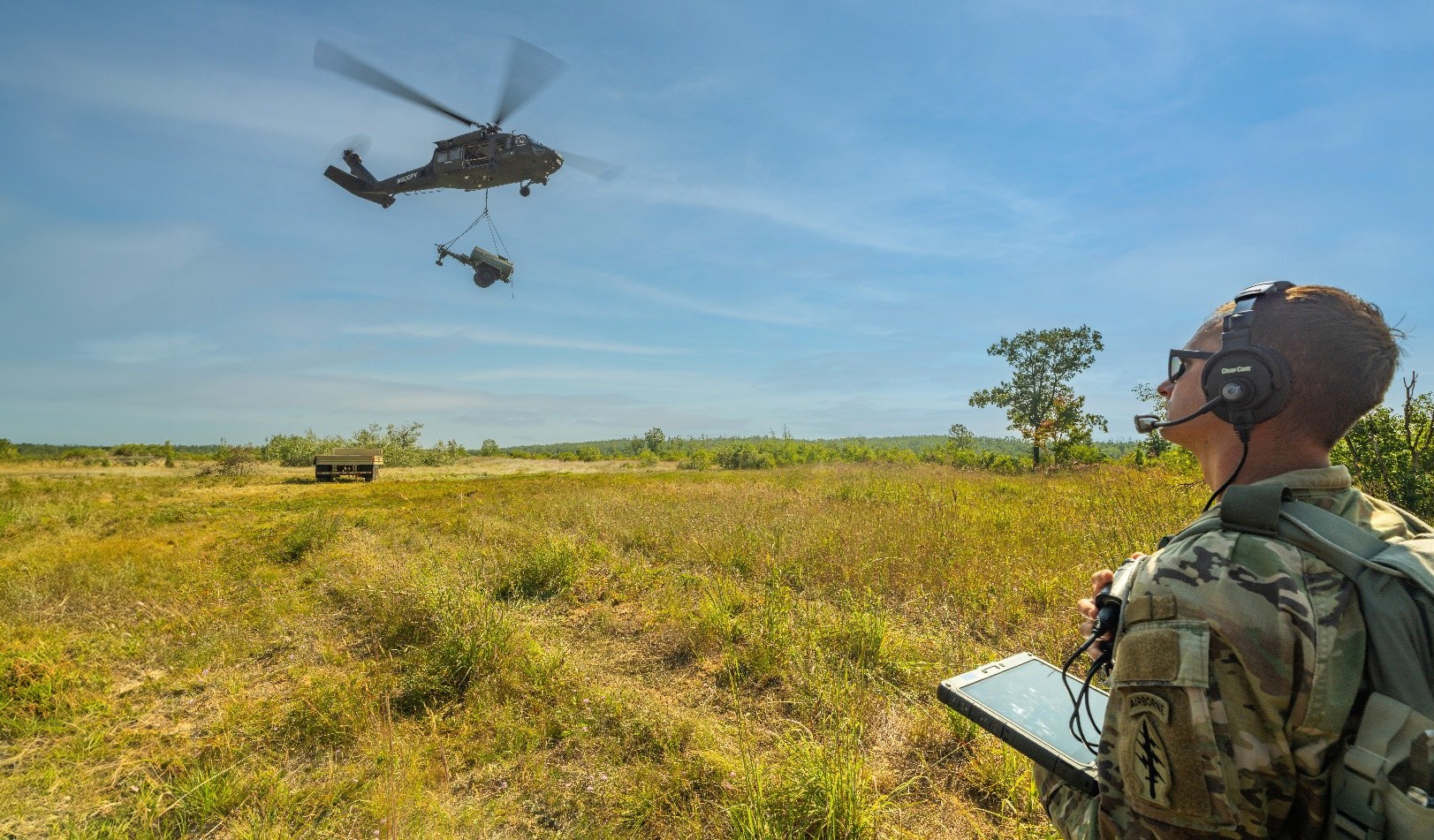

A U.S. Army National Guard soldier planned and executed autonomous missions using a Sikorsky Optionally Piloted Black Hawk helicopter powered by MATRIX™ technology, Lockheed Martin said Thursday. Lockheed said the soldier was not a trained aviator.
Demonstrations took place during Northern Strike 25-2 in August at Camp Grayling, Michigan. The aircraft was fielded in partnership with the Joint Personnel Recovery Agency and the Defense Advanced Research Projects Agency (DARPA).
The soldier, trained in less than an hour, used a handheld tablet to command the helicopter to transport cargo 70 nautical miles and perform multiple precision airborne drops.
During the exercises, the MATRIX-equipped Black Hawk conducted several first-time operations, including an autonomous external sling load and a fully automated MEDEVAC recovery. In one mission, soldiers used the aircraft’s hover-stability system to attach a 2,900-pound water tank while airborne. In another, the Black Hawk transported HIMARS launch tubes and performed a simulated patient transfer to a piloted helicopter at an unimproved landing site. Lockheed said the demonstrations were conducted to assess how MATRIX autonomy could support logistics, resupply, and recovery operations without requiring onboard pilots.
“With lives on the line, Sikorsky’s MATRIX flight autonomy system can transform how military operators perform their missions,” said Rich Benton, vice president and general manager of Sikorsky. “An optionally piloted Black Hawk aircraft can reduce pilot workload in a challenging environment or complete a resupply mission without humans on board. In contested logistics situations, a Black Hawk operating as a large drone offers commanders greater resilience and flexibility to get resources to the point of need.”
Benton said the system allows a Black Hawk to operate autonomously or reduce pilot workload in demanding environments. Sikorsky stated that the demonstration at Northern Strike provided data to inform the continued integration of autonomous capabilities in military aviation.
Sikorsky, owned by Lockheed, has also been developing emergency response variants of the autonomous Black Hawk, based on the same MATRIX platform. The company also announced it’s S-70UAS U-Hawk, a fully autonomous version of the UH-60L Black Hawk helicopter, earlier in October.These developments come as the U.S. Army announced in September that it would begin cutting around 6,000 aviation roles in FY 2026 and 2027, in a move towards increased reliance on autonomous flight capabilities.


0 replies