
















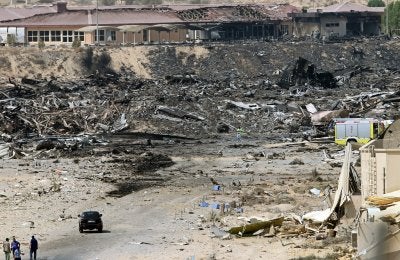
A newly released 322-page report on the Sept. 3, 2010, fatal crash of a UPS Boeing 747-44F noted “catastrophic uncontained fire” in an area that carried a “significant number” of lithium batteries as cargo, but did not resolve how the batteries ignited.Both pilots were killed in the crash. There were no other people on board. The General Civil Aviation Authority (GCAA) of the United Arab Emirates’ report said the fire directly affected independent systems “necessary for crew survivability.” Specifically, extreme heat resulted in failure of the captain’s supplementary oxygen system, leading to his incapacitation. UPS pilots, through their union, have been working with the carrier on an active fire-suppression system. The report included several recommendations, including some for the FAA.
The crash took place after the cockpit filled with smoke. The pilots elected to return to Dubai rather than attempting to land at another, closer, airport. At Dubai, they overshot the airport, made a tight turn and crashed near a military base. The union, working together with UPS, has designed, built and tested its new container system, which they hope will prove capable of containing a fire for up to four hours. The containers disperse a potassium-based aerosol suppressant and apply a more fire-resistant design. UPS has said it lost two of its best pilots in the Dubai crash and it is determined to “minimize the risk associated with onboard smoke and fire events.” The GCAA report specifically calls on the FAA to require that pilots have access to full-face oxygen masks. It asks the FAA to cooperate with other regulatory agencies to mandate “vision assurance devices,” including mask-mounted thermal imaging devices, to aid visibility during continuous smoke in the cockpit emergencies. The Independent Pilots Association (IPA) supports the report’s findings. UPS recently ordered more than 1,800 shipping containers with improved fire resistance, potentially giving pilots up to four hours longer to deal with an onboard fire emergency.Find the full GCAA report online here. (PDF; may take some time to load.)

