















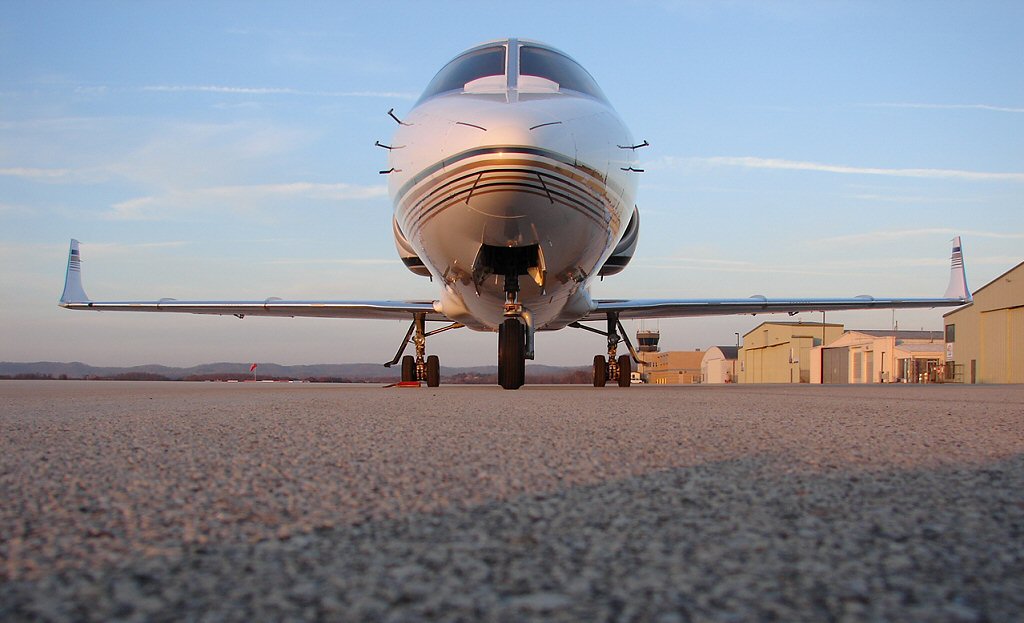

Nine people were killed Sunday when a Learjet 60 went down in a residential neighborhood in Palm Beach County, Florida, according to federal officials. The aircraft was traveling from Austin, Texas, to North Eleuthera Airport in the Bahamas when the accident occurred around 12:50 p.m. local time on Nov. 1. Transportation Secretary Sean Duffy confirmed that all nine people aboard were killed.
The privately operated Learjet departed Austin-Bergstrom International Airport earlier that morning. According to ADS-B data, the jet climbed to 41,000 feet before beginning a descent near Naples, Florida, to approximately 35,000 feet. Shortly before the accident, the aircraft briefly climbed before entering a steep descending right turn. ADS-B recorded a maximum descent rate exceeding 32,000 feet per minute before tracking information was lost.
Icing and Turbulence Reported
“We have light, clear ice that is manageable and moderate turbulence,” a pilot told Miami Air Route Traffic Control Center, according to air traffic control audio captured by LiveATC.net.
BREAKING UPDATE | A jet plummeted onto a busy Greenacres roadway Sunday afternoon, triggering a fiery explosion that sent a boom echoing for miles and prompted a massive emergency response. Read more: https://t.co/bwjIAmATF9 https://t.co/J1WNuqrdWe
— WPEC CBS12 News (@CBS12) November 1, 2026
The crew subsequently reported precipitation, requested a climb and declared an emergency. In a later transmission, the pilot reported an overspeed condition and a descent rate reaching 20,000 feet per minute.
Thunderstorms were present across South Florida at the time of the accident. A nearby National Weather Service weather observation recorded thunderstorms in the vicinity, three miles of visibility and winds gusting to 19 knots approximately 15 minutes before the accident. The Learjet appears to have passed through a stronger thunderstorm cell several minutes before its rapid descent began.
Investigation Underway
The accident left a large crater and scattered wreckage near homes and a roadway. Emergency crews responded to fires and secured the surrounding area. Authorities have not yet confirmed whether anyone on the ground was injured.
The NTSB will lead the investigation, assisted by the FAA. Investigators have not determined what caused the Learjet’s rapid descent or whether weather conditions contributed to the accident.


Unfortunately, the com audio is all over the web and is one of the most heart wrenching I have heard. I assume the copilot was handling the radio and she was doing her professional best to let ATC know what was happening and perhaps help us analyze the cause. The pitch of her voice rises and those chilling final words emerge as the ground raced up at 30,000 ft./min. Words which may go into history alongside “let’s roll”: “we’re out of time.”
Very sad, and very chilling audio. Clear ice at -41*C in severe turbulence, looks like the vertical stabilizer and T-tail broke off
‘There’s weather you can’t fly through.’
NTSB reports that pieces of most of one elevator were found back from the crash site.
When they broke off in the flight will depend on descent angle, which was steep.
Finding the CVR will take time as water has filled the impact crater.
Beware of pontificators who have much aviation experience.
They don’t have all the facts and don’t think things through well enough.
Yet to be determined, …but “runback icing” on a super-critical wing is a deadly combination.
Nothing beats experience. NOTHING.
NO TWENTY YEAR OLD BELONGS IN A LEAR60, I don’t care if they are a flying savant. The fact is, it takes a LOT of time to build awareness and skill when dealing with weather.
Wanna take a shortcut in experience? Most of the time, you’ll live. But then there’s that one day you reach into the bag and its empty. Unforgiving, brutal, and entirely avoidable… if only you had but more experience.
What? And shut down half of YouTube?!
Good advice for the white male who was flying the plane.
Good advice for everyone… what is your point (white male)?
Without question, this is a tragic mishap. We don’t know all the facts, but several have emerged.
We know the acft was in icing conditions at a high altitude and the flt. crew was experiencing turbulence in the a fairly severe thunderstrom.
It was reported that the left horizontal stabilizer was founf four miles from the mishap site. We know the acft impacted the ground without either horizontal stabilizer.
Without other facts, one can only speculate. If the ice accumulation on the horizontal stabilizer continued to increase to the point of accute structural icing, combined with severe turbulance, it’s possible it failed structurally causing to separate from the empanage. And, at some point, the right one separated.
Hence, total loss of flt. control.
However, two considerations are worthy of discussion.
1 - Were the anti-ice and deice systems operable? If so, why weren’t the used? One can assume ice build up on the wings and empanage was a causal factor.
2 - If the flt. crew had a good WX brief and was continuing to monitor the WX, why didn’t they amend their flt. plan and request a lower altitude to fly in less harsh conditions?
While there is still more to sort out, it’s plausible that the pilots didn’t exercise good judgment in attempting to fly over the T-strom and perhaps not fully understanding the vagaries of icing and it’s effects on the acft.
I feel very sad this mishap happened as it may appear it was preventable.
Recently, there was a similar mishap in Montana that cost the lives of six or so. Severe icing conditions is nothing to take lightly.