















A firefighting helicopter involved in a fatal accident in Yosemite National Park last month experienced problems with its water bucket earlier in the day, according to a preliminary report released by the National Transportation Safety Board. The Airbus AS332 L1 Super Puma was conducting water drops on the Dome Fire on Sept. 20 when the accident occurred, killing both pilots aboard. The cause of the accident remains under investigation.
Earlier that day, the helicopter completed more than 25 water drops during a 2.9-hour firefighting flight over Yosemite. The aircraft was carrying an 800-gallon Nomad bucket suspended from a 200-foot longline. According to investigators, the crew experienced problems with the bucket during the flight. After the helicopter returned to its helibase, mechanics tightened the bucket’s air pressure regulator and performed a pressure check before the aircraft departed for another firefighting assignment.
Final Water Drop
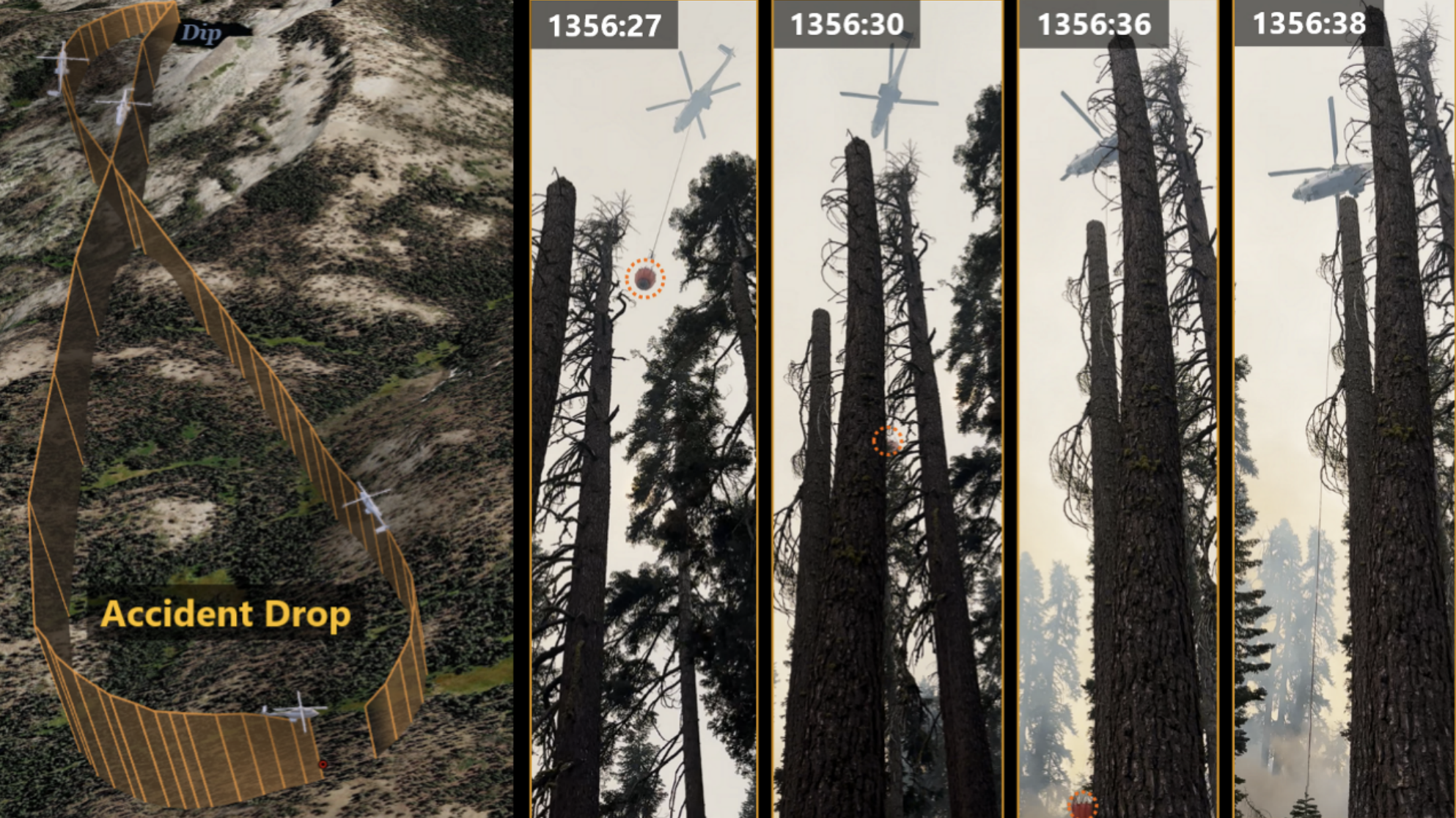
The helicopter departed its helibase around 1:28 p.m. and completed two water drops near helispot H-5 after collecting water from Ostrander Lake. During the third Yosemite drop, which began at approximately 1:56 p.m., the bucket emptied in about three seconds before the helicopter yawed to the left. Investigators determined from flight-tracking data and video recordings that the helicopter’s groundspeed decreased to approximately 4 knots as its descent rate reached 1,344 feet per minute.
“The bucket appeared to drop almost vertically and then contacted the ground about 1356:38,” the NTSB stated.
The helicopter’s cargo hook released the longline approximately one second later, and the aircraft appeared to move forward. Investigators reported that the helicopter struck trees about five seconds after the bucket contacted the ground. The wreckage came to rest on sloping, forested Yosemite terrain at an elevation of approximately 8,150 feet.
Investigation Continues
Investigators located the bucket about 90 feet from the main wreckage and found the cargo hook in its locked position, consistent with a normal electronic release rather than a manual release. Much of the helicopter was consumed by a postimpact fire, leaving extensive damage to the cockpit and instruments.
The NTSB recovered and downloaded the cockpit voice recorder and conducted a preliminary analysis of engine and rotor speeds using audio from ground video recordings. Additional examination of the wreckage is planned as conditions permit. The agency has not determined what caused the helicopter to descend into the trees.


A 200 foot long line and 800 gallon bucket are difficult to control since they take on a life of their own that the pilot has to compensate for constantly. The helicopter may have been near its maximum load limit without much of a performance margin to deal with bucket problems.
It is a sizeable helicopter, many in use - Okanagan Helicopters flew them offshore Newfoundland to oil platforms. I worked on them. Eurocopter AS332 Super Puma - Wikipedia
I don’t have a feel for the length of long line, there were trees - how tall?
It’s an odd accident:
I cannot find information on ‘Nomad bucket’, only a Nomad utiity trailer loaded with equipment for firefighting including pump.
There are several designs in the world but I favour the proven Bambi Bucket from a Richmond BC inventor. This case does not look like a Bambi Bucket to me.
Sounds like density altitude might’ve played a major role?? I’m not a rotorcraft pilot, but 8,000+ MSL, likely close to 7,000’ load, they slowed to 4 knots… would I be correct that if the bucket didn’t empty in a timely manner they’d not be able to maintain altitude out of ground effect at that density altitude? Hence the release of the bucket but by that time it was too late to get enough forward airspeed to climb out of ground effect. Also possibly settling of power situation? Again, I’m not a rotorcraft pilot and know just enough to get it really wrong…
EDIT: From what I could find, HOGE is 6,070’ ISA at gross. 4 knots GS at 8,000’+ with a full bucket— they must’ve been right at the absolute limits of being able to hover. No margin left…
The preliminary NTSB report with photos almost seems like the bucket got snagged in a tree. If that happened, then the pilot would have dropped the bucket, which happened. But if the long line was caught in the tree, then it would take a few seconds after dropping the bucket to figure that out and release the long line. By then the helicopter might have been jerked downward where the main rotor hit a tree. I don’t know if the flight data or voice recorder will help figure out if that happened.
Engine power level was increased.
NTSB photos seem to show bucket was well above trees, whereas with an earlier drop it was close. But I suppose there may have been a tree or three that were taller, report flags three trees.
The key is the 1344 foot per minute descent rate; can not be stopped immediately. So the helicopter continued down until it struck the trees! Does not seem like a mystery. If the helicopter pilot had released the water in the bucket at one or two minutes earlier; he or she could probably have avoided the trees. Hindsight is always 20-20! A downward movement of 1344 feet per minute is significant and needs time for recovery. This long time pilot gets goosey with any downward movement over 400 feet per minute. So, the helicopter pilot was doing too much up and down and got comfortable with 1000 feet per minute downward movements. Adding close to the trees, resulted in tree contact, evidently!