















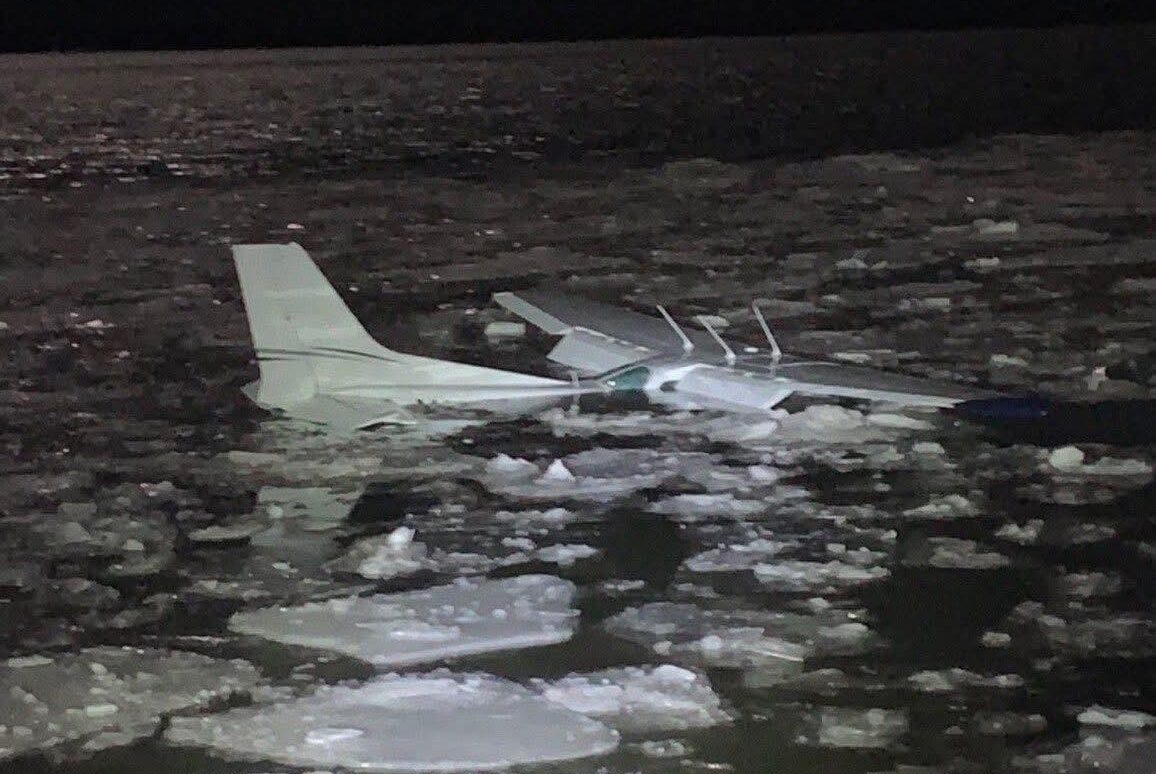

The National Transportation Safety Board released its preliminary report on the March 2 ditching of a Cessna 172N in the Hudson River near Newburgh, New York. The airplane, operating a Part 91 instructional flight, was substantially damaged after an engine-power emergency developed shortly after a touch-and-go at New York Stewart International Airport. The flight instructor and student pilot suffered only minor injuries.
The instructor told investigators that the engine was not producing normal rpm after departure from Stewart. When he leaned across the cockpit to check the gauges, he saw oil pressure at zero, declared an emergency and requested a direct return to the airport. The engine then began running “extremely rough” before losing power entirely. He took the controls from the student pilot and determined the airplane would not make it back to Stewart.
A Night Emergency Over Cold Water
He chose to put the airplane into the Hudson River near the western shore, in what he described as the area “with the most lighting.” Conditions at Stewart at 7 p.m. included clear skies, 7 miles visibility, light wind and a temperature of minus 2 C. The report does not say how much altitude remained when the engine quit or whether a restart was attempted before the ditching, although the loss of oil pressure suggests a restart would have been unlikely, regardless.
The airplane came down among broken ice floating on the Hudson River and struck underwater structures that damaged the fuselage. Both occupants got out and made it safely to shore. The airplane remained partially afloat with the wings at the surface until it was was recovered the next day.
What Investigators Have, and Haven’t, Said
At this stage, the NTSB is limiting itself to the basic facts. The wreckage was retained for further examination. A Lycoming representative is listed among the participants in the investigation, along with FAA personnel from Teterboro and Farmingdale. The agency also noted that it did not travel to the scene.
The report also fixes the point at which the instructional flight became the instructor’s emergency. He took over from the student pilot after the engine deteriorated and it became clear the airplane could not reach the airport.
The preliminary report does not say what caused the loss of oil pressure or whether any preexisting engine condition played a role. That will wait for the wreckage examination.
What it already shines a light on, though, is the shape of the instructor’s decision making. Once Stewart was no longer reachable, the instructor was not choosing between good options, but between increasingly narrow ones. He seems to have recognized that reality quickly and appears to have acted decisively, committing to a controlled ditching at night in a spot on the Hudson River with enough light to be useful while there was still enough time and airplane left to do it. In that sense, the most important part of the sequence may prove to be not only what failed under the cowl, but how promptly the cockpit understood what that failure meant.


Single engine at night over a hard blocks with canyons between, and water?
Ummm…
and they survived a perfectly legal operation. What would have been better during the day? 100 people killed in US car accidents every day ? My back ground is over 50 single engine flights across the N. Atlantiic/ Pacific day and night. Now 85 and still alive to fly my LA4-180. If you are that scared of single engine ops, I would suggest giving it up. 9’000 TT, A&P/IA
“If you are that scared of single engine ops, I would suggest giving it up.”
“Scared” no… prudent, yes.
Thankyou for saying that.
Clearer vision of the space between huge blocks, in hopes you could go between them down to street.
(They were able to get to a lit area of the water to see obstructions and be more visible to rescuers.)
Legal does not equal wise.
Nothing to do with road accidents, but I could draw parallels of:
Happened in Calgary AB one day, on 6+ lane street. I always drive in centre lane. Had just checked to left in rear view side mirror, saw a big car moving toward my right fender. So I wheeled over into the left lane. Offender realized mistake late but I was already out of his way - and prepared to brake hard if he swerved further. So my good practices avoided an accident.
(Some people like to swerve across several lanes to make an exit - common on H1 at east end of Abbotsford BC city eastbound to make exit cloverleaf north into the town.)
Ohh God you sound like a lot of the wives who won’t fly because… of the above. They are prudent. “If I don’t fly I won’t crash”. Makes sense to me.