















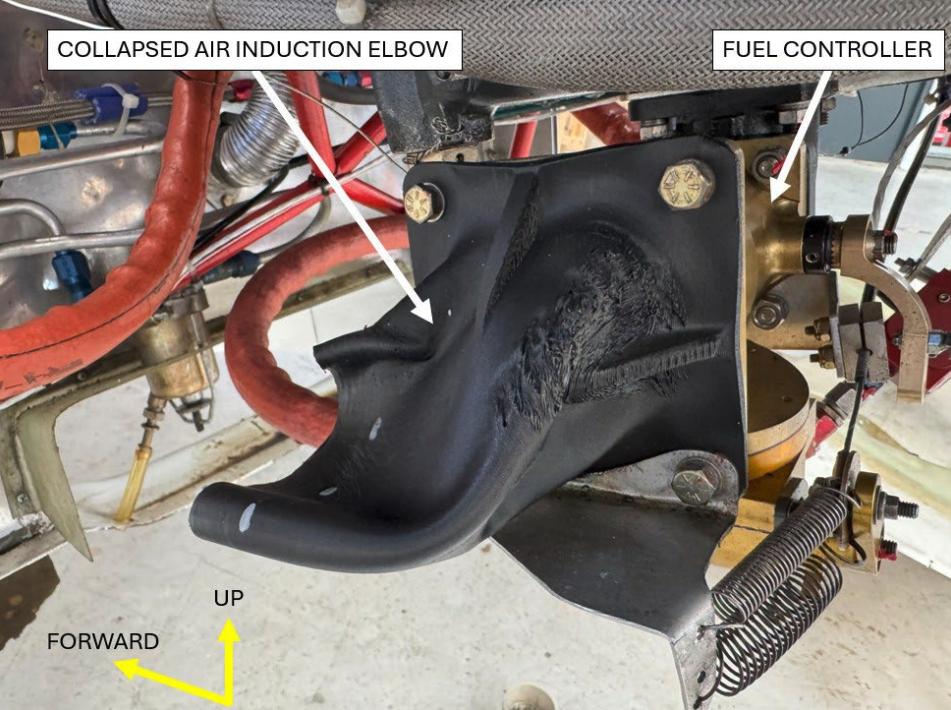

British investigators released a report Thursday that linked an accident involving a Cozy Mk IV homebuilt aircraft to the use of a 3D-printed induction elbow. The aircraft was destroyed after losing engine power on final approach to Gloucestershire Airport in England.
Engine Failure on Final Approach
According to the U.K. Air Accidents Investigation Branch (AAIB), the single-seat flight was returning from a local outing on March 18 when the pilot initiated a GPS-based approach to Runway 09. The pilot advanced the throttle about 500 feet above ground to execute a planned go-around, but the engine was unresponsive and the aircraft landed short of the runway.
3D-Printed Component Found to Be the Cause
The AAIB report determined the loss of power resulted from a plastic, 3D-printed air-induction elbow that softened and collapsed in the engine compartment, severely restricting airflow. The aircraft’s previous owner purchased the part at an airshow in the U.S. and installed it during a 2019–2022 modification of the aircraft’s fuel-injection system.
Although the aircraft’s original plans specify a laminated fiberglass assembly reinforced with an aluminum inlet tube, the printed component did not include the metal support and was believed—incorrectly—to withstand higher temperatures. Lab testing later showed the part’s glass transition point was far lower than expected.
Oversight Gap and Planned Safety Actions
The previous owner had the modified fuel-injection system approved by the Light Aircraft Association (LAA), which oversees amateur-built aircraft approvals in the U.K. However, because the induction elbow was not listed on the modification’s parts sheet, the LAA did not evaluate the component during the system upgrade.
In the end, the AAIB report found that it was the material failure of the elbow that directly led to the engine’s power loss and the subsequent off-runway landing.
The final report said the LAA plans to issue an alert to inspectors outlining safety concerns with 3D-printed components and will ensure the guidance is referenced whenever a permit to fly is renewed.


Why I would never get into a homebuilt. You never know what was thrown into those things.
Risking life just to save a few bucks. Stupid.
Now he’s walking around on 3D printed crutches.
He’s lucky! Could’ve been a 3D printed casket!
I’ve seen home built aircraft meticulously put together better than any factory airplane. And then I’ve seen some thrown together like the jalopy Jethro Bodine drove in the Beverly hillbilly show.
I’ve seen many built more meticulously than a factory produced aircraft ever could be. They probably got sold a bill of goods on that printed part unfortunately.
Common sense is just not as common as it used to be.
This accident… due to a 3D printed plastic part… IS being discussed in the aerospace ‘additive manufacturing’ [3D manufacturing] world.
Part was obviously made from low strength, low temperature inferior plastic material… that was never subjected to loads/pressures/temperatures/cycles of the engine operating environment.
‘Caveat Emptor’… ‘[Let the] Buyer beware’ -ancient Latin
‘Caveat Erector’… ‘[Let the] Builder beware.’ –JRB, Eng-Tips forums