















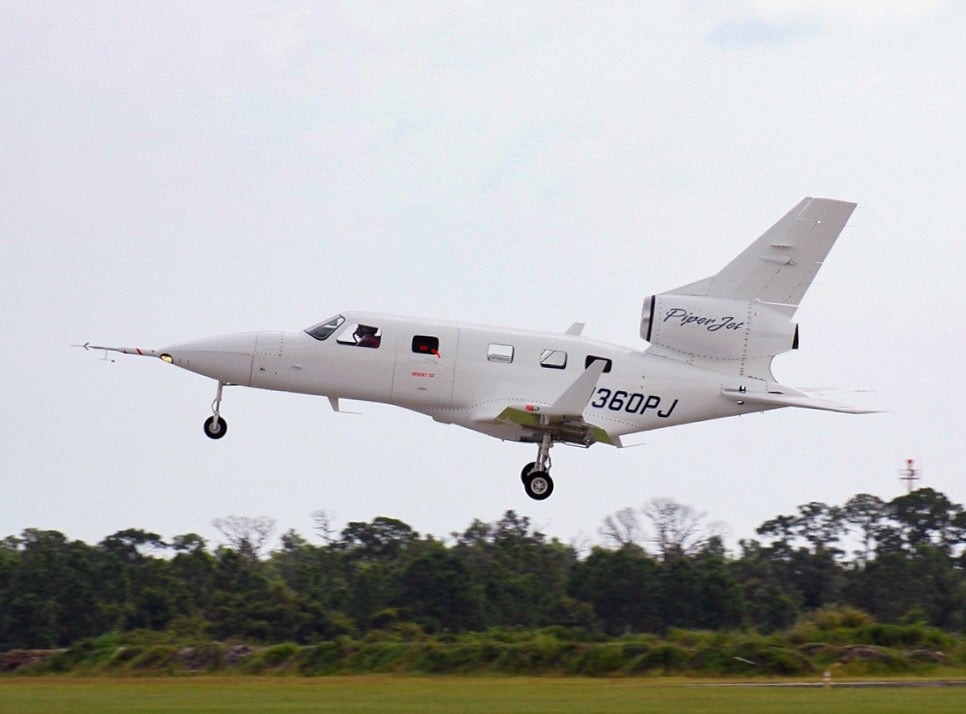

When an unusual looking tail-mounted-single-engine PiperJet took off for the first time in Vero Beach, Florida, it marked a milestone 71 years in the making. It was the summer of 2008.
The aircraft was powered by a Williams FJ44-3AP engine and promised a cruise speed of 360 knots at 35,000 feet. It was Piper Aircraft’s first venture into jet propulsion and its boldest step yet toward modernizing its brand.
For a company known for the yellow J-3 Cub and a long line of mostly piston and turboprop singles, the PiperJet seemed to point to a new horizon. Early results were promising: the jet flew smoothly, reached 10,000 feet and 160 knots on its first flight, and Piper claimed more than 200 customer deposits. At $2.2 million, it was pitched as a practical, efficient “personal business jet” for owner-pilots.
But by the time a mock-up of the renamed PiperJet Altaire appeared at the 2010 National Business Aviation Association convention, the world had changed. The global financial crisis had gutted the light jet market and Piper itself had new owners. In 2009, the company was sold by American Capital to Imprimis, a private equity fund backed by investors from Brunei. The new owners infused cash and promised a global push, especially in Asia.
Piper CEO Geoffrey Berger called it the start of “a new era in aviation history.”
A Redesign and Renewed Optimism
Under Imprimis, Piper expanded production, opened new overseas offices, and reimagined its jet. The Altaire featured a larger, round fuselage to replace the earlier design based on the Meridian, promising a more spacious cabin and refined aerodynamics. Piper added more than 140 engineers to the development team, invested in a new 75,000-square-foot assembly facility, and began hiring aggressively.
At the time, Piper projected certification by 2014 and displayed full-size mockups at major airshows. Executives described the Altaire as “the next logical step” beyond the company’s M-Class turboprops, offering jet performance with turboprop economics. The company’s backlog, it said, was enough to sustain the first three years of production.
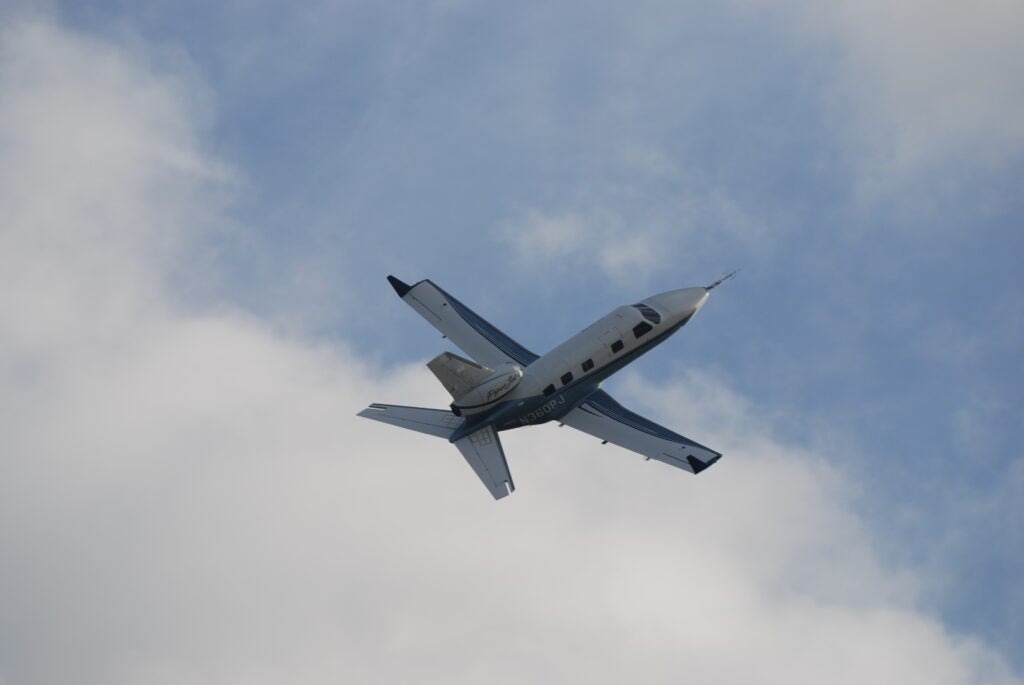
The airplane itself was an unusual design. To avoid asymmetric thrust, the single engine sat atop the fuselage, integrated into the vertical tail. The configuration solved some problems but created others. Engineers battled the effects of a high thrust line, which caused the aircraft’s nose to pitch down with power increases and up with power reductions. Piper’s solution, a clever Coanda-effect exhaust nozzle that subtly varied thrust angle with speed, was both simple and elegant. Test pilots later said power changes produced less pitch effect than on some propeller aircraft.
Still, the design carried inherent challenges. A single engine certified to 35,000 feet meant complex systems for pressurization, icing, and redundancy, and the Federal Aviation Administration had reservations about approving such a high operational ceiling for a single-engine jet.
Reality Sets In
Even as the engineering team advanced, the economics began to unravel. Development costs mounted, and by 2011 Piper’s management was under pressure to justify the project amid a weak global market for light jets. Sales in the segment had fallen sharply, and competitors such as Cirrus, Eclipse, and Diamond were facing their own financial difficulties.
Industry observers questioned whether the numbers would ever add up.
“It’s a tough market and Piper has a difficult product portfolio,” aerospace analyst Richard Aboulafia said when the company changed hands in 2009. By 2011, AVweb’s own analysis was blunter.
It was thought that Piper would need to spend between $100 million and $200 million to complete certification and would need to sell hundreds of Altaires just to break even. With a sticker price of around $2.6 million and tight profit margins, the math was hard to justify.
On October 24, 2011, the company made it official. Piper announced it would “indefinitely suspend” the Altaire program, laying off about 150 employees and releasing another 55 contractors.
Interim CEO Simon Caldecott said the decision followed a thorough review of forecasts showing development costs “had risen above the point that were recoverable under foreseeable light-jet market projections.”
Caldecott emphasized that the program had been “on schedule, on budget, and hitting performance targets,” but the economics simply didn’t work.
“Clearly, the market for light jets is not recovering sufficiently and quickly enough,” he said. Customers who had placed deposits—estimated at more than 100—were refunded or offered credits toward other Piper products.
Aftermath and Reflection
The cancellation hit Vero Beach hard. The layoffs dropped Piper’s workforce to about 700, triggering potential repayment obligations for state and county incentives tied to employment levels. Local officials and workers expressed disappointment but little surprise.
“It’s hard to be focused when you don’t know what your future is,” one engineer told Vero News.
In the years since, the PiperJet has taken its place in aviation history as a promising idea that couldn’t overcome timing and economics. Later retrospectives have noted that Piper’s tail-mounted, single-engine concept was as innovative as it was risky. The Altaire’s engineering solutions, like its thrust-vectoring nozzle and revised tailplane, demonstrated real ingenuity. But innovation wasn’t enough to overcome ill timing a market that had all but vanished.

After a long spell at the Florida Air Museum in Lakeland, the lone PiperJet prototype now sits at the Piper Aviation Museum in Lock Haven, Pa., a reminder of both ambition and restraint. For Piper, the experience reinforced the company’s strength in its core market of piston and turboprop aircraft, where it continues to thrive.
In the end, Piper never made a business jet not because it couldn’t—but because the business case for doing so never truly took off.


The jet demand is buoyant … the problem was a weak design. Taking a single engine piston and slapping a Williams turbine on the tail along with an obviously weak landing gear design is not the way to woo customers. Nonetheless, there is a market and Piper could have done it — and still can.
The Piper Comanche, Ed Swearingen design, originally was designed with trailing link suspension so Piper knew how to build it … this jet prototype seems to have the same old bungee assisted gear system, and I imagine that would have been improved. But no thrust reverser on the prototype? That’s absurd.
As for the statement that Piper would have had to sell “hundred to break even”, we can see now where that would have been achieved.
The trend is to personal jets – that market will grow. I’m not a fan of single engine anything, but this would have been a winner.
That engine looked a little hard to access(yes, I know about DC-10s and 1011s).
Business case never took off? Cirrus has delivered 700+ Vision Jets since 2016. Seems like the business case is pretty solid
You just can’t fix ugly.
Didn’t Piper also screw up about the same time by agreeing to tweak and market the historically Chip–Erwin-mismanaged/bankrupted CZAW’s flawed SPORT CRUISER? They realized within a year that Czech business and overall ethical standards were incompatible with pre-Trump American minimums and filed for divorce.