















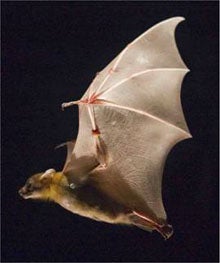
 The Air Force is putting $6 million into a Brown University project thats trying to apply the amazing flight capabilities of bats to agile stealthy unmanned aircraft. The team of researchers speculates that bats are wired for flight with an array of sensors on their highly flexible wings that allows them to perform maneuvers that would send a bird or an airplane tumbling from the sky. The Air Force is hoping it might be able to replicate bat flight to some degree with electronic sensors and computers and achieve some of the nocturnal mammals aerial prowess. “The Air Force envisions a future in which they have lots of autonomous air vehicles that can take on different kinds of missions and that don’t have pilots,” Sharon Swartz , an evolutionary biologist at Brown who is helping run the project, told the Boston Globe. The Air Force will have to come up with a lot more than electronic wizardry to capture some of the magic of bat flight, however. Bats have very light, very flexible wings that, in the blink of an eye, can change from a smooth, low-drag, high-lift configuration to a contorted shape that allows a 180-degree turn in the space of half a wing span. Not only that, pregnant female bats carrying half their body weight in babies can keep flying the same way, which is getting the Air Force thinking about payloads. “We know a lot about the aerodynamics of large things moving very fast, Swartz said. There is almost nothing known yet about the basic physics of bat flight.”
Bats Hold Keys To Future UAVs

Key Takeaways:
- The U.S. Air Force is investing $6 million in a Brown University project to research bat flight for potential application in agile, stealthy unmanned aircraft.
- Researchers are studying bats' unique flight capabilities, attributing their extreme maneuverability, quick turns, and ability to carry significant payloads to highly flexible wings and an array of sensors.
- The Air Force aims to replicate some aspects of bat flight using electronic sensors and computers to develop advanced autonomous air vehicles.
- A key challenge is the limited current understanding of the basic physics behind bat flight, particularly concerning their highly flexible wing movements.
See a mistake? Contact us.

