
















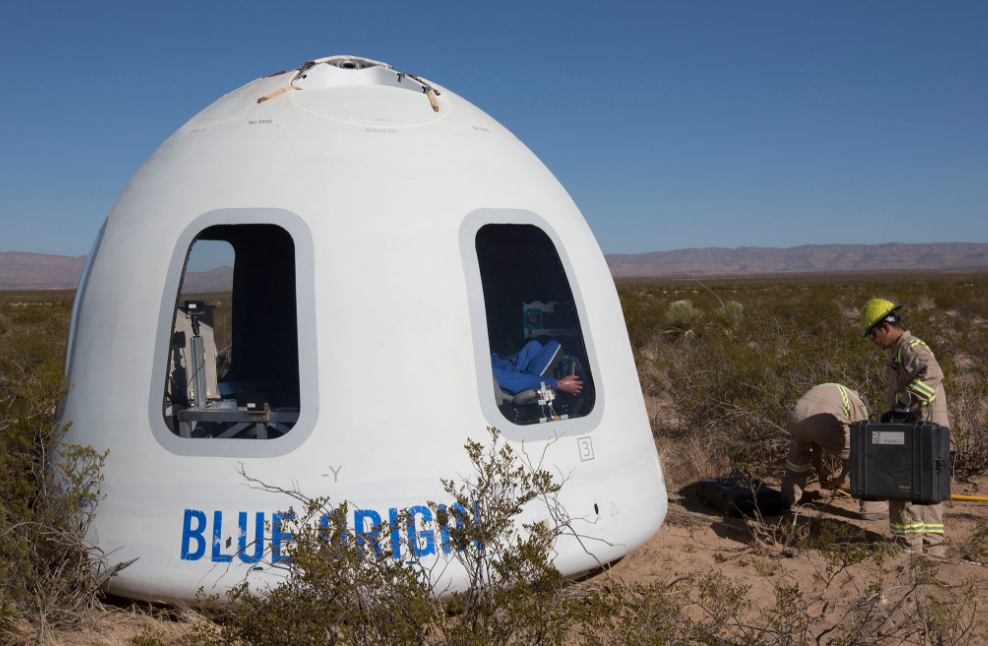
Blue Origin, the company funded by Amazon founder Jeff Bezos that’s working to develop sub-orbital space tourism, successfully launched a rocket from a west Texas site on Tuesday. The 60-foot-tall rocket carried crew capsule 2.0 on its first flight, to an altitude of about 322,000 feet, or 61 miles, in about two and a half minutes. The capsule then separated from the rocket for a few minutes of free fall, and then returned to the surface under three canopies. The rocket returned to its launch pad in a controlled vertical landing. The pressurized crew capsule, which features several large windows (about 2.4 by 3.6 feet), was occupied by a test dummy and a dozen payloads containing commercial, research and education projects.
The capsule can accommodate six astronauts in comfortable seats, and is roomy enough for tourists to experience weightless floating and even turn somersaults, the company says. The altitude of 61 miles, or about 100 km, is generally considered the boundary between the atmosphere and the edge of space. During the parachute landing, a retro-thrust system adds extra cushioning, for a contact speed of about 1 mph. The entire system is fully reusable, the company says.

