
















Blue Origin will be the 2016 winner of the Collier Trophy “for successfully demonstrating rocket booster reusability with the New Shepard human spaceflight vehicle through five successful test flights of a single booster and engine, all of which performed powered vertical landings on Earth.” Although Space Exploration Technologies (SpaceX) was first to guide a boost stage to a successful powered landing after launching a real payload to orbit, which Blue Origin has yet to do, Blue Origin has led in actual reuse of the booster stage. SpaceX launched a used rocket on Thursday from Cape Canaveral and recovered it yet again.
The Collier Trophy is awarded annually by the National Aeronautic Association (NAA) “for the greatest achievement in aeronautics or astronautics in America … the value of which has been thoroughly demonstrated by actual use.” “Blue Origin’s New Shepard program is remarkable,” said Jim Albaugh, chairman of NAA. “Developing the first new large liquid hydrogen rocket engine in almost 20 years and demonstrating repeatable vertical takeoffs and landings makes the long sought-after goal of low-cost reusable rockets and access to space a reality.”
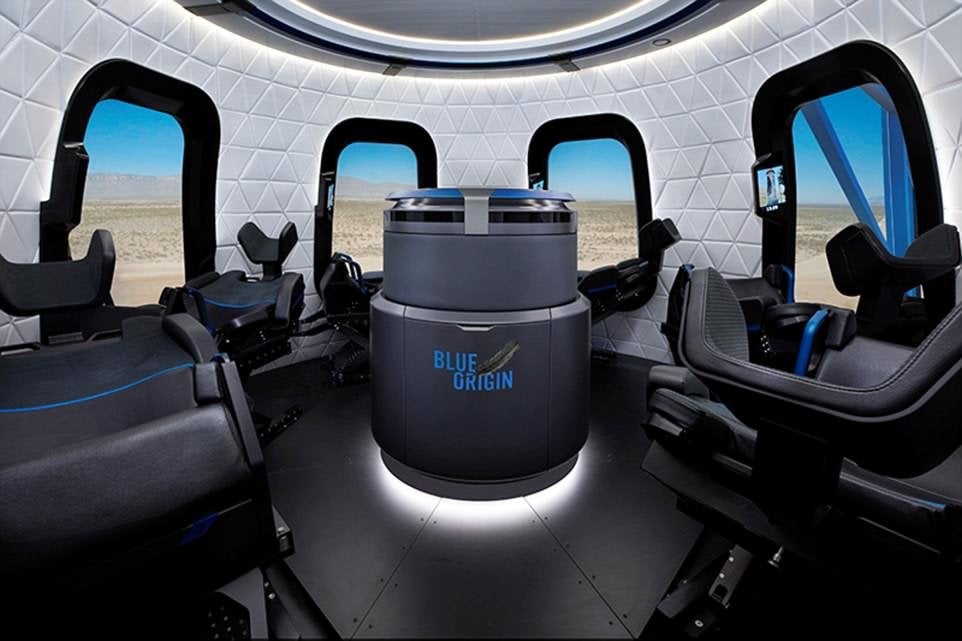
Blue Origin also released images this week of its design for the New Shepard crew capsule designed to take paying space tourists on their ballistic ride through space. The New Shephard launch system is designed to be sub-orbital, so customers’ time in space will be measured in minutes and seconds. New Shephard is named for Alan Shepard, the first American in space during a 15-minute, sub-orbital ride aboard Freedom 7. Blue Origin’s long-term plans rely on its much larger planned New Glenn rocket, which, in a three-stage configuration, will be almost as large as the Saturn 5 that took Apollo missions to the moon. New Glenn is named for John Glenn, the first American to orbit the earth.

