














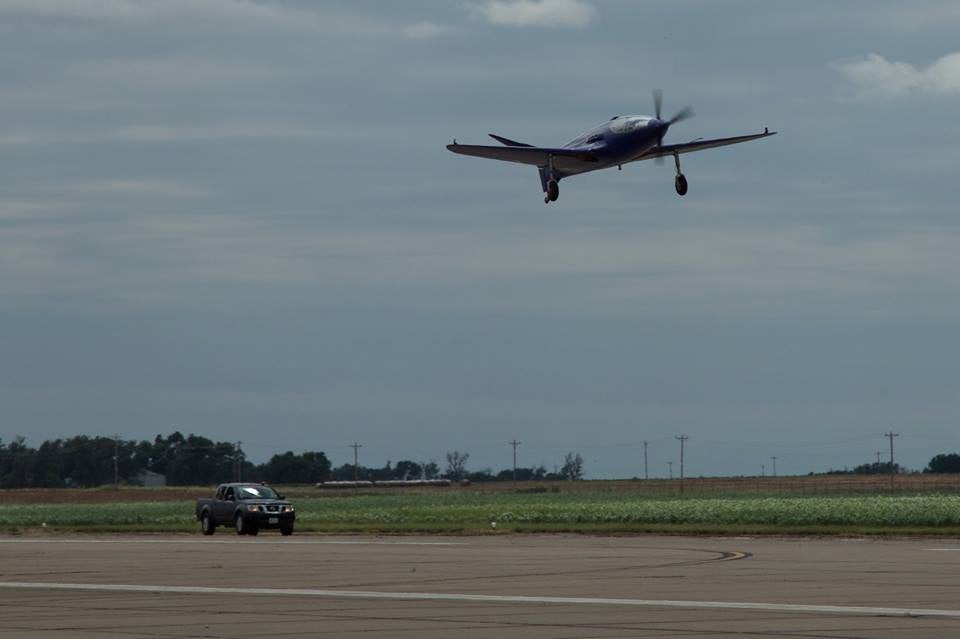
The replica of the Bugatti 100P racing airplane in Tulsa, Oklahoma, went airborne briefly for the first time Wednesday but suffered damage after landing. Scott Wilson’s team marked the flight as a triumph nonetheless, describing what happened in a Facebook post. The flight began as a “short hop down the runway” to test the twin Suzuki motorbike engines and flight controls, Wilson wrote. The takeoff was normal and the airplane climbed to 100 feet AGL and reached 110 knots. During the landing, though, the Bugatti floated more than expected. There was enough runway for stopping, but “unfortunately, I lost the right brake and the airplane departed the left side of the runway at slow speed. Due to heavy rains the night before, the ground was soft and the airplane tipped upward on its nose, damaging the spinner and both props. Such is the nature of flight testing a new design.”
Taxi tests began just a week ago for the Bugatti, which the team was able to build after raising $65,000 in a Kickstarter fundraising campaign. Wilson’s team hopes to fly it at about 200 mph. More than 75 years ago, race car maker Ettore Bugatti designed the airplane with the goal of reaching 500 mph to break the world speed record, but did not complete the project in time. The original plane was unfinished at the onset of World War II and it ended up in storage in France. It came to the U.S. in the 1970s and changed hands several times before EAA acquired it in 1996. It’s now on display at the EAA museum in Oshkosh.