
















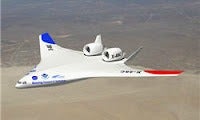
NASA flew a new version of its remotely piloted blended-wing-body test aircraft for the first time, on Tuesday, at Edwards Air Force Base in California’s Mojave Desert. The X-48C aircraft is modified from the X-48B, which last flew in 2010. The winglets from the earlier design have been moved inboard from the wingtips, close to the engines, “effectively turning them into twin tails,” NASA said. The X-48B’s three 50-pound-thrust engines have been replaced by two engines, each with 89 pounds of thrust. Also, the aft deck of the aircraft was extended about two feet to the rear. The aircraft has a wingspan of about 20 feet. The new model will be used to evaluate the low-speed stability and control of a low-noise version of a hybrid-wing-body aircraft design, NASA said.
The flight experiments with the X-48C will help researchers further develop methods to validate the design’s aerodynamics and control parameters, NASA said. During a second series of tests this fall, NASA will test yaw-control software incorporated in the X-48C’s flight computer. This research will use asymmetric engine thrust to create yaw, for trim and for relatively slow maneuvers. The aircraft was designed by Boeing and built by Cranfield Aerospace Limited, of the U.K. The research is funded by NASA’s Aeronautics Research Mission Directorate and Boeing. The project’s goal is to create designs that burn less fuel, emit fewer waste products, and make less noise, NASA said.

