
















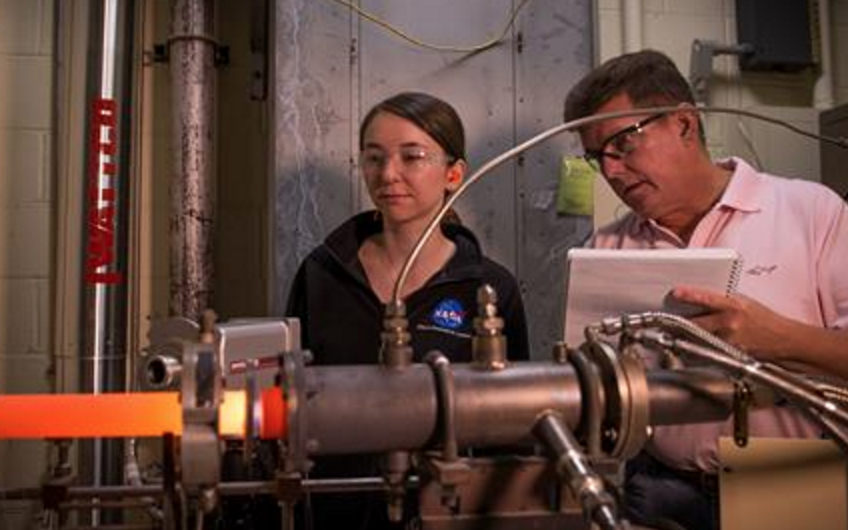
Researchers at NASA are “investigating promising advances” in high-temperature materials that can be used to make turbine engines run more efficiently, the agency said last week. The materials, called ceramic-matrix composites, or CMCs, are lighter and stronger than the metal alloys used today, and can withstand the extremely high temperatures of 2700 degrees Fahrenheit and more that are generated in the core of jet engines. In general, the hotter an engine runs, the better the fuel efficiency. “CMCs are in a position to replace the nickel-based super-alloy metals in today’s aircraft engines,” according to NASA’s news release.
The current research is focused on how CMCs and protective coatings can withstand not only high heat, but also environmental particle hazards such as dust, sand and volcanic ash.”This is important because, as aircraft engine temperatures increase to promote fuel efficiency, sand, when it’s ingested into an engine, can actually melt into glass and potentially cause power loss or failure,” saidNASA Glenn materials engineer Valerie Wiesner. Moving next-generation aircraft toward greater operating efficiency will depend, in large part, on advances in engine technology and materials manufacturing capabilities, NASA said.

