
















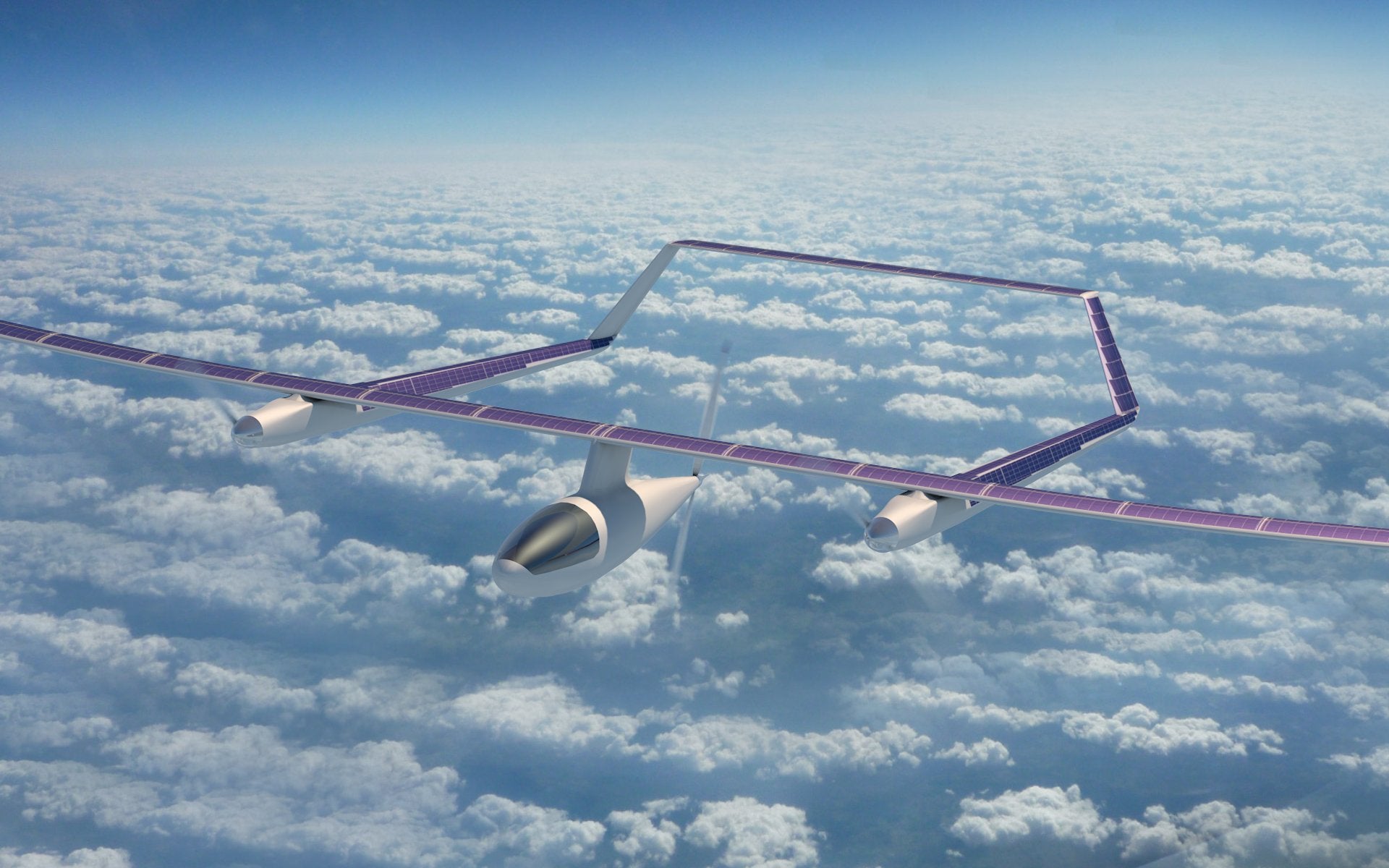
Solar Flight has released plans for the SunStar, a solar-powered airplane designed to act as an unmanned telecommunications platform, able to remain in flight for months at a time. Eric Raymond, president of Solar Flight, said, “What we are designing is known as an atmospheric satellite, which operates and performs many of the functions as a satellite would do in space, but does it in the atmosphere. Uplink and downlink speeds will be far better than a satellite, due to the shorter distance.” According to Solar Flight, one SunStar aircraft could provide service over a large area on the ground, far greater than any land-based tower.
Similar in configuration to high-performance sailplanes, the SunStar is designed to fly at high altitudes on the lowest possible power. It also makes use of proprietary lamination of solar cells that allows for a smooth skin. Three electric motors power the aircraft-which will be offered in a piloted version as well-as it climbs to altitude. Once at its operational altitude, the front-mounted motors and props stow. The third motor, in pusher configuration, drives a large-diameter prop optimized for high altitudes. Solar Flight has been building and operating solar-powered aircraft for 28 years-its SunSeeker made the first solar-powered flight across the U.S. in 1990.

