
















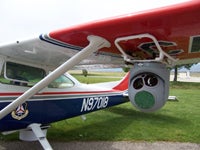
As if to prove that technology tends to come full circle, the Air Force is now using piloted aircraft as simulators to train pilots of UAVs. “We’re using a manned aircraft to simulate an unmanned aircraft,” said CAP-U.S. Air Force Commander Col. Bill Ward. The Air Force has installed a “Predator Ball” under the wing of a CAP Cessna 182, giving the four-place single the ability to pretend it’s a Predator or Reaper UAV ready to mix it up with insurgents in Iraq and Afghanistan. All the actual UAVs are busy doing that and that’s left a “critical training gap” for Army and Marine personnel learning how to use the drones. “The Surrogate Predator (as the CAP 182 is known) is the solution,” said Maj. Matt Martin, chief of the Predator/Reaper Ops Branch of Air Combat Command at Langley Air Force Base, Va.
With the pod in place, the 182 has the “capability of locking onto a target and tracking it” a CAP news release says. But since the Cessna lacks any other refinements, it’s role is that of camera platform, using the pod to stream live video to the trainees as they sort out their battlefield priorities. There will, of course, be extra training required to teach CAP pilots how to make their aircraft behave appropriately.”Basically, we will imitate being a Predator,” said CAP Capt. David Lewis, one of six pilots initially selected for training. Assuming it all goes well, Lewis says mimicking UAVs will be “the next big thing for CAP in homeland security and the defense of our country.”

