
















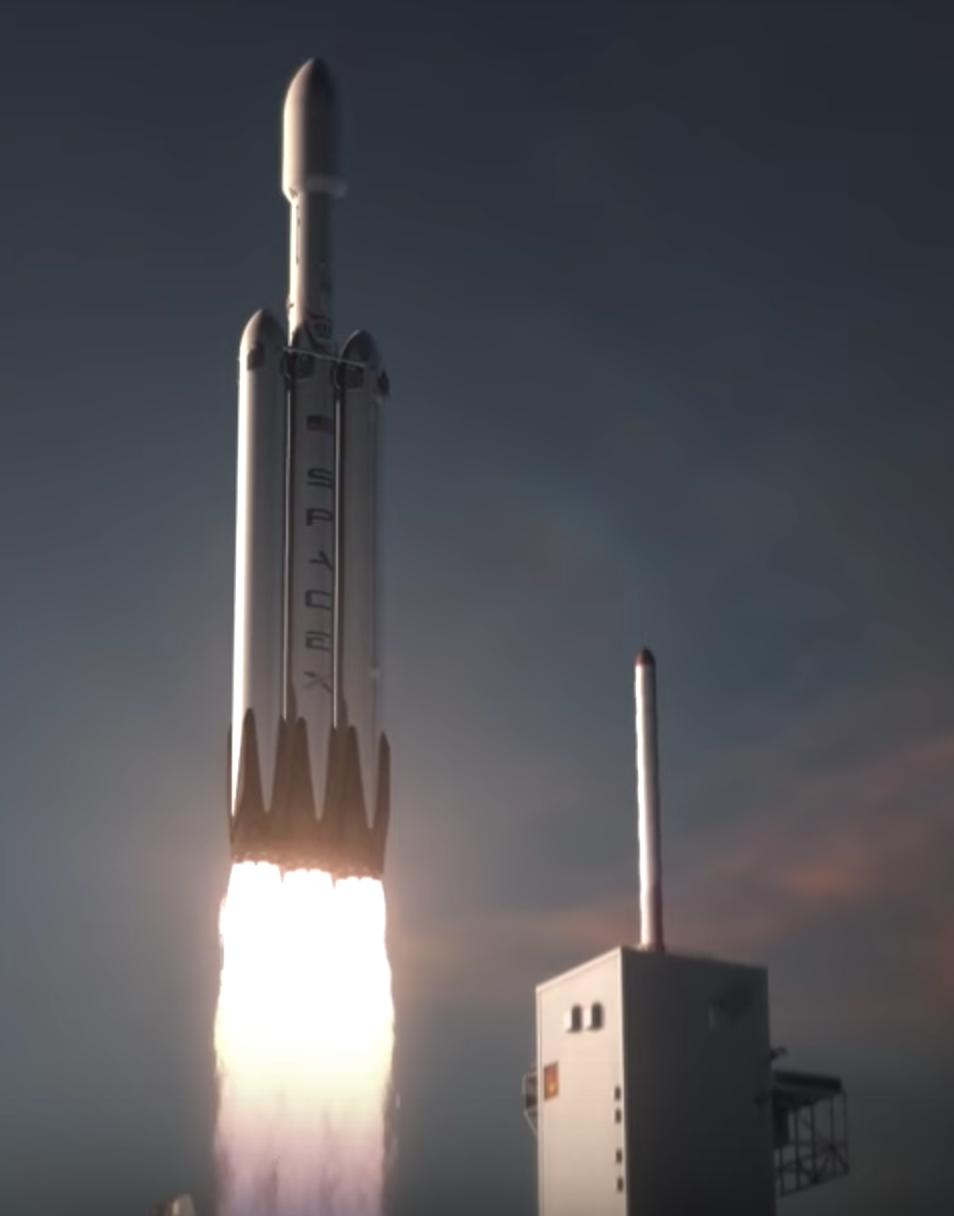
SpaceX will send two people on a trip around the Moon next year in a Falcon Heavy rocket, the company announced on Monday. The two private citizens, whose names have not yet been released, have already paid “a significant deposit,” SpaceX said. “Like the Apollo astronauts before them, these individuals will travel into space carrying the hopes and dreams of all humankind, driven by the universal human spirit of exploration,” says a statement posted at the SpaceX website. The private astronauts will first need to pass a battery of SpaceX health and fitness tests. Initial training will begin later this year.
Falcon Heavy is due to launch its first test flight this summer and, once successful, it will be the most powerful vehicle to reach orbit since the Saturn V moon rocket. At 5 million pounds of liftoff thrust, Falcon Heavy is two-thirds the thrust of Saturn V and more than double the thrust of the next largest launch vehicle currently flying, SpaceX said. Later this year, as part of NASA’s Commercial Crew Program, SpaceX plans to launch a Crew Dragon (Dragon Version 2) spacecraft to the International Space Station. This first demonstration mission will be in automatic mode, without people on board. A subsequent mission with crew is expected to fly in the second quarter of 2018.
Once operational Crew Dragon missions are underway for NASA, SpaceX says it will launch the private Falcon Heavy mission on a journey to circumnavigate the moon and return to Earth in about a week. Liftoff will be from Kennedy Space Center’s historic Pad 39A near Cape Canaveral – the same launch pad used by the Apollo program for its lunar missions. The vehicle will operate autonomously. “This presents an opportunity for humans to return to deep spacefor the first time in 45 years, and they will travel faster and further into the Solar System than any before them,” the company said. Musk said the crew will be identified, upon their approval, after they pass health and fitness screening, but he did say “it’s nobody from Hollywood.”
NASA also is reportedly considering adding a crew to a planned circumlunar flight in 2018.

