
















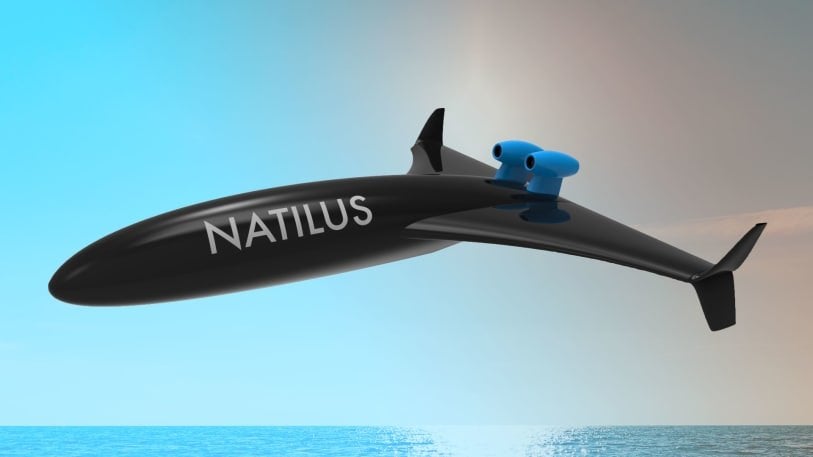
Natilus, a small company with just three employees, based in Richmond, California, is working to launch a transoceanic cargo business with airliner-size drones. They are currently building a 30-foot-long prototype that they plan to test this summer, according to their press kit. They then plan to produce a full-scale, 200-foot-long turboprop drone, built of carbon-fiber composite, by 2020. The design is fairly simple, since there is no need for a cockpit, or landing gear, or pressurization. The drone is designed to land and take off from the water, and motor up to a dock for loading. CEO Aleksey Matyushev said the vehicle would cost about one-tenth as much as a crewed freight aircraft, and transoceanic trips would cost about half as much as standard air freight.
Matyushev says he plans to launch an 80-foot-long production-ready vehicle with 40,000-pound cargo capacity for a launch customer in 2019, to fly a route between Los Angeles and Hawaii. The next step will be a 140-foot-long vehicle with 200,000 pounds cargo capacity, to fly between the U.S. and China by 2020. Since the drone won’t be flying in U.S. airspace, no FAA approval is required, he said, which simplifies the production process. The drone will land in international waters, about 12 miles offshore, and taxi into port under the control of a remote human pilot at speeds of about 30 knots.

