














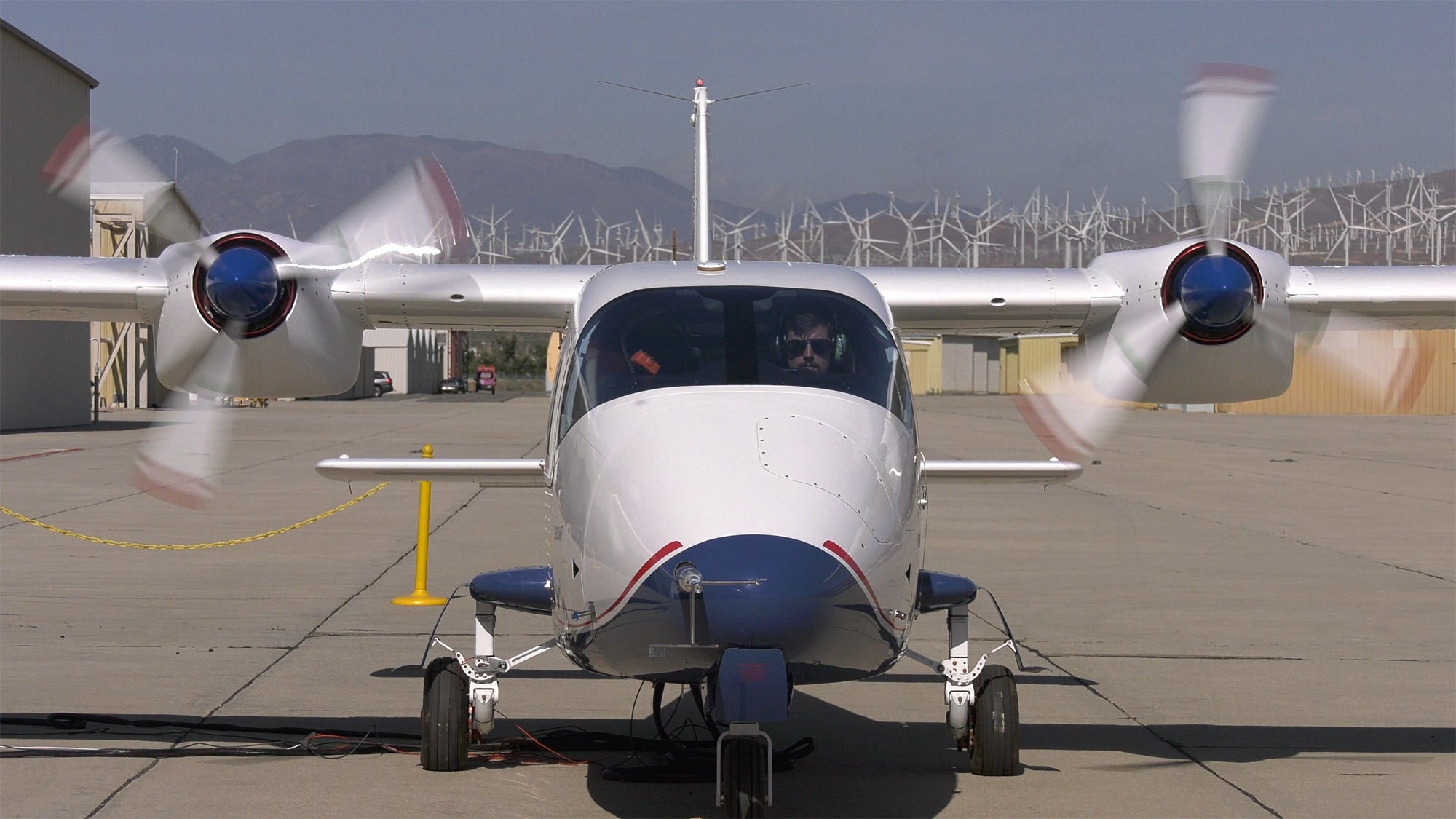

NASA’s all-electric X-plane has made significant progress toward its stated goal of “demonstrating innovative technology through electric-powered experimental flight,” the agency announced on Thursday. The X-57 Maxwell, a modified Tecnam P2006T, has been undergoing a series of phased modifications (“Mods”) in preparation for its first flight and eventual use as an electric propulsion research platform.
As part of Mod II activity, which has included replacing the aircraft’s two combustion engines with electric cruise motors, the NASA team completed its first successful test of the motors and propellers since installing them on the aircraft. “This is the first time we’ve had the electric motors installed with propellers and had them spinning,” said NASA’s X-57 Principal Investigator Sean Clarke. “This was a big milestone, as it was a big systems test where we were able to run both motors on the airplane at the same time. It’s really exciting to actually have all of the systems integrated and to be able to operate the vehicle that we’ve been designing for our system tests.”
Testing took place at the Scaled Composites facility in Mojave, California. The initial “spin test” was conducted using a ground power supply with plans to repeat it using battery power in the not-too-distant future. Following that, the aircraft will be delivered to NASA’s Armstrong Flight Research Center in Edwards, California, for verification, taxi, and flight tests.
Working simultaneously, the X-57 Mod III team has taken delivery of a new wing from contractor Empirical Systems Aerospace (ESAero). Mod III involves replacing the P2006T’s wings with high-aspect-ratio wings and moving the electric motors to the wingtips. According to NASA, the new wing will undergo verification testing followed by weight and balance measurement, ground vibration testing and wing loading tests. In preparation for the final phase, Mod IV, the wing will then be sent back to ESAero to have twelve nacelles added. Each nacelle will house a small, high-lift electric motor and propeller. In addition to being NASA’s first all-electric X-plane, the X-57 will be the agency’s first crewed X-plane in two decades.
