














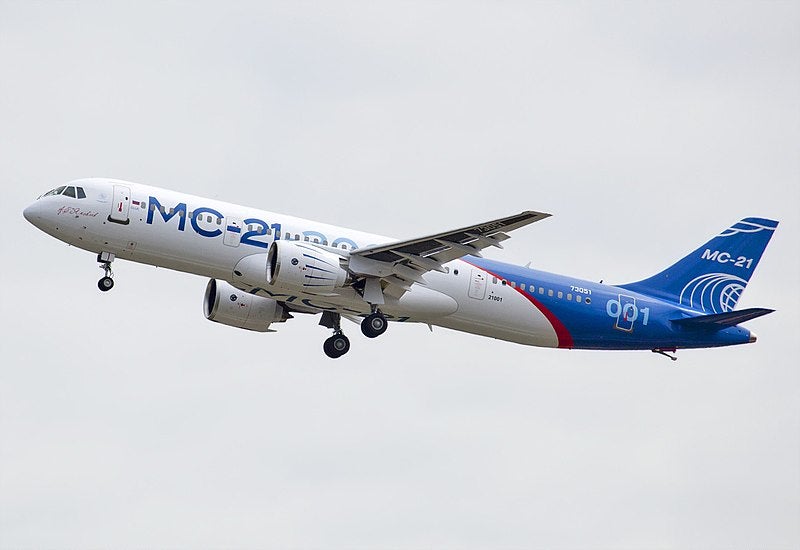

Russia’s plan to replace Airbus and Boeing aircraft with homegrown versions of its own designs has been delayed at least a year according to the Moscow Times, as translated by the Kyiv Post. Last year President Vladimir Putin ordered the country’s aviation industry to build at least 1,000 domestic route airliners a year by 2030 and that was supposed to start ramping up this year. The aircraft targeted are the Yakolev MS-21, a 737/A320-sized single aisle, the Sukhoi Superjet 100, which is like an Embraer 195, and the Il-114 turboprop regional airliner.
All three companies now say they can’t begin building the planes until 2025 or 2026 and Sergei Chemezov didn’t mince words about why trying to rush the project is a bad idea. “Tests are not yet completed. As soon as we complete the tests, we will immediately see the results,” he said. “We are still worried about the safety of all of us—we will fly on these planes.”
The big issue is that all the aircraft were designed to use engines, avionics and other parts made in the West. Sanctions resulting from the Russian invasion of Ukraine have cut off the supply of those items, along with the parts needed to keep the Airbuses and Boeings in the air. So the Russian manufacturers have the daunting task of developing their own versions of those sophisticated components and they’re not having much luck.
“Companies are faced with objective limitations—completely new systems, recreating competencies from scratch, the need for full testing and launching mass production under time pressure,” a spokesman for United Aircraft Corporation told the Moscow Times. Even the government seems to be complaining about the “unprecedented” schedule. “All global aircraft manufacturers rely on broad international cooperation, suppliers from several dozen countries. Russia will have to cope on its own,” the Ministry of Industry and Trade spokesperson said.
Even if they manage to get some aircraft off the line in the next couple of years, at least one, the MS-21, might not live up to its original billing. The plane was supposed to have a range of about 3,100 miles and that has slipped to 2,200 miles. More troubling, however, is the drastic reduction in the MS-21’s seating capacity from 211 to 135. It would appear the issue is the substitution of Russian-made engines for the PW1400s with which it was originally built.
