















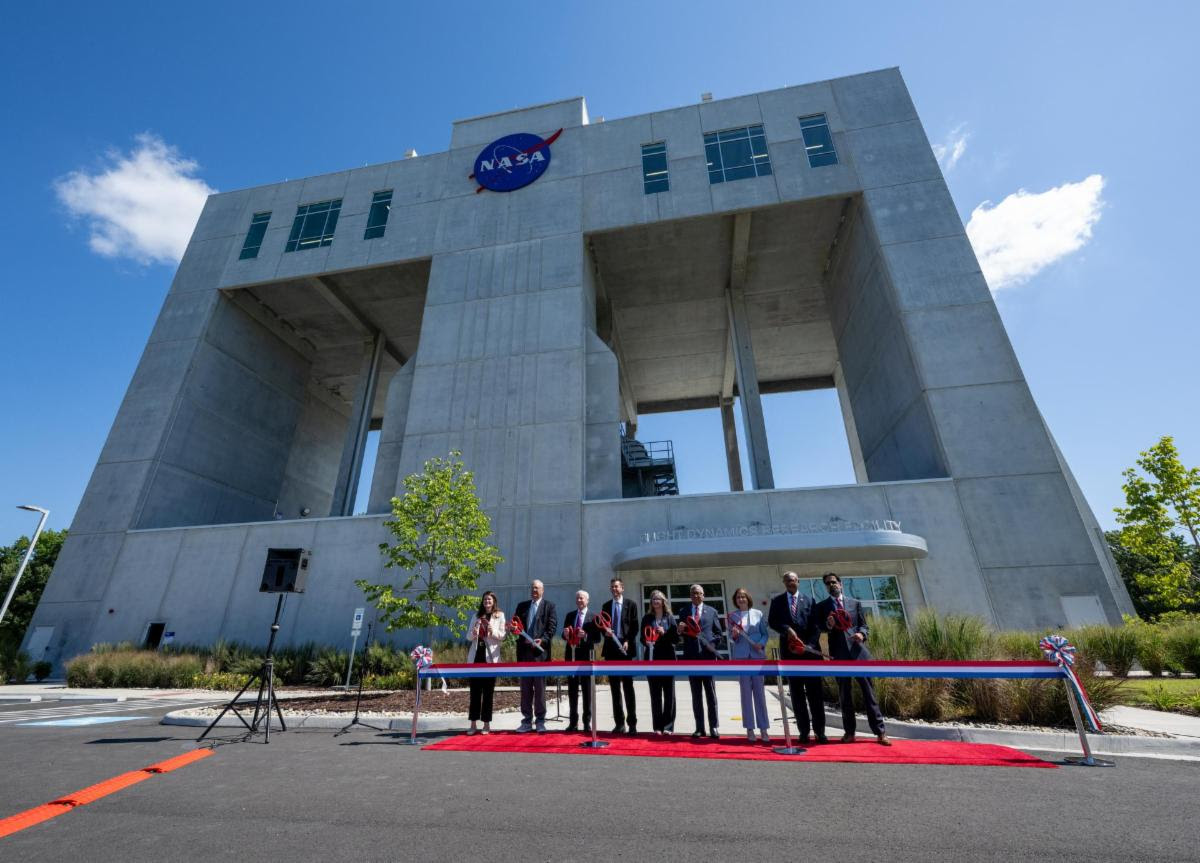

NASA opened the Flight Dynamics Research Facility on Friday at its Langley Research Center in Hampton, Virginia. The agency’s first major new wind tunnel in more than 40 years will allow researchers to test scale models of aircraft, rockets, drones, parachutes and atmospheric-entry vehicles.
New Testing Capabilities
“The Flight Dynamics Research Facility is NASA’s first major new wind tunnel in more than 40 years and gives us a powerful new platform to test the ideas and technologies that will shape the future of aviation and exploration,” NASA Administrator Jared Isaacman said.
The 25,000-square-foot facility combines capabilities previously provided by Langley’s 20-Foot Vertical Spin Tunnel and 12-Foot Low-Speed Tunnel. Its 20-foot-diameter test chamber can accommodate larger models and reach 117 mph, twice the maximum speed of the older facilities. Four 750-horsepower motors drive four 14-foot-diameter fans. Each fan uses eight carbon-fiber blades that allow researchers to adjust airflow during free-flight testing.
Aircraft and Spacecraft Research
Researchers can conduct mounted tests or place unsupported models into the tunnel’s vertical airflow. NASA said planned work includes aircraft stability and spin research, autonomous-flight testing, drone development and evaluation of vehicles designed to enter planetary atmospheres. The higher airspeed also permits testing of heavier models and simulations of full-size vehicles operating at higher altitudes.
The facility was constructed through a partnership between NASA and the U.S. General Services Administration. It is the fourth new building delivered under Langley’s 20-year campus revitalization plan and replaces research infrastructure that had remained in service for decades.


Impressive! And that’s some big fans. The lights in Hampton will be dimming every time it starts with each one at about a half a megawatt!!