














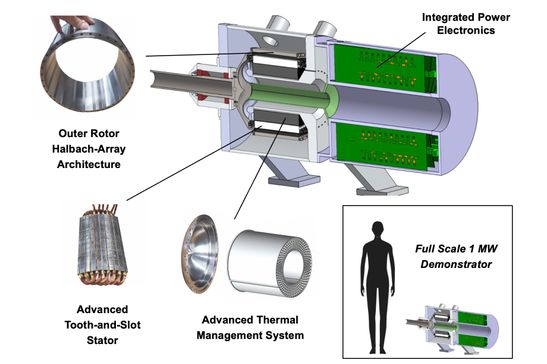

MIT researchers say they’ve come up with an electric motor design with a power-to-weight ratio high enough to be practical in regional airliners. The team says they’ll get 17 kilowatts per kilogram out of the complex design, which means they can create a one megawatt motor that weighs just 125 pounds. “Many things together make the design possible, and the devil is in the details,” said researcher Zoltan Spakovsky.
Physics dictates the basic design of all electric motors but the MIT design uses novel approaches to the design of the rotor and stator to allow the use of lighter materials especially in the rotor, which is the drum like structure in which the stator spins. A total of 30 circuit boards alternate the currents inside the motor at high frequency allowing it to spin at higher speeds than conventional designs. That means heat dissipation is an issue and an air-cooled heat exchanger inside the stator accomplishes that. The heat exchanger is so complex it has to be 3D printed..
