
















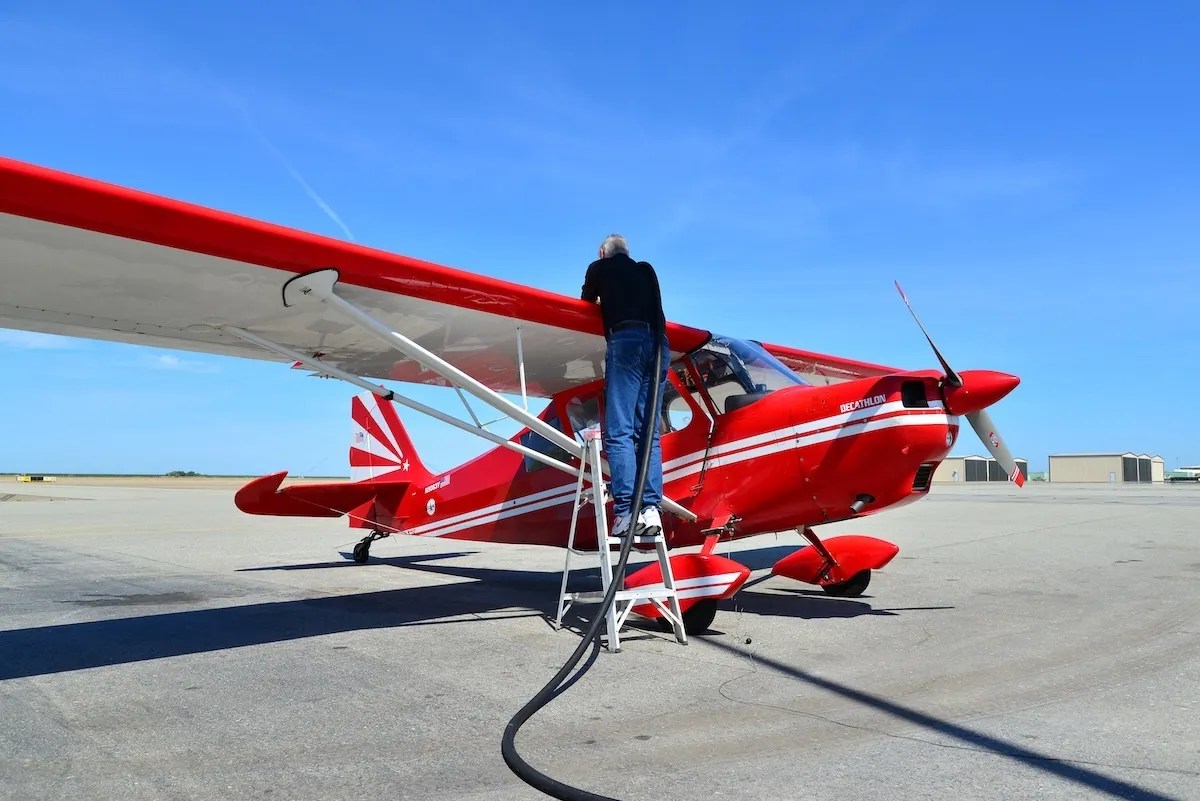

On Tuesday, Swift Fuels announced that the Federal Aviation Administration (FAA) has significantly expanded the list of piston aircraft eligible to operate on its 100R unleaded aviation gasoline, adding more than 1,200 engine models and 1,600 airframe models through updates to the fuel’s Supplemental Type Certificate (STC).
According to the company, the expanded Approved Model List (AML) includes engines from more than 80 manufacturers, including approximately 395 Lycoming models, 195 Continental models, 95 Curtiss-Wright models, and 95 Pratt & Whitney models. The airframe expansion covers more than 1,600 aircraft models, including approximately 118 Cessna aircraft, 101 Beechcraft models, 98 Piper aircraft, along with aircraft from Mooney, Grumman, Stinson, WACO, Fairchild and others.
The expanded approvals represent another step in the FAA’s effort to support the industry’s transition away from leaded 100LL avgas by the end of the decade.
Swift said the newly approved aircraft represent about 56% of current U.S. 100LL consumption and mark the first phase of its broader certification plan. The company expects additional approvals for higher-performance engine and airframe combinations during Phase II and Phase III of the program through 2028.
The company noted that 100R is currently the only commercially available 100-octane unleaded avgas that both operates under FAA-approved STCs for eligible aircraft and complies with ASTM International’s D8603 production specification.
Pilots must obtain a Swift Fuels STC before using 100R in eligible aircraft. Owners who previously purchased the company’s UL94 STC will automatically receive a 100R STC through Swift’s “Forever STC” program at no additional cost.
Swift said 100R has been sold commercially for nearly two years at five U.S. and five European airports and that distribution is now expanding. The company expects the initial transition from UL94 to 100R at participating airports to begin this summer, with locations in 29 states, including California, Colorado, Arizona, Florida, Minnesota, Utah and Wisconsin. International availability has also expanded to airports in Canada, Australia, Germany, France, Austria, the United Kingdom and the Netherlands.
The company said work continues with the FAA and engine manufacturers to certify the remaining high-performance piston fleet, with additional approvals expected through 2027 and early 2028.
The FAA first approved Swift’s original 100R STC in September 2024.


Why do you need an STC. Why can’t FAA publish a list of aircraft approved to use this fuel. If an aircraft can use this fuel without any modifications to performance or any modifications to the airframe or power plant why would it need an STC. This is not making sense. Just make it available and aircraft that are approved to use it can just use it. In the days when 80 octane avgas was an available I don’t remember pilots having a problem picking the right fuel for their aircraft. They did not have to have an STC to show the FBO before they bought their avgas. Is the FAA over regulating the aviation system beyond their original congressional mandate now requiring STC’s for everything?
STC’s cost a lot of money to obtrain. The holder is entitled to compensation under our capitalist system, a bit like a trademark or patent.
The STC is $100 per aircraft regardless of type or engine. If you’re a pilot and aircraft owner I can hard see how $100 for a lifetime STC is going to break the bank
I agree with Ehsif727 and KenH. It isn’t a matter of how much it costs. It is a matter of whether or not it is necessary. You can be rich, you can be poor, but why throw $100 and the effort at anything that has no purpose?
Also, the money goes where?
I really don’t think this STC that Swift is supplying to aircraft holders at 100 dollars each is a profit deal. It probably costs that much just to administer the distribution of the STC‘s.
Indeed … where does the money go?