
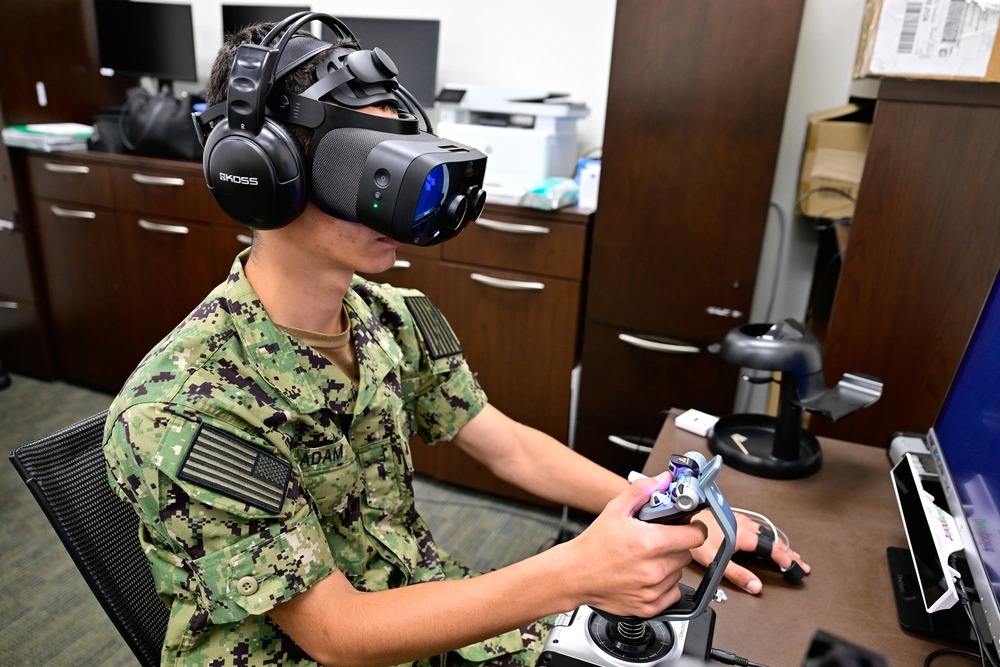

The Naval Aerospace Medical Institute is expanding its approach to pilot candidate evaluation with ASANA, a virtual reality system that tracks cognitive and physiological performance during immersive tasks. Developed by a small team of Aerospace Experimental Psychologists and civilian researchers at Naval Air Station Pensacola, the platform is designed to complement traditional testing methods by capturing subtle indicators of focus, adaptability and spatial awareness. ASANA grew out of the Navy’s long-standing effort to refine the Aviation Selection Test Battery, a process that helps determine who will move forward in flight training for the Navy, Marine Corps and Coast Guard.
The system places users inside a virtual reality simulated cockpit where eye movement, head rotation and heart-rate changes are monitored while participants navigate shifting mission demands. According to researchers, the layered data could help link performance in virtual settings to real-world cognitive abilities.
“We’re collecting high-resolution evidence of how people navigate, think and adapt,” said program contributor Allison Bayro.
The intent is to create a more detailed picture of how aviators process information under pressure, providing selection and training programs with additional tools for identifying candidates who have the potential to succeed in high-stakes environments.
While the virtual reality project remains in development, early results have encouraged Naval Aerospace Medical Institute researchers to consider applications beyond the cockpit. The team at Pensacola noted that similar approaches may eventually support screening across roles where technical performance and spatial reasoning are critical, such as air traffic control, aircraft maintenance and other mission-essential specialties.
“Our team of AEP officers, civilian scientists, and NRL partners built the environment, but ASANA exists because of Allison’s hard work, creativity, and insightful research,” said Lt. Cmdr. Michael Kukenberger.
As testing continues and more data is processed, the researchers say their goal remains to improve the match between aptitude and assignment to help preserve readiness and reduce costly attrition across naval aviation.