
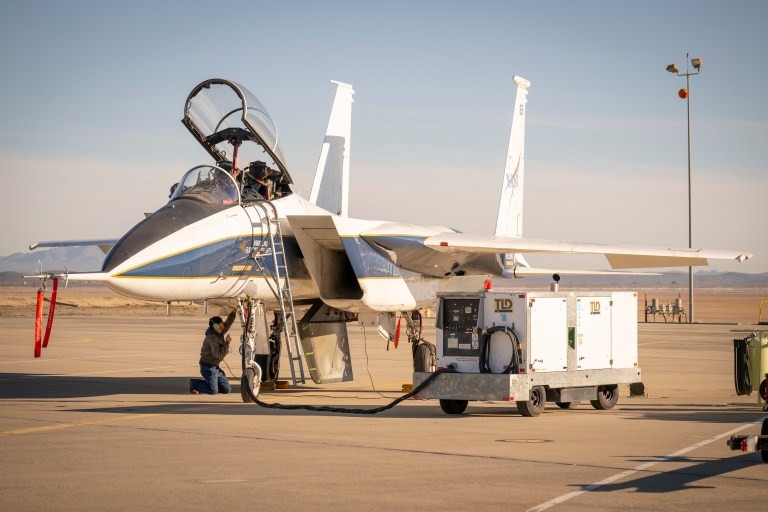

NASA marked an early milestone in its effort to reduce drag on future commercial aircraft with a high-speed taxi test of its Cross Flow Attenuated Natural Laminar Flow (CATNLF) concept. The test article, a 3-foot-tall scale wing mounted vertically beneath an F-15B research aircraft, reached speeds of about 144 mph on Jan. 12 at NASA’s Armstrong Flight Research Center in Edwards, California.
NASA said the configuration allowed engineers to evaluate a swept-wing design without modifying the host aircraft, using the F-15 as a flying testbed. Previous NASA studies estimated the concept could deliver fuel savings of up to 10% if applied to large, long-range transports.
The CATNLF design focuses on extending laminar flow by reducing crossflow effects that typically disrupt it on swept wings. NASA aims to produce a design with decreased airflow disruption, ultimately leading to less drag and lower fuel burn.
“Even small improvements in efficiency can add up to significant reductions in fuel burn and emissions for commercial airlines,” Mike Frederick, CATNLF principal investigator at NASA Armstrong, said.
The project is part of NASA’s Flight Demonstrations and Capabilities effort, with design work shared between Armstrong and NASA’s Langley Research Center. With taxi testing complete, the program is expected to move into initial flight testing in the coming weeks.
The work is a good example of NASA’s continued reliance on the F-15 for advanced flight research. The agency recently added two retired U.S. Air Force F-15s to its Armstrong fleet to support supersonic programs, including chase and data-gathering roles for the X-59 quiet supersonic demonstrator.
Interest in laminar-flow concepts is not limited to government research. In the commercial sector, Otto Aerospace is pursuing similar aerodynamic principles in its Phantom 3500 business jet.