















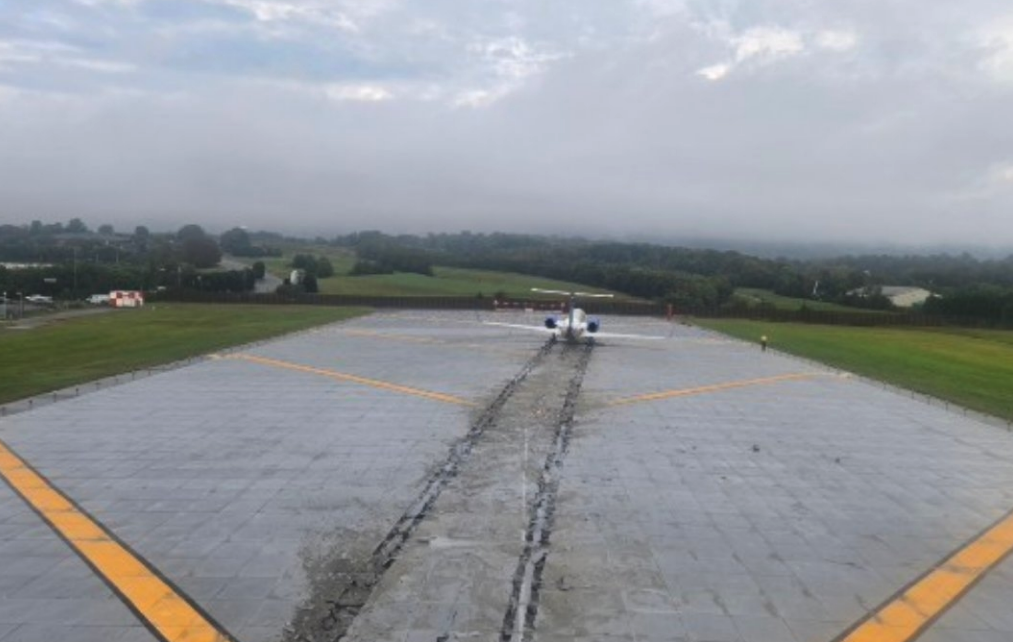

A CommuteAir regional jet operating as United Express Flight 4339 overran the runway during landing at Roanoke-Blacksburg Regional Airport (ROA) late last month on Sept. 24. The landing occurred in heavy rain and low visibility despite two go-around calls by the flight’s first officer, according to a preliminary report released by the National Transportation Safety Board (NTSB).
The Embraer EMB-145XR came to rest in the airport’s engineered materials arresting system (EMAS) at the end of Runway 34. All 53 people aboard, including three CommuteAir crew members and 50 passengers, escaped without injury. The aircraft sustained only minor damage.
The flight, part of a four-day crew rotation, had already experienced two maintenance-related deplanings before departing more than two hours late, investigators said. En route, weather reports indicated calm winds and no precipitation, and the crew initially planned for an approach to Runway 6. However, approach controllers later advised of rain and reduced visibility along that route, and that other aircraft were using Runway 34 instead.
The captain, who was flying, requested an instrument landing system (ILS) approach to Runway 34. As the aircraft began its final approach, the crew heard reports of “marginal visibility and bumpy conditions” from another arriving aircraft. Rain intensified as the jet descended below 500 feet, according to the NTSB.
The first officer, monitoring the approach, called for a go-around two times; once as the aircraft flew past the runway threshold, and once again after the aircraft was past the halfway point of the runway. The captain proceeded with the landing.
The plane touched down long on the wet runway. Despite maximum braking and thrust reverser deployment, the jet slid beyond the pavement into the EMAS, where it stopped. Airport rescue personnel responded immediately, helping passengers evacuate safely down a ladder, the NTSB said.
NTSB emphasized the investigation remains ongoing, noting that its findings are preliminary and subject to change. The overrun occurred later during the same month that two jets were halted by EMAS system in one day.


I don’t know about CommuteAir, but I thought in aircraft/operations like this a go-around call by either crew member was mandatory. We’ll see what happens to the Captain on that point. It will be interesting to see whether the NTSB will talk about whether the FO should have taken control from the Captain and gone around.
I share the same thoughts as Ron Levy.
Frankly, I have to question the judgment/headwork of the captain.
Even without the go-around calls from the FO, he should have initiated a go-around once he passed the picket fence and half the runway.
This is basic, good airmanship - sound judgment - and something taught early in one’s training.
Cleary, a completely preventable mishap.
Mark Denari
The regional I flew with had that policy. If either crew member called for a go-around there was no question; a go-around would happen. We would talk about it on the ground afterward if there was a disagreement. Most, if not all, U.S. airlines have a no-fault go-around policy for a reason.
My regional airline also had a policy about landing within the touchdown zone or first third of the runway, whichever was smaller. It seems that either of those policies would have stopped this incident.
I remember the question from a job interview for my first crewed flying job. “If you, as a first officer, call for a go around and the Captain doesn’t commence the go around, what do you do?” The answer they wanted was “physically push the power levers forward and be assertive.”
It’s noteworthy that the EMAS turned it into a safety non-event for the crew/pax and a minor event for the aircraft. Imagine if that’d been just grass with lighting or other equipment out there… or a road.