















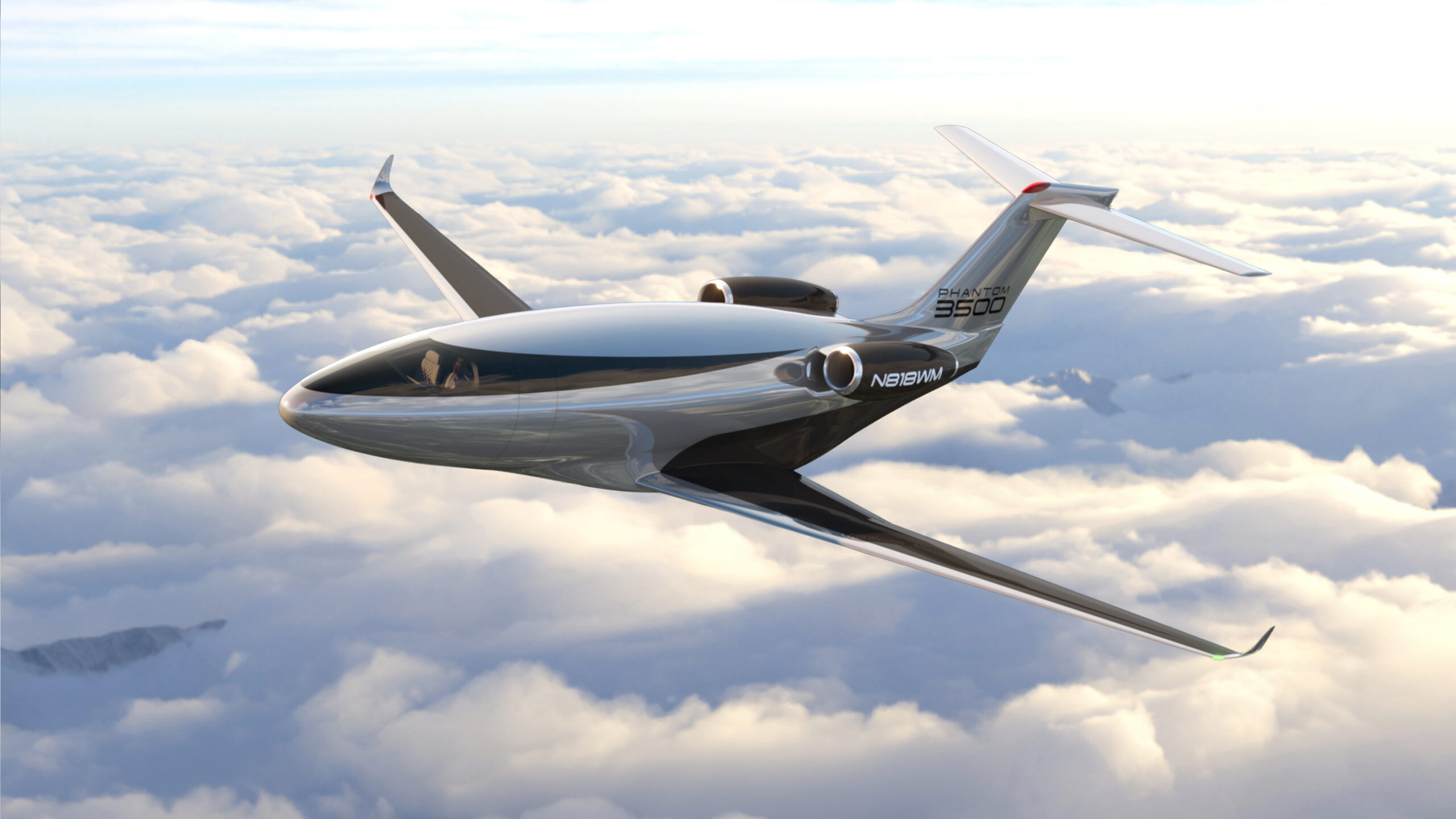

Otto Aerospace says it has developed a proprietary artificial intelligence model designed to accelerate aerodynamic configuration for its Phantom 3500 program and future aircraft. The company claims the AI aircraft design system, trained on computational fluid dynamics simulations and wind tunnel data, can shorten design evaluations from months or years to a single day.
The model is being deployed on Luminary Cloud’s GPU-accelerated Physics AI platform, which provides tools for aerodynamic analysis. Otto claims the system will enable rapid testing of laminar flow airfoils and ultra-efficient configurations.
“Luminary’s platform gives us the computational power and infrastructure to quickly train an AI model optimized for next-generation laminar flow aircraft,” said Obi K. Ndu, PhD, chief information and digital officer at Otto.
Otto says the AI-driven design approach could produce aircraft capable of reducing fuel burn by up to 60 percent and emissions by as much as 90 percent when using sustainable aviation fuel. The company aims to begin testing its Phantom 3500 by 2027, with entry into service targeted for 2030.
While AI and machine learning have been applied in several aerospace research settings to date, much of the public work has focused on academic studies and early-stage tests. Recent design-related examples include generative AI for eVTOL takeoff trajectory planning and broader aviation uses in areas like predictive maintenance, training, and communications.
How these methods scale to full aircraft design remains an open question as companies like Otto pursue new approaches.
Otto Aerospace was formed in Fort Worth, Texas in 2008. The company is best known for the Celera 500L, a laminar-flow technology demonstrator that never advanced to certification but served as a working proof of concept for the company’s unique design philosophy. Its current focus is the Phantom 3500, which the company calls a “clean-sheet” business jet aimed at long-range efficiency, though no aircraft have yet reached the market.


The AI generated video is really cool looking but the reality is that maintaining laminar flow over large aircraft surfaces at speeds in excess of 200 mph is extremely difficult even without windows in the aircraft. The the science and engineering on this topic has been well established for years and without active boundary layer control systems it is not practical. Even with them it is cost prohibitive. If you don’t want to do the research, at least do a little critical thinking here. The airlines go nuts if they can save 5% on their fuel costs. If an aircraft manufacturer could build an airliner that would save double that they would dominate the industry and sell planes faster than they could build them. Also note that the Celera 500 fell far short of its performance goals and never came close to being certified. I don’t know why I am even bothering to write this. Few people these days care about science, engineering, and facts.
Agree completely… thank you for adding science based sanity.
I guess I was wrong, some people do care about science, engineering, and facts. Thank you sir for your comment.
If people have stopped caring about science, engineering and facts, it may be because of what passes for S, E & F these days. The internet was supposed to be the information highway that would bring information to all people, elevating the knowledge of humans to unprecedented levels. Sadly, it wasn’t designed to distribute only valid and true information, nor is there any way for the novice to detect fact from fiction. Add in the human tendency to get an ego boost from publicly showing that they are informed and therefore above reproach and the pretended competence emerges, protected by the anonymity inherent in the internet. Thus one can pretend to be an expert for a while, dispensing techno-nonsense to people who can’t discern its fallacies and swallow it up—hook, line and sinker—then disappear when someone reveals them to be a fraud and reappear under a new alias for round two, three, four, … that ego boost can be addictive.
If the books and magazines that substantially helped educate me in various aspects of aviation in my youth were similarly lacking in assumable authenticity and validity I can’t imagine what I would have done or become. The human brain has no capacity to deliberately forget anything and deliberately educating others (especially young enthusiasts) with false information to pretend competence for an ego boost should be criminal.
That is why I dread the growing reliance on AI to perform safety/reliability-sensitive work… who knows what info it was raised on or what it will feed itself when it matures. Tasking humans to keep an eye on it won’t work just as it hasn’t worked for monitoring autonomous vehicles. Humans don’t take kindly to just watching someone or something do anything, especially if the performance is generally excellent; they read a book while the car drives into pedestrians or fall asleep while the autopilot flies the airplane past the destination.