
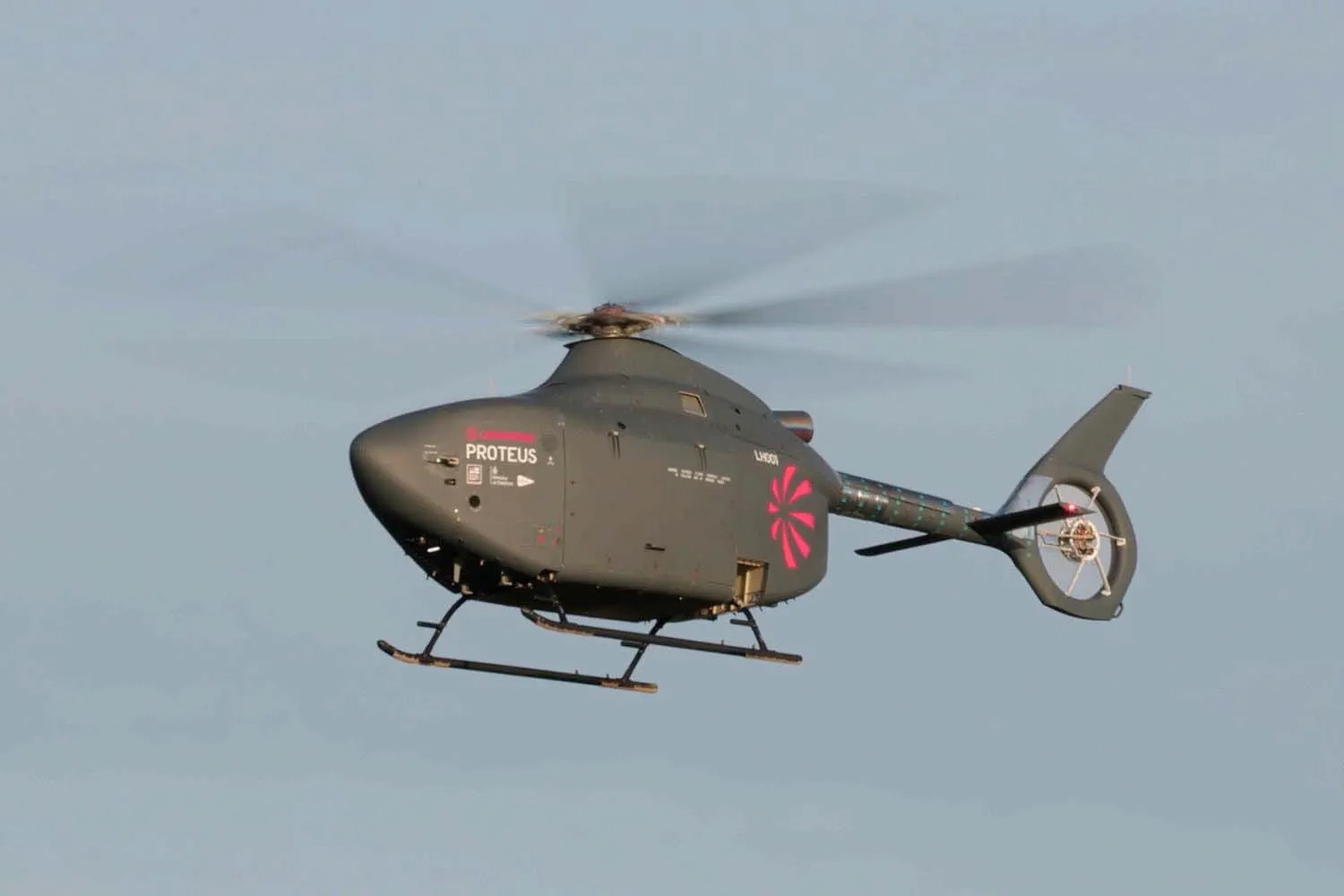

The U.K.’s Royal Navy said Friday that its first full-size autonomous helicopter completed its maiden flight from Predannack Airfield in Cornwall.
This new autonomous aircraft is designed to operate without an onboard crew while conducting maritime missions. According to the Royal Navy, the helicopter completed a short test routine during which it controlled its own flight systems under supervision from ground-based test pilots.
Proteus was designed and built by Leonardo as part of a £60 million program to support the Royal Navy’s future use of uncrewed systems alongside crewed aircraft. The helicopter is intended for missions including anti-submarine warfare and maritime patrol, and is expected to operate as part of a planned hybrid air wing.
The autonomous helicopter relies on onboard sensors and computer systems to interpret its surroundings and make decisions during flight. It is the largest and most complex autonomous rotorcraft operated by the Royal Navy to date.
“Proteus represents a step-change in how maritime aviation can deliver persistence, adaptability and reach – conducting the dull, dirty and dangerous missions in challenging environments without putting human operators at risk,” Nigel Colman, Leonardo’s managing director of helicopters U.K. said.
The Royal Navy said Proteus is designed to help track submarines and monitor activity across wide ocean areas, particularly in the North Atlantic, and that the successful first flight demonstrated the aircraft’s basic autonomous capabilities as further testing continues.
Leonardo’s Proteus is not alone in development work towards an operational autonomous helicopter. Sikorsky unveiled its autonomous U-Hawk concept in the U.S. in October 2025. Sikorsky has also been developing autonomous variations of its existing lineup in the form of its S-70i Firehawk helicopter, for instance, as well as an autonomous Black Hawk.