















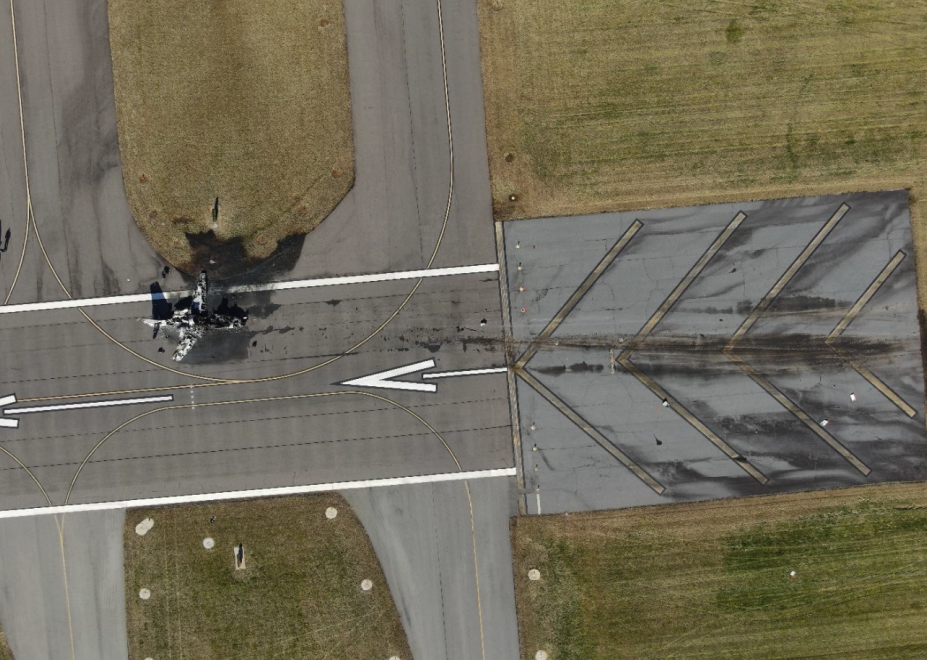

Greg Biffle’s Cessna Citation 550 encountered multiple instrument failures and communication issues before crashing near the runway at Statesville Regional Airport in North Carolina in December, according to a new NTSB preliminary report released Friday.
The December 18 accident killed Biffle, his wife, two children, and three other occupants. The aircraft, registered to a company linked to the retired NASCAR driver, was destroyed when it struck approach lighting structures and terrain short of the runway. A post-crash fire consumed most of the airframe.
Trouble After Takeoff
Biffle’s aircraft departed Statesville shortly after 10 a.m. local time on a personal flight to Sarasota, Florida. The pilot, a retired airline captain with multiple type ratings, took off under visual flight rules with the intention of activating an IFR clearance once airborne, the report said.
SVH’s AWOS recorded calm variable winds with ten mile visibility, 3,900 ft broken and 4,800 ft overcast ceilings, and a temperature of 7° C.
On board were seven people, including two additional individuals with pilot certificates, one of whom was seated in the right seat. That individual, an instrument-rated single-engine private pilot, was not qualified to serve as second-in-command. Even so, the left-seat pilot controlled the fully-fueled jet while the right-seat passenger handled radio calls and checklists.
Cockpit voice recordings, along with reports from nearby ground personnel, confirmed that the left engine did not start-up on the first attempt. Both engines were nonetheless running before the aircraft began taxiing. The pilot and passengers discussed a malfunctioning thrust reverser indicator, though the reversers themselves appeared functional.
After departure from Runway 10, the airplane climbed in a left turn. At approximately 2,200 feet, it began to descend. The right-seat passenger attempted to contact air traffic control to activate the flight’s IFR clearance, but those transmissions went unanswered due to the controller’s workload at the time. Around the same time, one of the pilot-passengers noted a difference in between the left and right ITT temperature indications, although no further discussion regarding engine instruments came up for the remainder of the recording.
At 4,500 feet, the pilot reported an altitude indicator issue, along with the possibility of other left-side instrument problems. The aircraft’s Garmin GTN-750 stopped recording airspeed at about that time, along with heading data about a minute later. Autopilot also disengaged around the same time, although it is not clear whether this was intentional or not. The right seat passenger, who did not verbally report instrumentation issues on the right side of the flight deck, took the controls for a moment.
Return Ends in Fatal Impact
The aircraft descended to around 1,800 feet by 10:13 a.m. Audio recordings suggest occupants could see the ground, and the pilot took control of the aircraft back at about this time and turned right to enter the airport traffic pattern. The pilot called out for flap and gear extension, but the landing gear indicator lights were not illuminated.
A few moments later, the right-seat passenger transmitted on the airport CTAF, stating, “We’re having some issues here.”
Although there is no alternator on the aircraft, one of the passengers asked the pilot about power to the “alternator,” and about four seconds afterwards, audio recording quality improved and the pilot responded that that was the “problem.” He did not elaborate further on what was meant by that, although there were no further references to instrumentation troubles for the remainder of the flight. Garmin GTN-750 airspeed data resumed seconds afterward.
GPS data indicated the aircraft rolled out on runway heading at approximately 1,240 feet and 114 knots. Airspeed declined steadly over the next 30 seconds during the final descent towards the runway threashold.
The first point of impact was a 29-foot-tall approach light structure located about 1,380 feet short of the runway. The airplane continued through additional light towers and trees before skidding across the runway overrun area and coming to rest roughly 400 feet from the threshold. A fire destroyed most of the fuselage.
Investigators said they found no evidence of structural failure that would have occurred prior to impact and said both engines remained attached. Fan blade damage was consistent with rotation at the moment of impact, and both thrust reversers were stowed.
Unqualified SIC
The pilot held a CE-500 type rating with a second-in-command limitation.
The right-seat occupant, a private pilot with a single engine land and an instrument rating, was not qualified to serve in the role of second-in-command.
The aircraft was not equipped with a flight data recorder and was not required to carry one. Investigators recovered a cockpit voice recorder and extracted roughly 31 minutes of audio, though poor audio quality hampered parts of the review. Limited flight data was recovered from the GTN-750 unit.
Biffle, 56, retired from full-time NASCAR competition in 2016. He was traveling that day with his family for a personal holiday trip.
The NTSB’s investigation is ongoing. A final report will determine probable cause and contributing factors.


Buen día cómo están? Una suposición mía de lo que puedo haber ocurrido. Es muy posible que hayan encendido los dos motores. El primero no no arrancó, posteriormente arrancaron el fallado anterior. Pensá que eso te lleva tres arranques, un consumo de batería notable, si los generadores no estaban en línea y de despega , la batería en emergencia dura 30 minutos en la barra de emergencia pero en la barra principal la batería tan solo dura 10 minutos si venís en vuelo con los generadores puestos, pero si arrancaron ambos motores con batería yo no creo que hayan tenido cinco minutos de batería remanente, por eso es que las luces no indicaban . Para mí se consumieron la batería y por eso en algún momento uno pregunta sobre los generadores, lo que pasa es que al colocarlos ya no te da tiempo para recuperar la batería. Bueno es lo que yo supongo.
Good morning, how are you? Here’s my theory about what might have happened. It’s very possible they started both engines. The first one didn’t start, and then they started the one that had failed. Keep in mind that this takes three starts, a significant battery drain. If the generators weren’t online and the plane took off, the battery lasts 30 minutes in emergency mode on the emergency bar, but on the main bar, the battery only lasts 10 minutes if you’re flying with the generators on. But if they started both engines using battery power, I don’t think they had five minutes of battery power remaining, which is why the lights weren’t working. In my opinion, the battery was drained, and that’s why at some point you ask about the generators. The problem is that once they’re engaged, there’s no time to recharge the battery. Well, that’s what I think.
Excellent presentation and it seems/ sounds like someone “had it in” for this “family situation”. Too many things going wrong too fast with a FAA rated airplane, of course not withstanding the human pilot errors as per current rules and regulations…
1. Fly the airplane.
This plane does have an alternator but it is called a generator, ether way it is what charges the battery and supplies power when the engine is running, but it is also the starter so after you start the engine you have to switch it to generator to supply power if you forget the instruments are running on battery which will quit not long after starting as what seems to have happened becoming a large distraction the first hole in the swiss cheese model.
A very sad story. My heart goes out to all involved.
For 60 years I’ve had my share of problems to deal with including 4 engine failures/shutdowns. I’m an ATP pilot, an engineer and can say from experience that there is a limit to the brain’s ability to think logically when overwhelmed with critical issues.
Well this leaves out the most pertinent part : the root cause was PIC missing out on a crucial item on the checklist. There was no defect or malfunction, only human error. Obviously, not having proper qualifucations didnt help either. But even without the qualifications (especially without the qualifications), for goodness sake follow the checklist.
generally the generator switches a re left in the on position (in most other Citation models) s when theneng rpm reaches the specified RPM, its change occurs seamlessly and requires no pilot action, it does appear one possibility in this case the men switches were indeed off for whatever reason…its happened in King Air aircraft, and Im sure others..
Absolutely scary what happened in that cockpit, poor decision making, total lack of safety conscious, not following protocols/rules, troubleshooting instruments when close to the ground, highly unstable final approach even after they solved the problem. Why not level the wings, climb to safe altitude, and sort things out?
Wondering who all knew that the left seat was occupied by someone without the proper training/sign-off, and qualification to be a PIC w/o a SIC in a CE550 … and who knew that a private pilot w/o proper SIC CE550 would be occupying the right seat.
Greg Biffle managed the Company and the plane. Did he know? Was he accommodating a pilot and the pilots son?
Personally, as a professional pilot with 47 years of experience and over 17000 flight hours, with over 2000 hours in 500 series aircraft, the only realistic comment above was Larry. Fly the airplane. I have watched too many very experienced pilots become preoccupied with problems, weather or just looking outside on a visual approach and the plane either flies into terrain or slows to the point of a stall.
Hard to believe a pilot would not notice 1. red annunciator lights indicating generators off and 2. zero amps on load meters. Easy to suspect that an inverter malfunctioned.
Been a long time, but I seem to remember the starter/generators automatically switching to generator mode during the start sequence. I don’t remember having to physically make the switch. These were 1982/83 models; maybe the earlier birds required physical switching.
Help me out here Peter; which checklist item did the pilot miss? A huge problem I have is pressing on with the flight with an airplane with obvious problems. What the maintenance logs reveal will be very interesting. Who was maintaining the airplane, and when was the last phase inspection. What discrepancies were previous annotated?
Wayne, it’s been a long time, but I seem to remember the starter/generators automatically switching to the generator function during the start cycle. No manual switching by the pilot was required. I flew 1983 model 550s; maybe the earlier ones had to be manually switched.
On all 550s the Gen Control Unit (GCU) connected the Hot Batt Bus to the Generator (to operate it as a starter motor), then after engine start (when the HBB was auto-disconnected based on starter RPM) it auto-connected the Gen to the (same-side) Main DC Bus when 2 conditions were met: 1) the generator output voltage was equal to or in excess of that Main DC Bus and 2) the Gen Switch was set to GEN. If the switch was set to OFF, the Generator would produce 28VDC but would not be connected to the rest of the electrical system.
It is possible to create Jorge’s scenario (neither gen connected to the buses and the battery providing all electrical power) by starting both engines with the respective Gen Switch set to OFF and then failing to set the switch to GEN after engine start, but that would result in the GEN OFF LH/RH lights lighting up amber and the Master Warning light flashing red. That’s pretty hard to miss.
If one Gen was connected to its Main DC bus and the other wasn’t, the Master Warning light would not be lit, only the GEN OFF (unconnected side) light would be lit amber and the latter may have been missed. The total of all electrical loads is 417 amps, and each gen is rated at 400 amps. I don’t have a list of the loads to hazard a guess as to which were on/off, but if the load did exceed the capacity of the one generator that was online and the GCU disconnected it from the bus, then the Master Warning would have started flashing red. If not, then the one gen would have supplied the loads (including battery charging) and Jorge’s scenario would likely not have occurred. (I’m baffled as to what Jorge meant by no time to charge the battery).
All this doesn’t explain why there was (seemingly) unilateral failure of the Captain’s instruments, differences between Left and Right engine parameters (indications only, no actual performance differences mentioned) and deterioration of the audio on the CVR, all of which does seem like a deteriorating LEFT Main DC bus voltage while the RIGHT Main DC bus was OK, i.e. the buses were operating in split mode. Since the L and R buses are each connected to the Battery Bus via a 225 amp fuse (not circuit breaker), they are effectively tied together and split mode is only possible if one or both fuses blow. The fuses cannot be reset in-flight, yet the problems on this airplane seemed to be quickly cured after a back seat passenger mentioned “alternator.” Obviously, some data is missing, as it usually is, which is why it’s never a good idea to speculate on the cause of an accident and serves no useful purpose. Determining the (possible) cause(s) should be left to the team that has access to the wreckage, the airplane specs, maintenance manuals, log books, the recorded data, etc.
Regardless of crew induced or system failure it appears that distractions caused a perfectly flyable airplane to be flown into the ground short of the landing zone. Given the experience of the pilot, the electrical issue appeared resolved, instruments back on line as well as basic pitot static and standby instruments and visual conditions the precautionary return should have had a successful outcome. Waiting to see if there was something more than what it appears in the NTSB final