
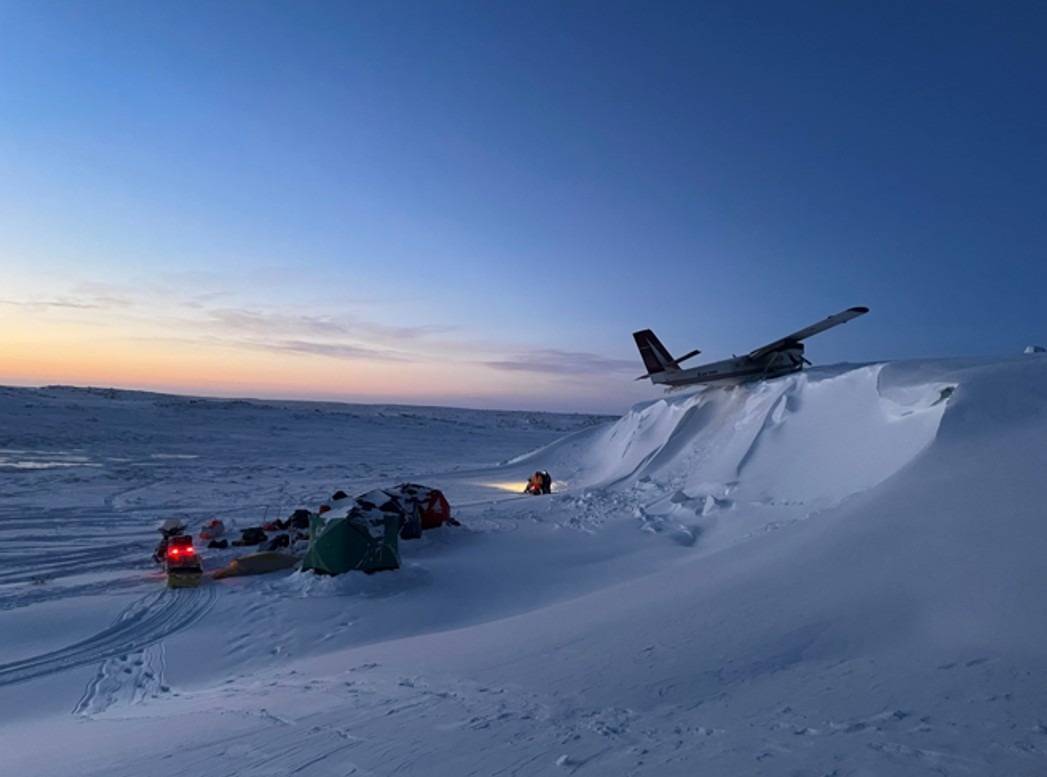

The Transportation Safety Board of Canada (TSB) released its final report into a December 2023 controlled flight into terrain (CFIT) accident on Thursday. The crash involved an Air Tindi de Havilland DHC-6 Twin Otter that impacted terrain near Lac de Gras, Northwest Territories.
Findings concluded that the crew’s decision to continue the flight in worsening weather conditions played a central role in the event.
The VFR flight struck a snow-covered hill just southeast of the crew’s intended landing site. The aircraft engaged in multiple approach attempts to the site in poor visibility ahead of the crash, which resulted in serious injuries to two passengers, while the remaining occupants, including both pilots, walked away with minor injuries. The airplane was substantially damaged, though there was no post-impact fire.
The occurrence is a good example not only of the risks associated with continuing VFR operations into deteriorating conditions, but also broader systemic issues related to operational oversight, company practices and regulatory surveillance in Canada’s air taxi sector.
A Flight Continued Into Marginal Conditions
The accident occurred on Dec. 27, 2023, when the wheel-ski-equipped Twin Otter departed Margaret Lake for the Lac de Gras road camp with two crew members and eight passengers on board. The flight was conducted as part of Air Tindi’s day VFR air taxi operations in support of northern mining activity.
Weather conditions in the region were already challenging and continued deteriorating over the course of the flight. Visibility decreased to approximately one-half statute mile in blowing snow, with ceilings estimated between 300 and 400 feet agl. Despite these conditions, the crew elected to proceed toward Lac de Gras, relying on prior experience operating successfully in similar weather, the report said.
Upon arrival in the vicinity of the road camp, the flight crew was unable to clearly distinguish the frozen lake surface from the surrounding terrain. Over the next several minutes, they conducted four improvised approach attempts, descending at times to below 50 feet agl while attempting to visually acquire the landing area.
During the final approach, the aircraft again descended below 50 feet agl when the crew lost visual contact with the terrain. Both pilots saw a hill directly ahead only seconds before impact. Although full power was applied and both pilots pulled aft on the controls, the airplane struck the terrain approximately two seconds later, according to the TSB’s reconstruction of the event.
Improvised Approaches and Normalized Deviations
One of the investigation’s more interesting findings was the routine use at Air Tindi of improvised “instrument” approaches during flights that were technically being operated VFR, particularly on the Twin Otter fleet. These approaches relied heavily on electronic flight bag data and company-generated Keyhole Markup Language files in order to provide lateral guidance to off-strip landing sites that lacked published instrument procedures.
These tools were originally meant to help enhance situational awareness during visual approaches, but the TSB found that they were frequently used in IMC as well. In these cases, aircraft would descend below minimum safe altitudes without the terrain separation guarantees provided by published instrument approach procedures.
#TSBAir released its investigation report (A23W0158) on the controlled flight into terrain of a de Havilland DHC-6 Twin Otter aircraft at Lac De Gras, Northwest Territories in 2023. Find out what happened: https://t.co/gRyy6EnArn#AviationSafety #Media pic.twitter.com/BXufGQV0Jg
— TSB of Canada (@TSBCanada) January 8, 2026
Over time, the report said, these deviations from standard operating procedures became normalized within the operation. Pilots from the company told investigators that using improvised approaches in marginal weather had become a common practice. They also indicated that this practice was not regularly challenged, nor was it corrected through company oversight mechanisms.
The accident aircraft’s terrain awareness and warning system was disabled early during the flight in order to prevent nuisance alerts during off-strip operations. While this can be permissable under Canadian regulations in some situations, investigators noted that there was no formal guidance from Air Tindi on when such systems should or should not be inhibited.
Human Factors and Plan-Continuation Bias
The report found that plan-continuation bias played a major role in the accident sequence. This human-factor is a cognitive bias in which crews persist with an original plan despite changing conditions. In this case, the report said it was reinforced by the crew’s previous success completing similar flights in similar weather conditions.
This bias reduced the crew’s perception of the situation’s risk, the report said, and ultimately contributed to their choice to continue descending toward the landing site even after multiple unsuccessful approaches and worsening visibility. The crew’s high workload, compounded by poor visual cues in flat, snow-covered terrain led to poor situational awareness during the final moments of the flight.
The report found no evidence that medical, physiological, or fatigue-related factors impaired the crew’s performance. Both pilots were properly certificated and qualified, and were both current for the flight. The aircraft also had no mechanical defects that would have contributed to the accident, according to the report. Both pilots and the aircraft were also properly qualified for IFR flight.
Oversight Gaps at the Company and Regulatory Levels
The TSB report pointed beyond the pilots’ actions to larger deficiencies in Air Tindi’s internal oversight. While the company had a safety management system and conducted training and proficiency checks, these were not effective enough to identify or correct the growing failure of the company’s pilots to follow documented procedures occurring in day-to-day operations.
Flight data monitoring was not used for off-strip operations, and deviations were often addressed informally, rather than through a structured safety reporting channel. What resulted, the report said, was the establishment of unsafe practices that failed to trigger any meaningful corrective action.
The investigation did not just point out problems with the pilots or the company. It also raised questions about Transport Canada itself; particularly questions about the agency’s ability to detect similar gaps between documented procedures and actual operational practices across the industry. Regulatory surveillance relies heavily on audits and inspections, which may not fully capture how operations are conducted in remote and highly variable environments like those Air Tindi worked in.
The TSB noted that this limitation aligns with a longstanding issue on its Watchlist related to regulatory surveillance, particularly in the oversight of the nation’s air taxi sector.
Safety Actions Taken After the Accident
Air Tindi conducted an internal safety investigation after the crash and implemented a series of changes aimed at reducing risk during off-strip operations. The TSB said that these included increased weather minimums for certain operations, more pilot monitoring, and expanded crew resource management and simulator training. Air Tindi also upgraded fleet instrumentation and issued new guidance on EFB and approach aid use in low-visibility operations.
While acknowledging these steps, the TSB reiterated that CFIT remains a persistent hazard in remote operations, particularly when visual cues are limited and operational pressures are high.
The Lac de Gras accident is a good reminder of the narrow margins involved in when we allow ourselves into ill-advised situations. We must be ever-cognizant of our biases, unwilling to introduce shortcuts in the cockpit at the expense of safety, and always ready to let good decision making win out over any form of convenience or pressure.