















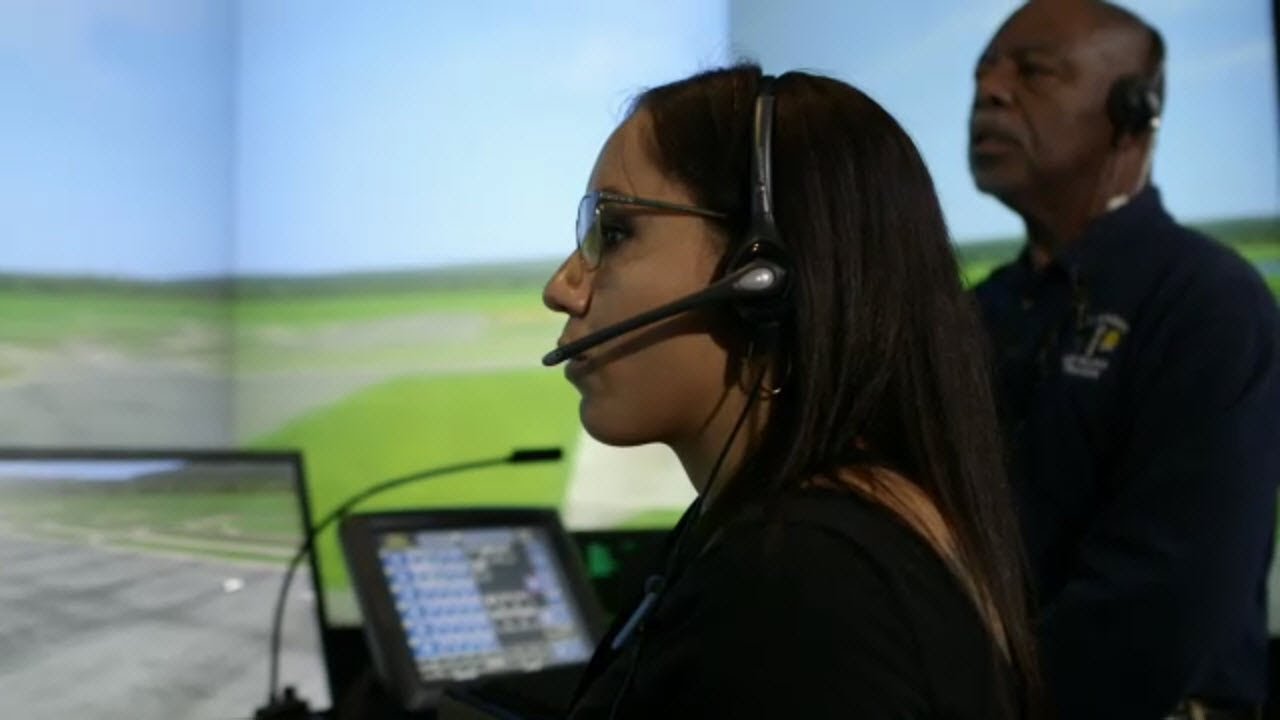

The U.S. Department of Transportation’s Office of Inspector General announced Thursday that it will begin an audit of air traffic controller training at the Federal Aviation Administration’s Academy. The office cited efforts to increase the number of certified controllers supporting the National Airspace System.
The review follows a February 2025 hiring campaign the Secretary of Transportation announced that was intended to “supercharge” recruitment and drew more than 10,000 applications. About 600 trainees entered the Academy as a result, according to a DOT OIG memorandum. In fiscal year 2024, the Academy faced a failure rate of more than 30 percent, the office’s memorandum noted.
The audit will evaluate the FAA’s actions to address challenges affecting training, including instructor availability, facility capacity and trainee outcomes. It will also examine progress on updating the controller training curriculum.
The DOT OIG stated in its announcement that it is initiating the review “given the importance of increasing the number of certified controllers to safely manage the NAS.”
FAA plans call for hiring at least 8,900 controllers by 2028, while factors such as attrition, retirements and training washouts continue to affect staffing levels.
A recent Government Accountability Office report determined that there remains a serious air traffic controller shortage despite more than 200,000 applicants over the last several years.
The OIG said the audit will start in the coming weeks. Work will be conducted at FAA headquarters in Washington, as well as at the Mike Monroney Aeronautical Center in Oklahoma City.


Lets hope the IG has an Aviation background!
They have a 30% failure rate because it’s a really hard job, takes determination & dedication so people don’t die. Lots of similarities with pilots there as well.
When candidates enter the academy the initial training is actually an 8 week screening and if a candidate does not pass they are out the door, no second chance. There are quite a few candidates that would’ve been great controllers if given remedial training and a second chance.
The 8-week “screening” ended in 1992. Now, it is a 5-week Air Traffic Basics course followed by either Terminal (Tower) Initial Qualification Training (12 weeks) or En Route Initial Qualification Training (16 weeks). Very few trainees (they are not “candidates”, they are sworn employees of the federal government in the 2152 occupation) fail AT Basics. Almost all of the failures and withdrawals occur in the IQT course. A 30% failure rate in initial training is not exceptional for this occupation. It is a question of taking the failures up front (@ $80 to 130K according to FAA reports to Congress in 2022) or taking them in the field (@ $300-500K invested). Given the costs, does it make financial sense to give remedial training at the Academy without increasing the probability of succeeding in the field?
And why isn’t the IG also auditing field training as well? They (the IG, GAO, FAA) need to look at this problem as a system rather than in isolated pieces.
Thanks Dana, for that logical and rational explanation of the process. I wonder about the necessity of an audited by the IG, which has a mission of making sure regulations and safeguards are in place and effective, and straightening out the parts that don’t work.
It sounds to me like the academy has all this figured out. I just wonder if their report is going to consider and honestly address the administrations interference in the past year and the effect on the professional in general.
Controllers dont make 300-500k as soon as they leave the Academy. Once certified enroute ctrl can make mid-100k and that often takes 2-3 years. I cant speak on tower bc I did enroute initial (arguably more $). Missed by 1 point on the last radar sim. Had an instructor tell me he was going to take off points bc I wore an FAA shirt as I was sitting down to take my last Non radar exam. The 3 radar Sims, I got the short stick schedule bc I went in last group. Day 1 I took 1 exam. Day 2 my first exam was the hardest one. Why do that? And on top of that the particular radar evaluator was known to be tough. This isnt even mentioning that an instructor got canned for hazing throughout the process. Its absolutely a joke in OKC. Someone literally pooped themselves and there was a smashed piece that stayed om the ground for 2 weeks. But they made sure to start dusting when they had a govt visit on the calendar. The reason no one says anything about this is bc if they pass, they cant speak against the system they work for and the ones who fail just “didnt have what it takes.” I hope this inspector goes down to the computer lab… That’ll cut the trip short.
I think so. There are (4) Thirty minute testing sessions in the TOWER domain. Students will sometimes have a rough session and not be able to overcome it as it relates to points. Throw out the low score and immediately retest. If they can’t do it they won’t pass.
My understanding is there is not a face to face interview anymore. By eliminating that interview approximately 10% of the students entering the academy do not have a chance to pass due to language barriers or communication skills.
The FAA has focused on quantity rather than quality! Management is filled with unqualified individuals who cannot do the job in which they are supposed to be supervising. The standards required for successfully passing the training phases has been lowered to provide more controllers. The strong controller union has not helped the failing training programs because they want “members”! They should be demanding a higher quality trainee at the facilities instead of fighting for the ones that do not perform at the necessary level to pass the simulation training phases. The terrible accident at DCA is revealing the ugly truth about the FAA disregarding safety concerns and the poor training and performance of controllers. The entire organization needs to be revamped OR return to pre-2000 training requirements and promotion requirements. Would you hire a doctor of physical therapy to supervise a group of surgeons? They are both doctors, right!? That has been the mentality of the FAA for a decade. Safety has been seriously compromised but slightly mitigated by the increase in aircraft safety innovations.
Thank you Dana,
The field training needs auditing drastically.